Jason Bailey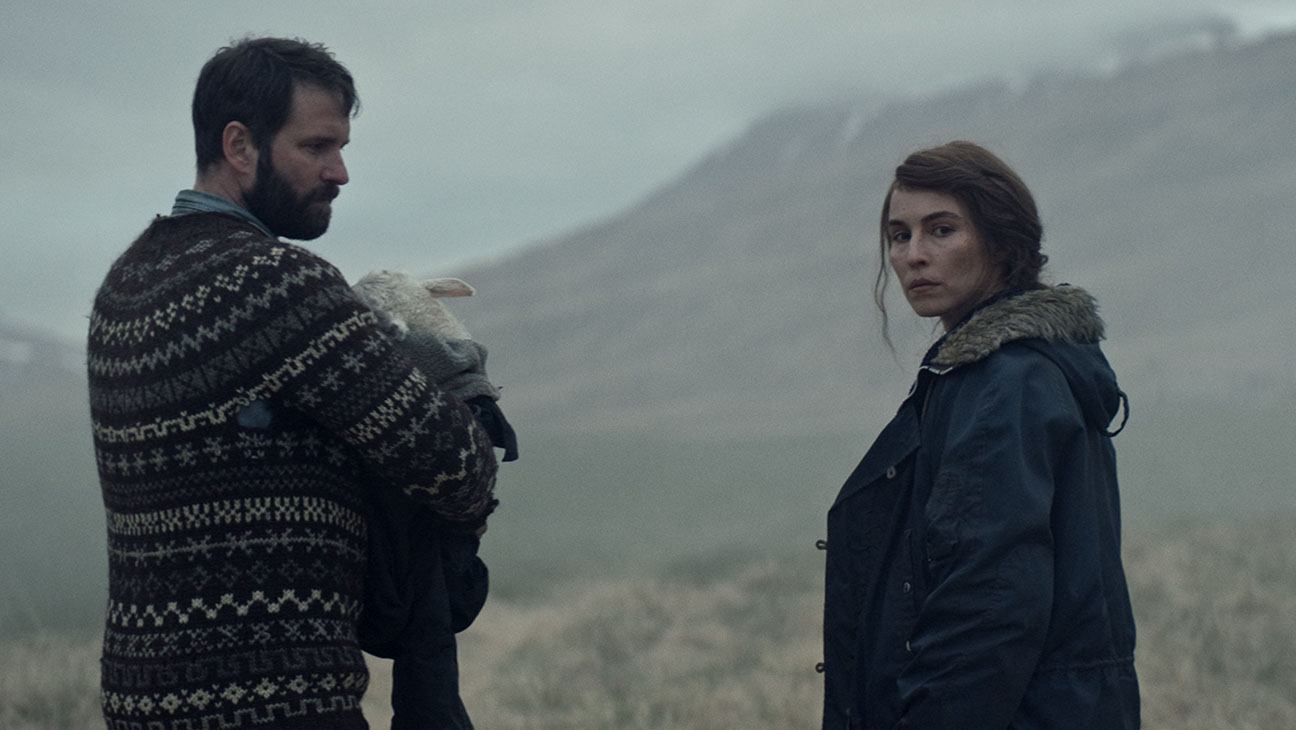
There is, to put it as mildly as possible, a lot going on in Valdimar Jóhannsson’s Lamb, but let’s start with the overarching motif: nature is fucking terrifying. Its earliest, mildest scenes opening scenes have a strange, unnerving calm about them, as if bad things are brewing just under the surface, and he achieves that effect partially by just allowing animals and objects to make their presence known. So we hear the sound of wet nostrils flaring, or the rumbling of a rapid river; we see the menace of a soupy fog, or the threatening look in the cat’s eyes (no, really). And that’s before we get to the nightmare visions of white-eyed goats.
But now I’m getting ahead of myself. First we meet Maria (Noomi Rapace) and Ingvar (Hilmir Snær Guðnason), a farming couple living a modest, rural life. The first few scenes are entirely free of dialogue, the soundtrack filled by animal sounds and country quiet, and Maria and Ingvar don’t seem to have much to talk about anymore anyway.
And then… well, something happens. The trailers and marketing have been careful not to say exactly what, and I’ll honor that here – and for several scenes of the film itself, it’s not entirely clear. (And then it’s revealed. Boy, is it revealed.) Suffice it to say that Maria is prompted to take over the “mothering” of a newborn lamb, a development that Ingvar initially side-eyes. But in the next scene, he breaks down during a moment alone, so there’s clearly some history at play here, and not long after that, he brings a barely used crib in from the barn. Soon, the lamb is sleeping in it.
Complications arrive in the form of Ingvar’s brother Pétur (Björn Hlynur Haraldsson), who asks (not unreasonably), “What the fuck is this?” And his brother replies with one word: “Happiness.” Hey, y’know, live and let live, and when Pétur insists, “It’s not a child, it’s an animal” … well, who’s to say? If “parenting” the lamb makes them happy, what of it?
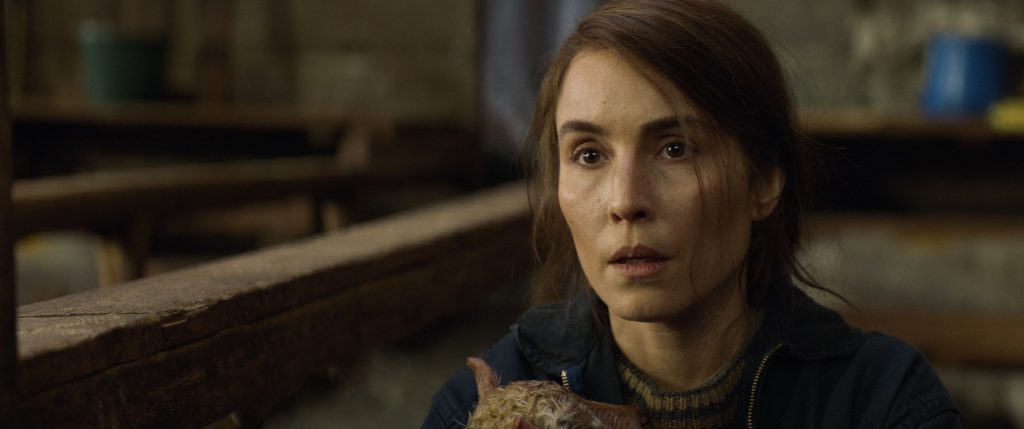
Again, preserving the story’s turns (and they’re frequently shocking, or at least startling) means talking around much of the narrative. But suffice it to say that Jóhannsson uses his cool, minimalist style to pack copious dread into ostensibly innocuous scenes; he has a way of framing his shots and assembling his scenes that makes them seem inescapably ominous, even when nothing obviously “bad” is happening. And Lamb gathers steam, framed and cut and scored in a way that’s just strangely, almost indescribably distressing – it speaks to the skill of the performers and the technique of the filmmaker that the connection between these characters seems so genuine and heartfelt that the mere notion of something disrupting that is so disturbing.
Jóhannsson’s approach has its limits. While his lack of expositional hand-holding is certainly refreshing, there are a couple of key moments where the storytelling is oblique to the point of inscrutability, or where motivations shouldn’t be nearly as foggy as they suddenly are. But given the choice, I’ll take this over the inverse, also known as pretty much every other movie in theaters right now.
I saw Lamb at Fantastic Fest, a freewheeling genre film festival that might not’ve been the best place to show a challenging grief narrative that A24 has (as is their wont) packaged as a Gothic horror joyride. There were scattered titters and giggles from viewers refusing to engage with it beyond the surface, looking for a good time even when the picture was giving them something quite different. But there’s nowhere to hide by the closing sequence, in which Rapace has a breakdown so raw and so vulnerable that I felt myself looking away – it seemed too private to watch. They stopped giggling then. What a wild, uncomfortable experience this movie is.
B+
“Lamb” is out Friday in theaters.