Kimber Myers
Is the greatest edit of 2025 a giant fertilized egg transitioning into a ping pong ball, set to Alphaville’s “Forever Young”? Maybe. Marty Supreme invites a lot of superlatives, some with less competition than others. The best table tennis scene in cinema? Sure. (Apologies to Forrest Gump.) Things get more interesting when you start thinking that this could be the best performance of Timothée Chalamet’s career, when he’s already earned two Oscar nominations before the age of 30. Even outside of Chalamet’s performance—and yet impossible to separate it from it—Marty Supreme is one of the top films of the year, an experience that leaves you as breathless as an endless volley between two pros. With his solo directorial debut, Josh Safdie has made a movie that feels at once of a piece with those he made with his brother like Good Times and Uncut Gems, while also marking a major step up for the filmmaker.
Written by Safdie and frequent collaborator Ronald Bronstein, Marty Supreme begins with a title card telling us that it’s New York in 1952, but it couldn’t be any other time or place. Co-writer and director Safdie doesn’t display nostalgia for this setting, but instead recreates it with grimy fidelity about these people and this city. Marty Mauser (Chalamet) has a job as a shoe salesman in his uncle’s shop, but he thinks and talks about nothing other than himself and his goal to bring table tennis to the fore of American culture with himself as its ambassador and star player. He’s a natural hustler; he struggles to pay for things as small as his meals or as large as a trip to Tokyo for a tournament, but he always figures out a way, though it may not be strictly above board or may not endear him to those around him.
As an actual human being, Marty Mauser is the kind of obnoxious, ego-driven young guy who might have magnetism, but not enough of it to outweigh a casual cruelty and singlemindedness that means you wouldn’t want to spend more than a minute in his presence. The 23-year-old phenom spits out insults that are offensive even in the movie’s setting of 1953, to say nothing of how appalling they are in 2025.
His singular focus is on table tennis, an activity that seemed so banal that I could barely manage enough interest to go down to the table in my grandparents’ basement. And yet, Marty Mauser and Marty Supreme are wholly engaging. I was rooting for this asshole, both in the entertaining table tennis matches that pit him against the best players and in the larger world, where he has to contend with both his own terrible decisions and a bunch of other assholes.
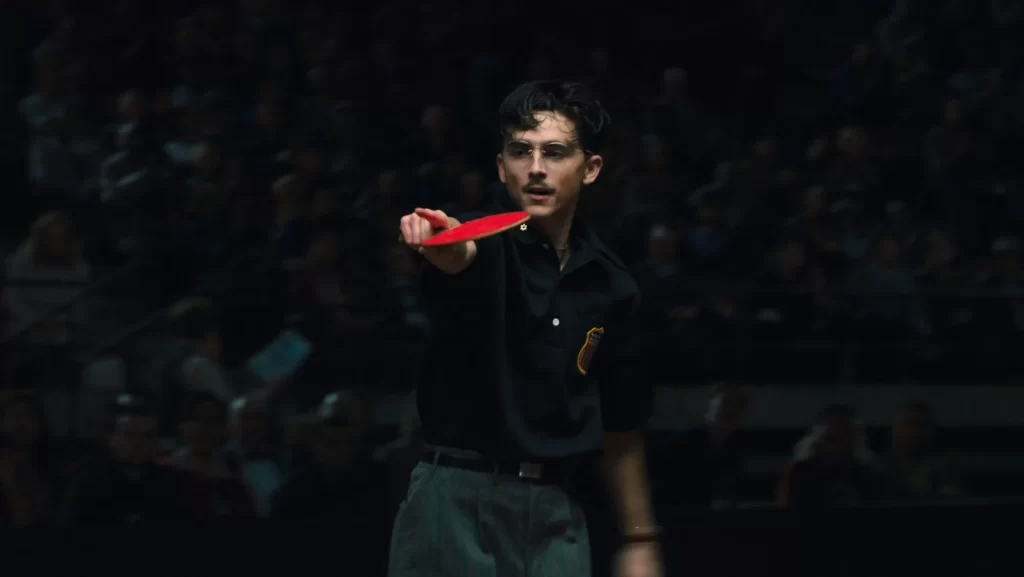
As befits a Safdie protagonist, Marty is all nerve and nerves, undone by both his own actions and things outside of his control. He makes cringe-inducing choices, but he also falls victim to circumstance. Once things start to go wrong, all we want is for something to go right, and not just so we can feel a little less anxious about what’s happening. This isn’t ever as stressful as Good Times or Uncut Gems, but there’s still a sense of unease about exactly what Marty will do or what will happen despite his best efforts. He has a fast-talking, fast-playing energy, but he still can’t ever seem to really get ahead. Chalamet is jittery and full of bravado, as good in the moments of hubris as when Marty is epicly humbled. It’s a role that requires both broad range and specificity, and Chalamet nails every second he’s on screen, which is practically the entire movie.
Safdie surrounds Chalamet with an ace cast of recognizable stars: Gwyneth Paltrow as a former movie star and current (married) love interest, Odessa A’zion as his childhood friend and other (married) love interest, Emory Cohen as her suspicious husband, Fran Drescher as Marty’s mother, Sandra Bernhard as his aunt, and Tyler Okonma (aka Tyler the Creator) as his partner in crime. The Safdies have always employed non-professional actors ranging from everyday people to NBA star Kevin Garnett, and Josh continues that here by employing big names that haven’t made their names as thespians, like Shark Tank’s Kevin O’Leary and New York grocery magnate (and locally famous jerk) John Catsimatidis. The biggest laughs of the movie come from a late cameo who delights with his initial appearance, and then continues that joy with each of his few lines of dialogue.
It’s bits like that that make Marty Supreme so much fun, even though it has the hallmark stresses of a Safdie film. Marty endures pain and humiliation in service of his dream, but there are moments that are so elating that you leave the movie on a high, as bouncy as Marty in his best moments. It has fizzy energy even beyond Safdie’s direction and Chalamet’s performance, which would be enough to sustain most films. The soundtrack has songs from the ‘50s that mingle with ‘80s synth and classical tones, all making it feel at once of that era, this particular moment, and utterly timeless, all at once.
Safdie, Bronstein, Chalamet, and the rest of the team have made something for the ages. Marty Supreme is a wild ride, whipping you back and forth with your heart in your throat from the moment it begins. The second it ends, you just want to get right back on again.
A
“Marty Supreme” is out now in a limited 70mm engagement in select cities. It opens in more theaters Christmas Day.