Jason Bailey
“Are you comin’ down to the pub?” the melodiously monikered Pádraic Súilleabháin (Colin Farrell) asks, as he does every day. But on this day, for some reason, Colm Doherty (Brendan Gleeson) doesn’t answer – ignores him entirely. Pádraic’s sister Siobhan (Kerry Condon) asks if they’ve been rowing. “I don’t think we’ve been rowin’,” he replies, genuinely baffled. “Have we been rowin’?”
“Maybe he just doesn’t like ya anymore,” she says, in jest. By the end of The Banshees of Inisherin, no one is laughing.
The latest from writer/director Martin McDonagh, five years after the Oscar-winning triumph of Three Billboards Outside Ebbing, Missouri, feels like a conscious effort to go back to this origins – not only to his home country of Ireland (Ebbing and its predecessor, Seven Psychopaths, were both set in America), but to his feature directorial debut, In Bruges, which also starred Farrell and Gleeson.
In that film, they were a pair of contract killers whose loathing of each other grew into something resembling affection, or at least tolerance, over the course of a work trip in the titular tourist destination. Banshees cleverly inverts that formula; its protagonists have, by all accounts, been best friends and constant companions for as long as anyone can remember, including themselves. But Colm doesn’t want that anymore, and it’s as simple as that. Pádraic didn’t say or do anything, Colm assures him: “I just don’t like ya no more.”
“What is he, 12?” is such a sensible question that even Dominic (Barry Keoghan), the town dim bulb, asks it. “Why does he not wanna be friends with ya no more?” But the genius of McDonagh’s razor-sharp screenplay is how it plays with our perceptions and assumptions; we meet Pádraic first, and see Colm only through his eyes, which allows the former to be our object of sympathy and the latter to seem enigmatic and impenetrable. But the more Colm is pressed, and the more he explains his thinking, the more sense he makes; he just wants “a bit of peace. In me heart, like.” And who doesn’t want that?
These conflicts never run in a straight line, either; Colm may be done with Pádraic, but when the poor sap is beaten senseless by the town policeman (and, almost needless to say, town bully), Colm reaches out with a moving gesture of pity and kindness. And when Pádraic gets liquored up and lets Colm have a piece of his mind, Colm chuckles, “That was the most interesting he’s ever been. I think I like him again.”
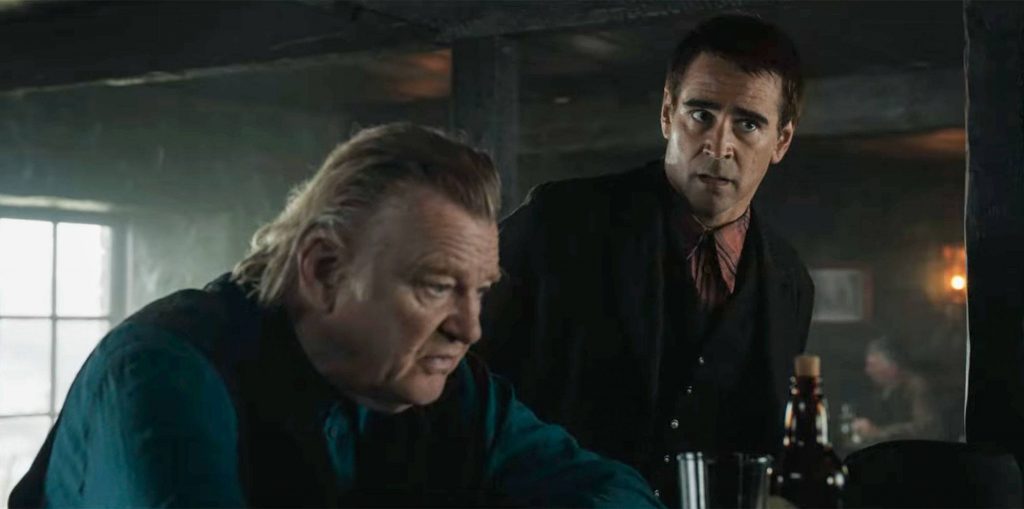
But he doesn’t – in fact, he grows so frustrated with his former friend’s inability to leave him be that he threatens to start cutting off his own fingers if Pádraic speaks to him. (“Now he’d rather maim himself than talk to ya!” Dominic notes.) It takes a certain kind of wit to spin this slight into a subject, and McDonagh leaves no stone unturned; he explores all the nooks and crannies of this conflict, no matter how ridiculous (there is, for example, the question of finger disposal: “I’m not throwin’ the finger out, I’ll get dirt on it”). And, in doing so, McDonagh keep raising the stakes, little by little, until we’re at a point where neither of them even know what they’re mad about anymore.
Farrell earns every ounce of praise he’s getting for this, which may be his most fully realized screen work to date; he takes all the character’s turns with grace and sympathy, and pulls of the neat trick of playing a dumb guy without playing dumb, which isn’t as easy as it sounds. Gleeson’s arc may be even tougher to convey, since we so frequently only see him through Pádraic’s eyes, but he finds and plays the poignancy in every well-placed pause and withering stare. Keoghan, whom we mostly know from convincingly playing creeps (including, most memorably, alongside Farrell in The Killing of a Sacred Deer) proves to have real comic chops, and Condon, as one of the few women in this orbit, plays the exasperation therein with real verve.
McDonagh’s vernacular, more than ever, is a perfect mix of lyricism and vulgarity (there are a lot of “feckin”s), and the rhythms of the conversations are tight as a drum; the Pádraic/Colm scenes, in particular, amount to a series of perfect little duets. But he’s never just leaning on his gift for dialogue. He sprinkles sharp little character moments throughout the script, so generously that even the smaller roles get them. And his regular thematic concerns – a stew of Catholic guilt, fear, responsibility, and forgiveness – are present and accounted for, particularly in the increasingly downbeat (and more than a little allegorical, as he certainly didn’t set it during the waning days of the Irish Civil War at random) third act.
It’s also McDonagh’s most aesthetically pleasing film yet; the landscapes are gorgeous, rolling hills and cobblestone paths and welcoming pubs, which he seems well aware can only serve to undermine the bleakness and grudges and loneliness within them. Grim and uproarious, quirky and chilling, The Banshees of Inisherin doesn’t quite reach the heights of In Bruges (hell, few things do). But it’s yet another winner from one of our most complex and compelling filmmakers.