Meredith Borders
On Saturday, March 10, every film that screened in The Paramount – SXSW’s premier venue in downtown Austin – was directed by a woman. It was representative of this year’s lineup, with the strongest showing (at 33% of features and 59% of shorts) of female filmmakers in the festival’s history. And Saturday culminated with a headliner screening of Blockers, Kay Cannon’s new sex romp that was the first of four great new comedies about love and sex directed by women this year.
 Blockers is, on the surface, a pretty standard teen sex comedy, much in the vein of American Pie, as three teens vow to lose their respective virginity on prom night. But the simple fact that those three teens are young women – in a movie directed by a woman – makes Blockers pretty special. It’s raunchy and extremely R-rated, and it’s for teen girls. That’s major.
The trailer might lead audiences to believe that Blockers (in theaters April 6) places uncomfortable emphasis on the chastity of teenage girls, or slut-shames those who lose their virginity before college. That would be a massive bummer, and fortunately, that’s not the movie that Kay Cannon directed. These girls (played by Kathryn Newton, Geraldine Viswanathan and Gideon Adlon) are cool and kind and sensible, and their friendship offers the sort of honest, supportive connection that helps girls survive the treacherous territory of sex in high school. Sure, their parents (Leslie Mann, John Cena and Ike Barinholtz) spend most of the movie going to insane lengths to keep their daughters’ virginity intact, but the real lesson here is that girls will be girls, and it’s never too early for them to learn that their bodies belong to them, not to their dads or boyfriends or Congress.
 It’s the same lesson Jessica Barden’s Blake learns, albeit in a roundabout way, in The New Romantic, (release TBA), from first-time feature writer/director Carly Stone. Blake’s a college senior whose romance column gets axed from the school paper because she’s fundamentally opposed to actual romance. “It’s a sex column without any sex,” her best friend Nikki (Hayley Law) points out, and she’s not wrong.
Desperate to generate a story, Blake finds herself wrapped up in the glamorous life of a “sugar baby,” the cutesy, almost wholesome-sounding name for a (typically) young woman who provides sex for a (typically) older, wealthy man, who in turn repays her in gifts, fancy dinners, and trips. Or, in Blake’s case, a moped and a recommendation letter for the gonzo journalism competition she’s determined to win.
The New Romantic is charming and funny, a very overt nod to Nora Ephron (Blake’s favorite filmmaker, as rom-coms these days are only allowed to be rom-coms if they’re winking and self-referential), with a very likable lead turn from Barden. Blake, like the girls of Blockers, has a healthy amount of perspective when it comes to sex, though her sex-positivity is challenged by the seedier side of her new lifestyle. In the end, Blake learns some stuff, but nothing’s too pat in The New Romantic. It’s a bit messy and a lot surprising, and a remarkable debut feature from Stone.
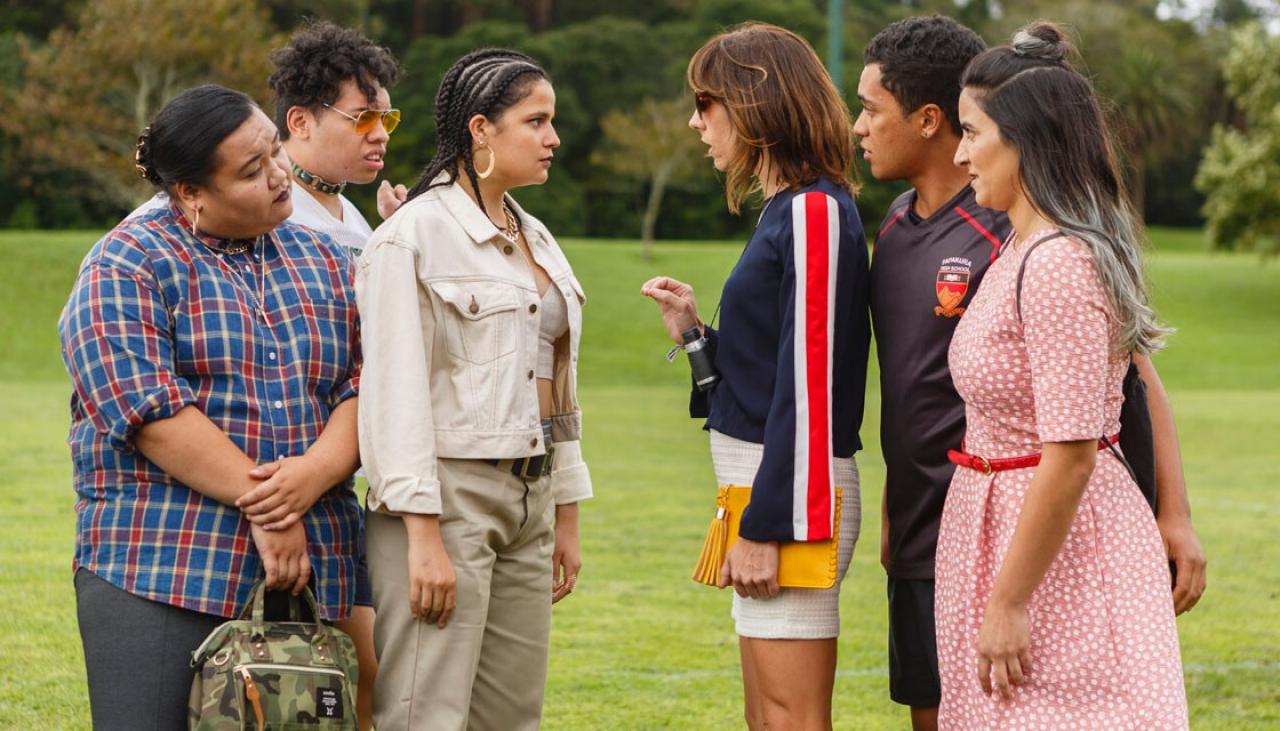 The Breaker Upperers’ Madeleine Sami is also at SXSW with her first feature film, which she co-wrote and co-directed alongside The Inland Road’s Jackie Van Beek. Sami and Van Beek play Mel and Jen, two women who were cheated on by the same man and, cynical and fed up, decide to open a break-up agency. Through elaborate costumes and ridiculous scenarios, Mel and Jen free those who are too chicken to free themselves.
The New Zealand comedy is absurd and bizarre, and it generated the biggest laughs of any film I saw at SXSW this year. Mel and Jen are broken, these two wonderful, terrible weirdos who only make sense when they’re together. The Breaker Upperers (release TBA) makes no bones about the fact that the only romance that truly matters here is the friendship that Mel and Jen share, because the only love you can trust is the love you have for your ride-or-die bestie.
Important to note: The Breaker Upperers features an extended fantasy karaoke sequence to Celine Dion’s “It’s All Coming Back to Me Now,” and an intricate dance scene to K-Ci & Jo-Jo’s “All My Life.” If you need to know more than that, then you might be joyless, and The Breaker Upperers is definitely not the movie for you.
 That could also be the case for Suzi Yoonessi’s Unlovable (release TBA), an utterly winsome comedy that is nevertheless likely to alienate some prudes thanks to its unblinking and nonjudgmental look at female sexuality and sex addiction. Charlene deGuzman stars and writes (alongside The Midnight Swim’s Sarah Adina Smith), based on her own experiences in recovery from sex and love addiction. DeGuzman plays Joy, an ebullient and colorful young woman who loses herself in relationships, in masturbation, and in meaningless sex, constantly searching for a connection in ways that ultimately constitute self-harm.
We meet Joy right as she bottoms out, and we follow her along her first thirty days of recovery, as she befriends her sponsor, Maddie (Melissa Leo), and Maddie’s brother, Jim (John Hawkes). We follow her as she learns that she likes to play the drums and paint cute pictures of fruit. We follow her as she messes up, again and again, constantly starting the recovery process over but never really going back to square one, because even messing up is an important part of that process.
It’s a beautiful, hilarious, heart-wrenching film that comes from a place of deep honesty and vulnerability, and deGuzman’s performance – inspired, as it is, by the truth of her own recovery – is both courageous and compelling.
These four films all examine romance and sex through a uniquely feminine lens. It’s weird that this lens is unique, since we women make up half the people having sex and falling in love out there, but we’re still such a small percentage of those telling the stories about it. That this year is SX’s strongest film lineup in ages while also the lineup featuring the most female filmmakers is probably not a coincidence, so thanks to SXSW for recognizing that diversity and representation not only matter – they pay off in great storytelling.