Bill Bria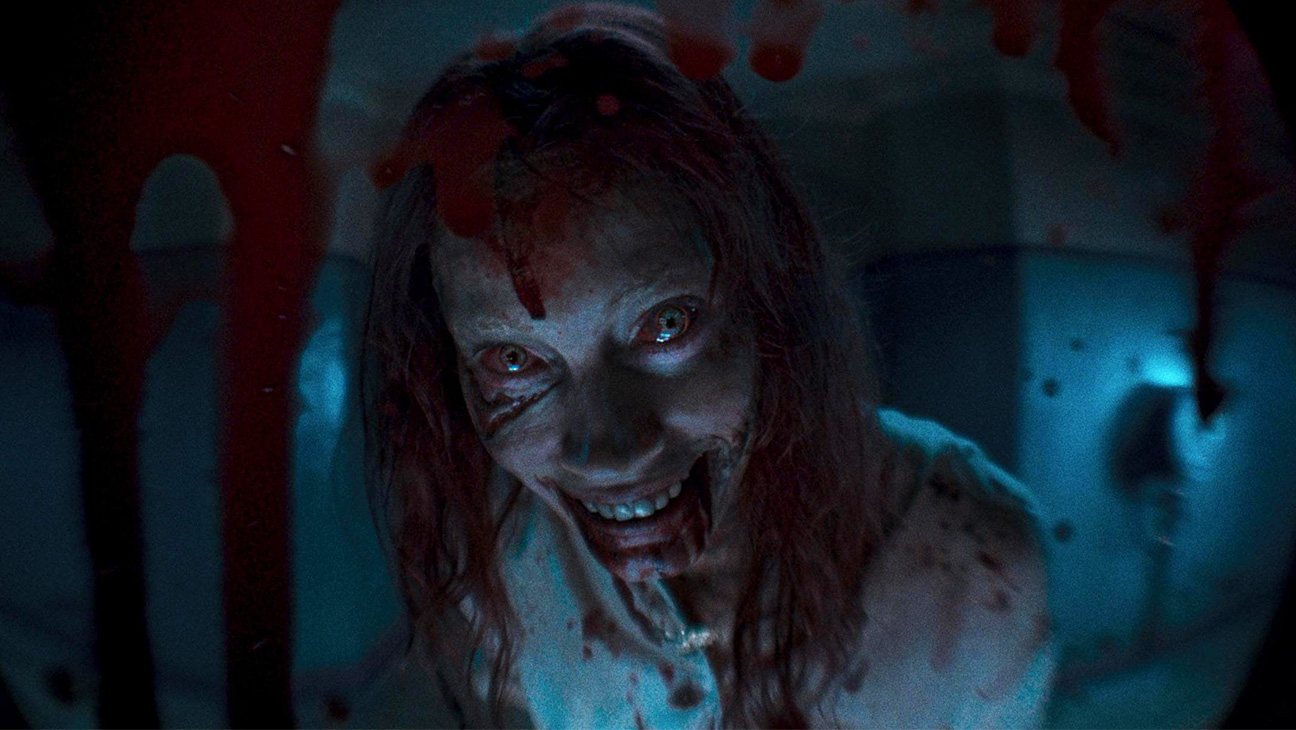
In H.P. Lovecraft’s 1927 critical treatise on the horror genre, he wrote: “The oldest and strongest emotion of mankind is fear, and the oldest and strongest kind of fear is fear of the unknown.” Lovecraft’s work marked the beginning of a subgenre now referred to as Cosmic Horror, a literary trend that’s begun to proliferate within horror cinema in a big way recently, thanks to films like The Void, Annihilation, The Endless and The Outwaters telling tales of horrific events occurring with little to no explanation.
That doesn’t mean Cosmic Horror in cinema is brand new, however. While direct adaptations of Lovecraft’s work to the screen ostensibly began with 1963’s The Haunted Palace, strains of Lovecraftian horror broke out in a number of experimental, hallucinatory horror features as in, for example, 1962’s Carnival of Souls, 1973’s Messiah of Evil, and the three films by John Carpenter dubbed his “Apocalypse Trilogy”: 1982’s The Thing, 1987’s Prince of Darkness, and 1994’s In the Mouth of Madness.
Most horror movie franchises tend to shy away from Cosmic Horror, simply because the rinse/repeat cycle of a sequel typically requires a formula, and with a formula comes rules: witness the slasher film, and the Scream franchise’s clever, meta take on the “rules” of that subgenre. One of the rare horror franchises that maintains its roots within Lovecraftian Cosmic Horror is the Evil Dead franchise, consisting of 1981’s The Evil Dead, 1987’s Evil Dead II, 1993’s Army of Darkness, 2013’s Evil Dead, the premium cable series Ash vs Evil Dead (2015–2018), and this month’s Evil Dead Rise. For a variety of reasons, the Evil Dead series has steadfastly committed to remaining untethered from a consistent tone, a grounded reality and strict continuity. Its contradictions and lack of predictability is a feature, not a bug, one which keeps the series unsettling no matter how cartoonish or slapstick-y it becomes.
The Cosmic Horror in The Evil Dead is established right away: the movie’s opening shot is a disembodied camera flying over a dank, foreboding swamp before continuing through the woods and finally landing on our protagonists’ car driving on a narrow road. Throughout the course of the movie and the subsequent sequels and spin-offs, this shot came to represent what was termed the Evil Force, yet writer and director Sam Raimi never provides a concrete explanation of what exactly it is during the first film, leaving the audience to wonder right from the get-go about whose perspective we’re seeing, what (if anything) this Force might look like, and how it operates — especially given that the characters have yet to read from the evil Book of the Dead they eventually find in the basement of the cabin in the woods they’re staying at. So technically the Evil shouldn’t be unleashed yet, but is.
As this opening shot establishes, nothing in The Evil Dead conforms to a strict set of rules. While it’s possible the characters might have survived had they not discovered the Naturom Demonto and a tape recording of a professor reading incantations from it, there’s the sense that perhaps they were always doomed. Once the Evil is officially unleashed and the companions of Ash (Bruce Campbell) begin to be possessed by it, their possession seems more haphazard than anything else — this is not the zombie archetype as established by the films of George A. Romero, where a bite or scratch from a creature will “infect” the victim. Nor is it the same kind of demonic possession as seen in The Exorcist and its many knockoffs; where those victims suffered demons entering their bodies looking to permanently set up shop, the people possessed by the Kandarian Demons (alternately termed Deadites) are “taken” at will, and may or may not get a chance to regain their humanity.
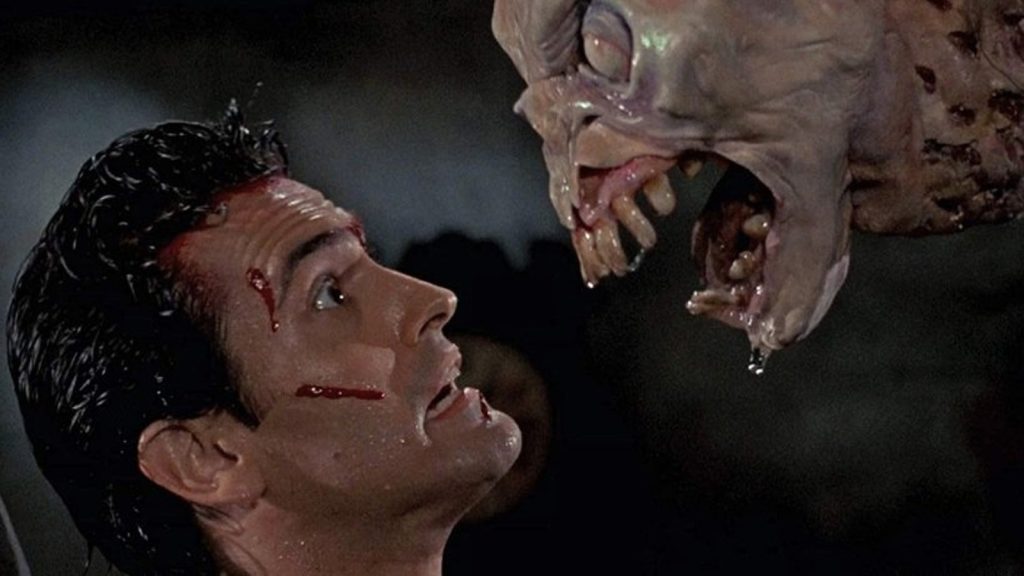
With Evil Dead II, almost everything stays the same — Ash travels to a cabin in the woods, plays a tape, unleashes Evil, has to chop up his girlfriend with a chainsaw, gets chased by the Evil Force — and yet everything is changed: Ash arrives at the cabin with only his girlfriend in tow (played by a different actress) instead of his sister and several others as in the first film, the Book of the Dead has a different name (Necronomicon Ex-Mortis, a more explicit reference to Lovecraft), Ash himself is possessed not once but twice (and manages to dispel it for good), and the film’s tone expands from being relentlessly grim to resembling a gorier Three Stooges short. The changes to the events of the first film in the recap sequence were done more out of legal necessity than intentional obfuscation, but they dovetail nicely with the franchise’s interest in keeping the characters and the audience continually off balance. It’s highly unlikely that anyone seeing the sequel for the first time expected it to end with Ash being pulled through a time vortex to the Middle Ages, a twist that in any other movie would be too off-the-wall, but for Evil Dead it feels highly appropriate.
Army of Darkness continues the tradition of retaining a lot of the series’ stylistic elements while completely switching things up, keeping Ash stuck in the Middle Ages as he struggles to battle a demon army and get back to his own time. The opening recap is again it’s own thing: yet another actress plays the hero’s doomed girlfriend, Ash is revealed to have been an employee of a blandly corporate chain of department stores called S-Mart before being sucked through time, and so on. Army of Darkness isn’t the only film to feature multiple cuts with wildly divergent endings, but their existence feels apropos, making the movie into a sort of choose-your-own-adventure experience when viewed on home media.
It’s no surprise that the continuation of the series with Evil Dead (20 years after Army of Darkness’ release) made a meal out of the franchise’s mercurial continuity. Evil Dead can be seen alternatively as a remake, a reboot or a reboot-quel, as various references both visual and aural go beyond mere fan service to indicate a larger, pseudo-multiverse concept buried within the film and the series: Ash’s Delta 88 can be seen rotting outside the cabin as Mia (Jane Levy) sits on top of it, echoes of voices from the original film can be heard peppered throughout the movie as well as during the end credits, and Ash (or is it Bruce Campbell playing himself?) appears in a brief post-credits shot. When Eric (Lou Taylor Pucci), explaining what he’s found within the Naturom Demonto, states that the passages in the book are “confusing” and “sometimes contradictory,” it’s both a clear statement of the film’s brand of Cosmic Horror as well as a wink and a nod to the series’ ever-changing playbook.
The series Ash vs Evil Dead, thanks in part to the dramatic requirements of serialized television, attempted to define the mythology of the franchise more concretely than any prior film in the series. The “Dark Ones” that were briefly mentioned in the opening narration of Evil Dead II become personified in the character of Ruby (Lucy Lawless), and the nature of Ash as a prophesied savior of humanity is given far more weight than it was in the films. Yet during the show’s brief three-season run, it ran into numerous narrative obstacles, straining against the more restrictive, Supernatural/Buffy the Vampire Slayer-style “big bads” and their various backstories. Although the series was confused, it never lost the appeal of the films: throwing all caution (and good taste) to the wind and letting loose with inspired setpieces, mean-spirited humor and bold visual moments.
Evil Dead Rise seems to be rebooting (or reboot-queling) yet again, as no recurring characters from the prior movies look to be making a reappearance. Yet the potential for any of them to do so is still very much in play, because if nothing else, the Evil Dead franchise has always retained its sense of “anything goes.” Whether that means old characters showing up or simply the shocking dismemberment of various limbs and appendages in increasingly creative ways, it’s a quality that lends the franchise a remarkable sense of fear and excitement toward the unknown.