Audrey Fox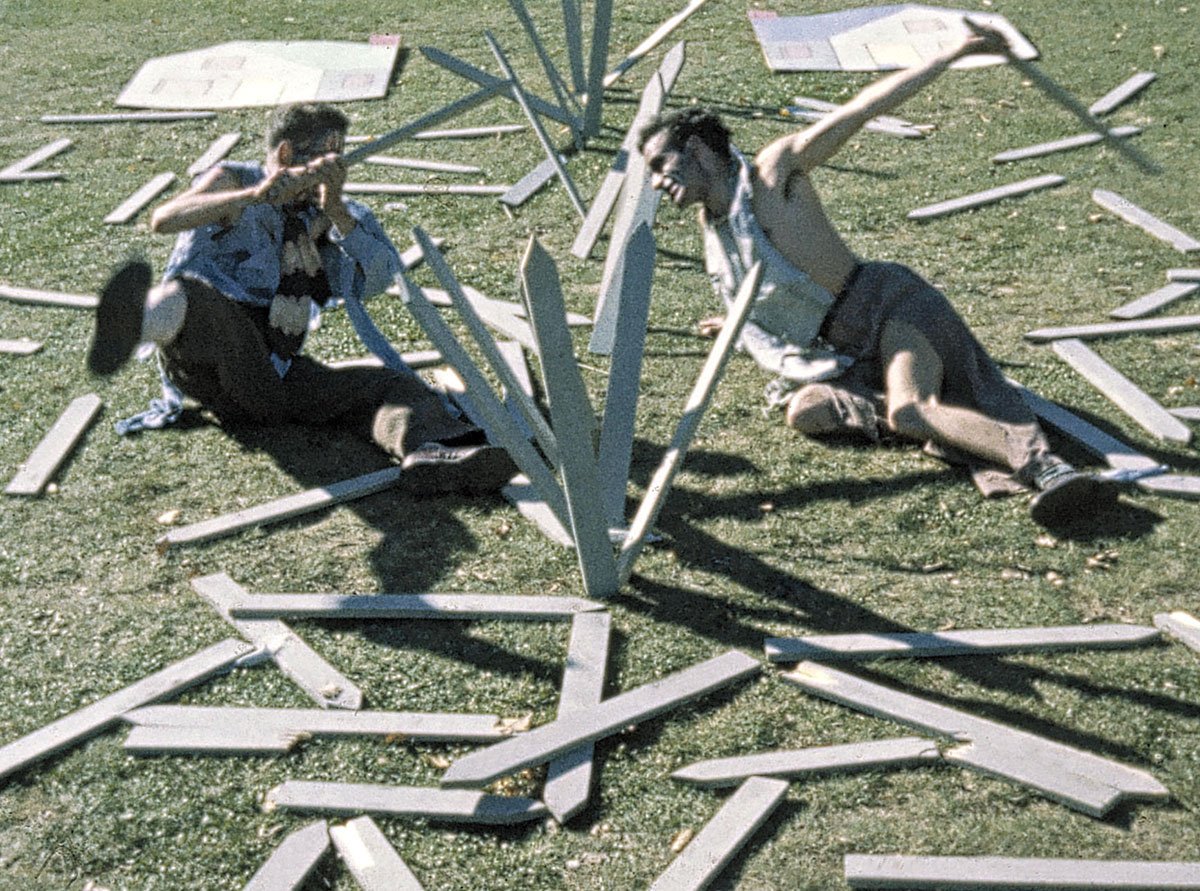
Two men sit on an idyllic suburban lawn, creating a mirror image of one another that suggests an inherent balance in their world – That is, until a single flower sprouts directly onto their shared property line, leading the two to come to blows, each claiming ownership over it. Neighbours, an experimental stop-motion short from Canadian director Norman McLaren, is not particularly subtle in its anti-war messaging. But perhaps it is because of this straightforward approach that Neighbours would stand as an example for future animated films to use their heightened sense of reality to introduce political commentary.
McLaren’s short film utilizes the animation technique of pixilation, where actors are manipulated frame by frame to create a living stop-motion puppet. This style of animation was especially popular during the silent era, when early filmmakers were endlessly experimenting with what their cameras were capable of, but it went out of vogue in favor of more traditional methods. It is, nonetheless, a perfect complement to Neighbours, giving the anti-war film a surrealist, madcap visual style that emphasizes the inherent silliness of the battle being fought on screen. The two characters take turns summoning the powers of pixilation to build a fence, ensuring that the single flower grows on their side of the property line, and moving it back and forth in an animated tug-of-war. Their actions become more frenzied and detached from reality as their desire for the flower grows stronger, and they resort to violence, made jarring and inhuman by the staccato motions of the animation style.
Neighbours was well-received by critics and awards organizations: It was nominated at the 1953 Academy Awards for Best Short Subject (one-reel) and Best Documentary (Short Subject), winning the latter despite being an abstract piece of narrative fiction and not, in fact, a documentary. But although some saw its merits, it was fiercely condemned in many quarters. The Canadian film was edited for American distribution by censors who demanded that McLaren remove a brief but controversial scene where both men pull apart their neighbor’s cardboard homes, murdering their wives and children cowering within. (Interestingly, McLaren himself preferred the shortened version after viewing it, and only released the full version in 1967 when he considered the barbarism an appropriate metaphor for Vietnam.)
Critics at the time saw in Neighbours a scathing indictment of the conflict in Korea, fought just a few short years after the devastation of World War II as an extension of the rapidly escalating Cold War. And to be fair, that was exactly the message McLaren intended to send: He was inspired to make the project after living in China during Mao’s revolution, only to return home to a Canada embroiled in an ideological war in Asia.
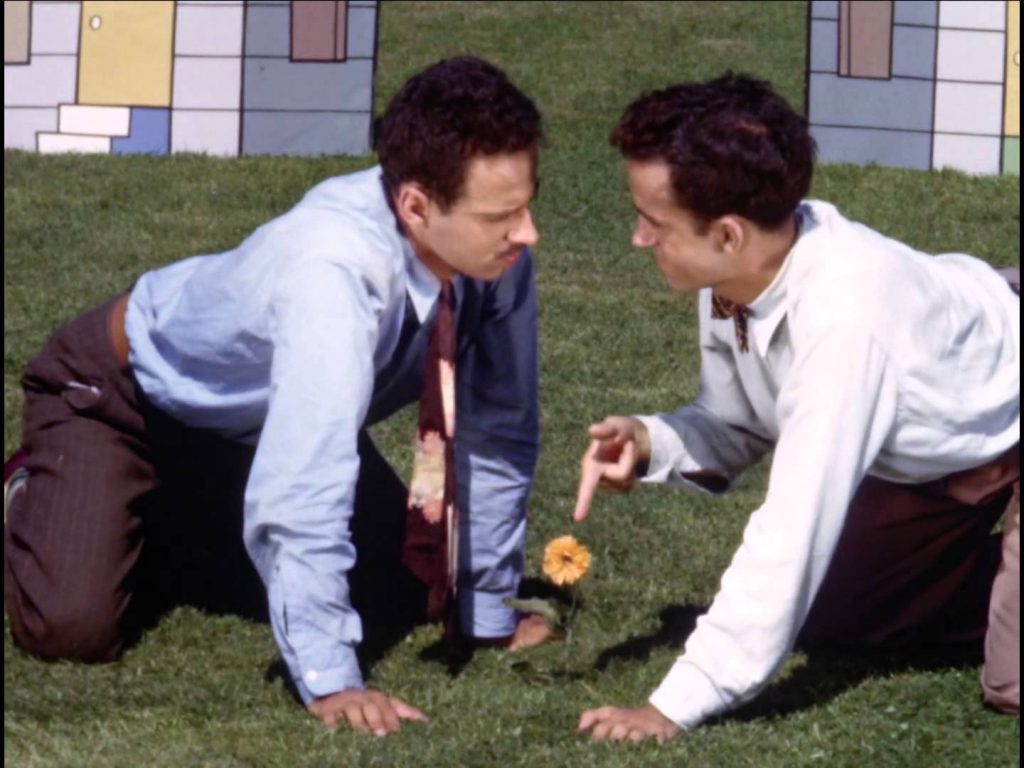
At just eight minutes long, Neighbours is brutally efficient. McLaren wastes no time in hammering home the utter pointlessness of the battle between the two neighbors: They fight over a flower, charging at windmills in the shape of a few measly petals. The line of fencing they build up and tear down reflects the trauma of past wars, white pickets a placid suburban evocation of barbed wire, trenches, and no-man’s-land. But it’s also a poignant image of the then-present conflict in Korea, with battles fought to maintain a seemingly arbitrary line in the sand.
Before Neighbours was released, animation techniques were considered the domain of children’s entertainment. If there is political messaging in pre-1950s animated films, it’s overwhelmingly subtextual (the only exception being cartoons released during World War II for propaganda purposes, showcasing Bugs Bunny or Daffy Duck squaring off against a buffoonish Hitler). But Neighbours is perhaps a harbinger of a larger movement of filmmakers experimenting with animation as a delivery system for sociopolitical commentary.
In 1965, Czech animator Jiří Trnka would direct Ruka (The Hand), featuring a puppet that is ruthlessly manipulated by an all-powerful Hand, a metaphor for Soviet social control so obvious that when he died four years later, the film was banned in Czechoslovakia until the Velvet Revolution in 1989. René Laloux’s 1973 animated science fiction piece Fantastic Planet would tackle issues relating to civil rights, racism, and apartheid with the dynamics between a giant humanoid race called the Traags and the much smaller, subservient Oms. More recently, we can look to the films of Hiyao Miyazaki, many of which feature a clear anti-war stance even amidst their more fantastical elements.
Now, of course, the door has been blown wide open: Even mainstream audiences are willing to accept more overtly political content in animation. And although it’s probably overstating matters to suggest that Neighbours was the singular film that created new paths forward for the genre, McLaren’s work operates at a crossroads that converges not just in animation, but with art in general in the 1950s. Here, rebelliousness and anti-establishment instincts have a place within even the most traditionally innocent cinematic genres.