Roxana Hadadi
“Damn the man.” Lucas’s (Rory Cochrane) recurring mantra in Empire Records never reached the pervasive cultural saturation of other cinematic moments of teen rebellion: Judd Nelson’s raised fist in The Breakfast Club, Winona Ryder’s “Lick it up, baby” snarl in Heathers, the Britney Spears sing-along in Spring Breakers. But in the 25 years since the film’s release, the film’s brusque rejection of corporate monotony has felt increasingly prescient. Those years have seen the shuttering of countless record stores, the cease in printing of myriad music magazines, the consolidation of radio stations, and the further homogenization of popular music. Initial reviews of Empire Records, nearly universally negative, panned the film for its “lame get-the-money premise” and “frenetic aimlessness,” and labeled it a “lost cause” and “a lousy comic drama.” What they missed was the film’s awareness that a certain kind of capitalist blandness was marching forward to flatten all the art that we hold dear, and that perhaps the only thing any of us could do to cope was hold each other closer, put on our favorite song, and dance.
From the time James Dean screamed “You’re tearing me apart!” in 1955’s Rebel Without a Cause, movies about teenagers have worked to find the emotional core of adolescent rebellion. Francis Ford Coppola’s double offering of The Outsiders and Rumblefish, Harmony Korine’s Kids, John Singleton’s Boyz N the Hood, Greta Gerwig’s Lady Bird; these movies can be scandalous and titillating, weighty and tragic. They strive to earn our respect—to prove to us as viewers that their protagonists are worth paying attention to, that their pain is real, and that their struggles are genuine. Those are admirable endeavors, and those are classic films. But a cult classic is something different. Unappreciated in its time, as Empire Records was. Mocked for its approach, as Empire Records was. And, most importantly, misinterpreted—as Empire Records was. To be fair, its characters are thin, their motivations are simple, and the film leans heavily on its soundtrack to build an atmosphere of messy affection and shared joy. But when that camaraderie is the very point, isn’t that enough?
Written by Carol Heikkinen (who would later script the teen ballet drama Center Stage) and directed by Allan Moyle (following up on his other cult classic about disaffected teenagers, Pump Up the Volume), Empire Records takes place over one day at an independent music store in Delaware. Empire Records is a vast, two-story building with its own gigantic marquee sign on its roof, packed inside with cassette tapes and CDs and vinyl and posters and Walkmans, a neighborhood spot that is equally popular with stoner teenagers, metalhead thrashers, and older jazz fans in sweaters and khakis. It is an institution, and night manager Lucas learns that it is in jeopardy: The place could be transformed into a Music Town franchise, another dull, soulless outpost of a company that prizes efficiency above originality. Convinced that he can win enough money at Atlantic City to help the store’s manager, Joe (Anthony LaPaglia), reject the offer, Lucas gets on his motorcycle in his black leather jacket and black turtleneck sweater, straps on his goggles, and heads toward a table. The store’s entire deposit of $9,104 is on the line—and he hits on 7! But instead of walking away, Lucas puts his winnings of $18,208 on the line again—and he loses, wiping out the cash Joe had trusted in his hands.
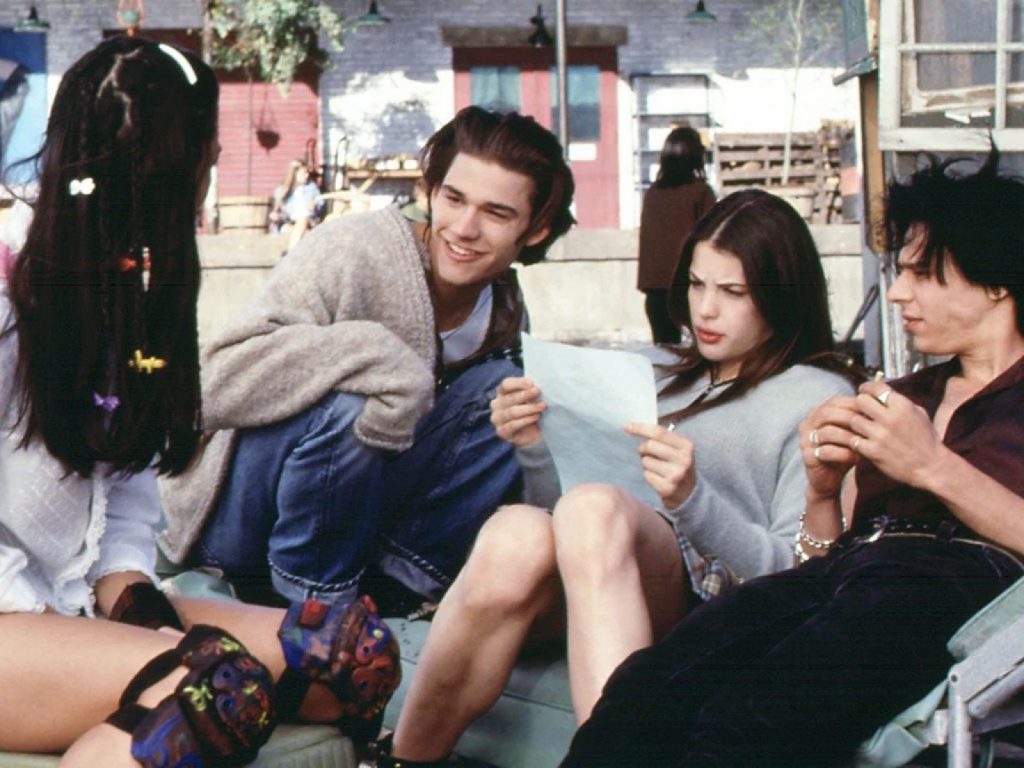
That loss is what spurs forward the next 24 hours of Empire Records, as Joe and the rest of the store’s young staff learn what Lucas did. The giggly Mark (Ethan Embry), whose greatest loves are the heavy metal group Gwar and his friend Eddie’s (James “Kimo” Wills) pot brownies. Aspiring artist A.J. (Johnny Whitworth), who yearns to tell his perfectionist virgin best friend Corey (Liv Tyler) that he’s in love with her. Corey’s other best friend, the more sexually adventurous Gina (Renée Zellweger), who butts heads with the sarcastic, nihilistic Debra (Robin Tunney), who is always off and on with her boyfriend, the musician Berko (Coyote Shivers). As long as they count the money twice and keep their hands off his beer, cigars, and drumsticks, Joe says, he and the teens will get along fine, but of course he cares about more than that. They all drive Joe a little crazy, and he might not know them all extremely well, but he notices things: A.J.’s feelings for Corey, the bandages on Debra’s wrist, how Gina flaunts her body as a defense mechanism. And normally, he would indulge their eccentricities and perhaps even engage with their silly antics. But this day is no normal day: It is Rex Manning Day, and the arrival of the once-popular singer (played by Maxwell Caulfield) further complicates the interpersonal drama already brewing within the walls of Empire Records.
Each hour brings another problem. Joe lies to the store’s owner to cover for Lucas (who, in perfect deadpan glibness, tells Joe that the money is “recirculating” in Atlantic City) and struggles to come up with how to raise the missing $9,000. Rex Manning appears with his employee Jane (Debi Mazar), and is just as much of a pompous blowhard as nearly everyone expected. Shoplifter Warren (Brendan Sexton III) is caught by the staff and arrested, threatening the employees on his way out. Confessions of love, various failed seductions, bad breakups, and nasty fights ensue. “If you’re in trouble, you can talk to me,” Joe says, and Lucas’s response, while not unkind, speaks to the broadness of their discontent: “Joe, we’re all in some kind of trouble. Am I the only one that sees it?”
Lucas is the film’s most complex, quotable character, a spin on the Hard Harry persona from Pump Up the Volume: His musing “What’s with today, today?” is as lovely a complaint as Harry’s “Do you ever get the feeling that everything in America is completely fucked up?” It helps that Cochrane is magnetic onscreen, a striking figure in his freshman-philosophy-major outfit, simultaneously soft-spoken and loyal while also reckless and radical. Every line of dialogue is uttered with a hint of slyness, like Lucas already knows the punchline to the joke or can guess how a story is going to end, but that snark doesn’t turn him pessimistic. Instead, his agenda, from the moment he learns of the possible Music Town takeover, is to fight against the destruction of the place he loves. “I will save the place that I work from being sold, and the jobs of my friends that work there, thus striking a blow at all that is evil,” Lucas swears, and although the statement is grandiose, the sentiment is worthwhile. And it’s a sign of how precious Lucas is to his friends that they encircle him in their protection even after they learn of his $9,000 gamble, and become aware of how everything that they cherish so much about Empire Records—the concurrent tolerance of individuality and encouragement of community—could soon be erased as a result. They might veto each other’s music choices or mock each other’s outfits, but they love each other, too.
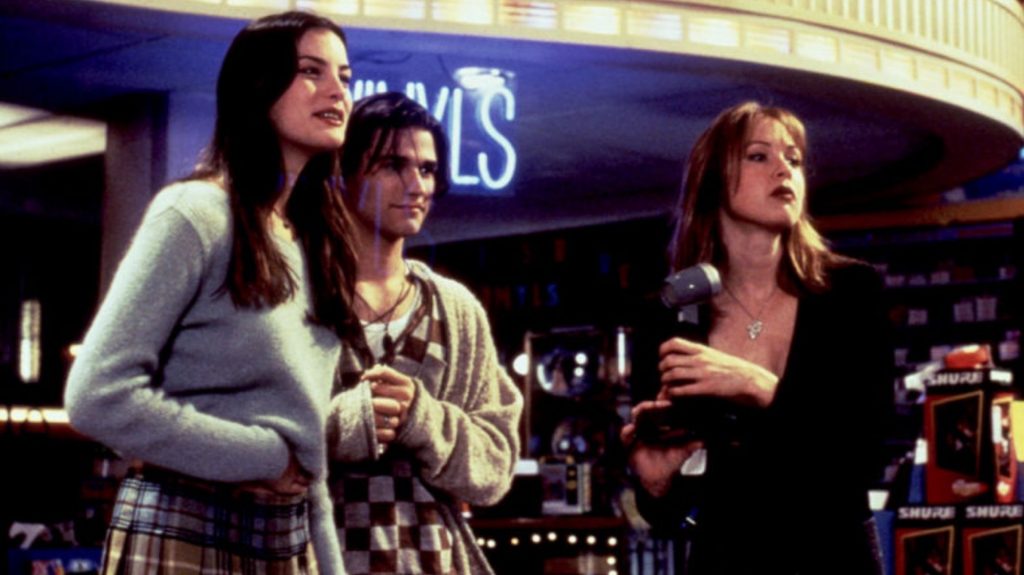
Empire Records is often portrayed as a place that actively encourages the unique joy brought on by a shared musical experience – five years later, High Fidelity would build the same feeling within its central store, Championship Vinyl – and the scenes that communicate that kinship to us are the ones that remain most delightful through every rewatch. Mark joining an impromptu Suicidal Tendencies-inspired mosh pit at a listening station. Gina singing along to the Flying Lizards’s “Money (That’s What I Want)” over the store’s intercom. Warren, A.J., and Lucas throwing their bodies around the break room in a highly energetic lip sync of AC/DC’s “If You Want Blood (You’ve Got It),” while Joe works out his frustrations on the drums. The entire store pairing off into couples who dance along, first ironically and then enthusiastically, to Rex Manning’s hit single “Say No More, Mon Amour.” Berko inviting Gina onstage with him to perform the punky “Sugar High,” and then handing over lead vocals to her; A.J. and Corey realizing they’re in love while they embrace to the Gin Blossoms’ “Til I Hear It from You”; and the entire staff, triumphant after saving the store, heading to the building’s roof for some early-morning revelry.
“We’re all losers,” Joe had told them when breaking the news about Music Town, and in a more-realistic version of Empire Records, maybe that would be the case. Maybe Empire Records would eventually close. Maybe Music Town would eventually close, too. Maybe Mark’s band would never come together. Maybe he and Eddie would never stop arguing about whether Primus or the Misfits were better. Maybe Gina would end up like her mother. Maybe Corey and A.J. couldn’t make it work. Maybe Berko never hit it big. Maybe Deb felt invisible again. Maybe Joe and Jane never went on that first date. Maybe Warren got in trouble again, and Lucas couldn’t save him again. Maybe Lucas got in trouble again, and Joe couldn’t save him again. But in that instant, Empire Records was safe, and the party was on, and they didn’t let the man get them down. “A record is like life. It goes around and around,” Eddie had said, and the fantastical charm of Empire Records is found in cranking the stereo up to 11, grabbing your friend by the hand, and dancing the night away.