Steve Erickson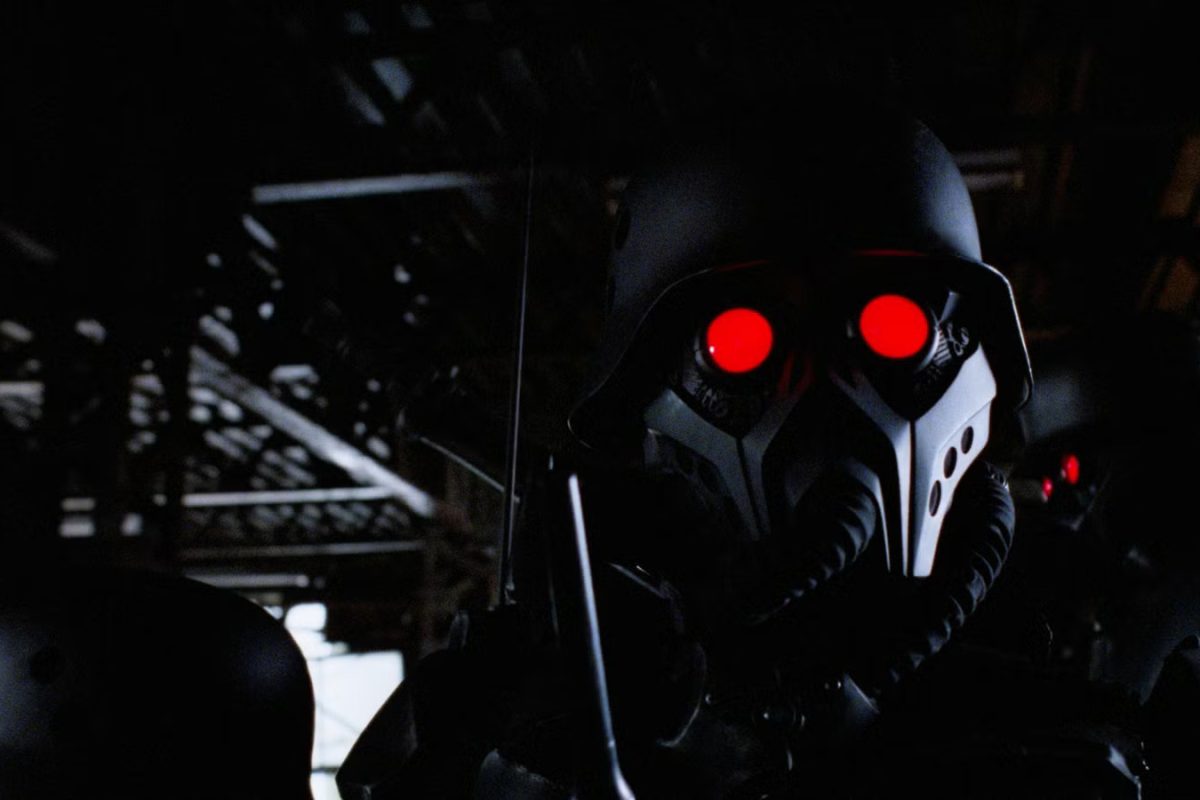
For a director who’s experienced great popular success, Mamoru Oshii is a remarkably eccentric artist. He’s lamented the fact that his live-actions films have been cursed to relative obscurity. But his first one, The Red Spectacles, is seeing a new re-release, following a crowd-funded restoration. Made in 1987, it weaves influences from Franz Kafka, Seijun Suzuki, film noir and the French New Wave into introspective science fiction. It’s easier to figure out its themes than its progression from scene to scene. Speaking about Breathless, Jean-Luc Godard said he thought he was remaking Howard Hawks’s Scarface when he was really creating his own version of Alice In Wonderland. Oshii knew exactly what he was doing with The Red Spectacles – it refers directly to the story of Little Red Riding Hood – but it’s a similarly unusual blend, up to the point where the ending offers an explanation.
The opening of The Red Spectacles sets the stage for its upending of genre expectations. Title cards establish the setting. A special police task force, granted armor and heavy weapons, is dismantled when their brutality becomes too much for the government to tolerate. They’re named “Kerberos: Watchdogs of Hell.” Three renegade members – Koichi (Shigeru Chiba), Midori (Midori Washio) and Soichiri (Hideyuki Tanaka) – hide out in a warehouse. A helicopter’s on the way, ready to give them a lift to safety. Suddenly, dozens of men with guns arrive on the scene. The Kerberos members fire off their machine guns in self-defense, strewing the environs with bloody corpses, which Oshii shoots like a “heroic bloodshed” action movie from Hong Kong at the time. Midori and Soichiri are seriously injured. Only Koichi escapes the police’s clutches.
Further title cards establish the arrest and trials of his companions. Koichi goes into exile for three years. When he returns, the style and tone of The Red Spectacles has become completely different. As he walks through Tokyo’s airport, the film is now black and white. Koichi heads into a taxi and arrives at a hotel. Repeating the earlier shootout, a group of men line up outside his room to take him out. Once again, Koichi kills dozens with no sweat. In this near-future city, stand-to-eat soba shops have been banned. The camera furtively roams around one, with men nervously glancing in its direction. From this point, The Red Spectacles heads down the rabbit hole. Only one thing is certain: Koichi is haunted by longing for his Kerberos colleague and former lover, Midori (Machiko Washio).
Much of The Red Spectacles takes place inside a movie theater. It points to the resemblance between dreams and films. At times, Koichi’s private memories appear to be projected for him to watch at the theater; at others, images made for the public (such as Midori’s filmed confession) speak to his personal experience. Television snow flickers away in the background of a serious conversation between Koichi and Midori. The distinction between fantasy and reality collapses into one between real life and movies.
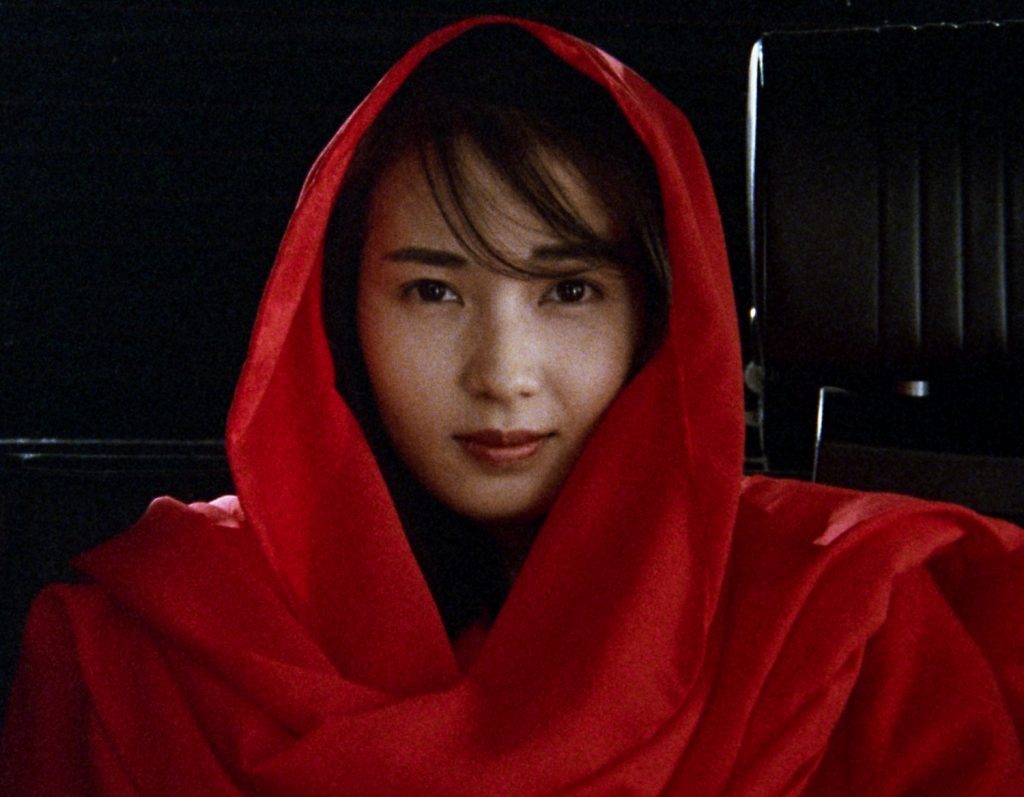
The film constantly swaps out its moods. In the middle of a discussion about the impossibility of living outside moral gray areas, it cracks a joke that “‘to live’ means ‘to dye.’“ Suffering from diarrhea, Koichi can’t use a toilet because fish are swimming in it. Part of the decay shown in Tokyo is expressed by the fact that life there has huge gaps which simply don’t make sense.
Although Oshii had only directed live actors in shorts, he achieved a striking look for The Red Spectacles, with lush black-and-white cinematography and a deep darkness over parts of the set. The film hints at much more than it shows. Oshii’s ongoing concern with the lingering toll of warfare is developed here, in a form that’s superficially more accessible than Angel’s Egg. Koichi’s facade of cool masculinity proves to run thin, no matter how much he dresses like Alain Delon. While it could be mistaken for a mere exercise in style, The Red Spectacles is concerned with the way men’s emotions manifest themselves in odd ways, no matter how much they try to tamp them down. Oshii would develop his ideas further, but the slow pacing and cerebral tone of his later films were already present, along with enough directorial skill to make them go down easily. The Red Spectacles fits philosophical queries into a genre framework.
After finishing The Red Spectacles, which was only his third feature, Oshii felt a dull disappointment. While the film was not well received on its original release, it proved to have legs, launching a franchise known as the Kerberos Saga. (Oshii began it with a radio drama, While Waiting For The Red Spectacles, which serves as a prequel to this film.) The full story, set in a Japan occupied by Germany after the Nazis won World War II, goes far beyond the characters and setting of this film. As sprawling as The Red Spectacles can be, it never loses sight of its main concern: the desire to turn oneself into a fantasy hero and get lost in a maze of images.
“The Red Spectacles” opens Friday for an exclusive weekend theatrical engagement at Metrograph in New York City.