Max Borg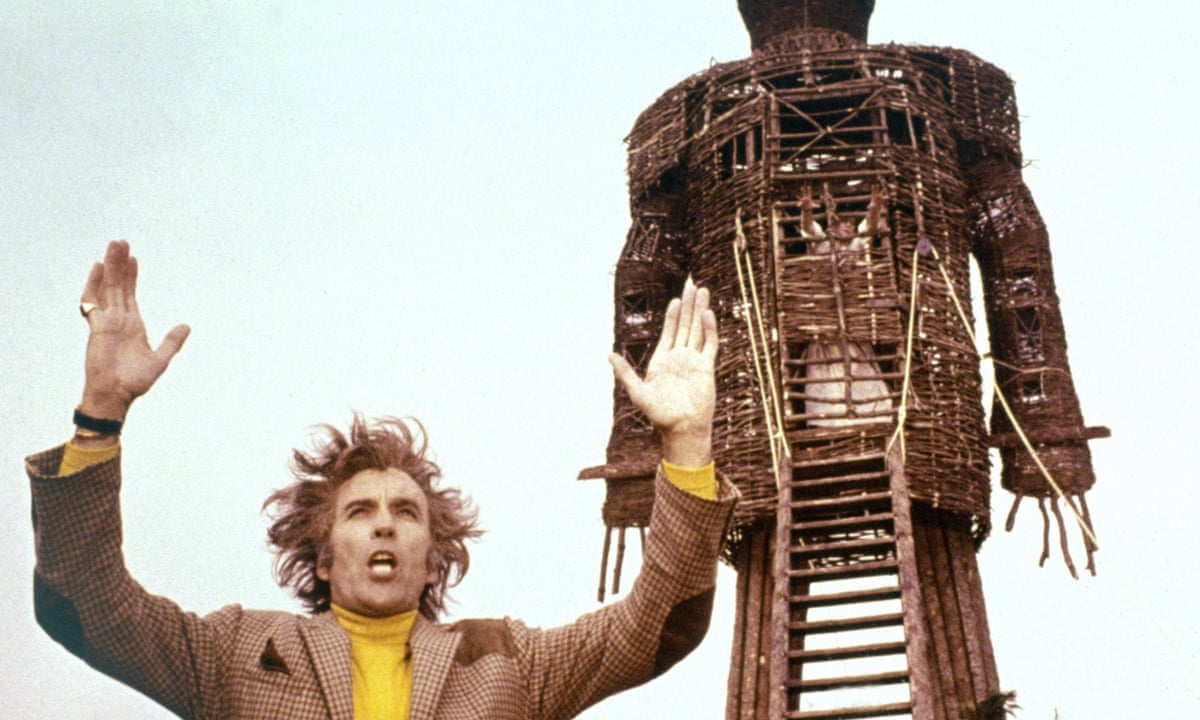
For a certain (younger) generation, The Wicker Man is primarily associated with the gloriously meme-friendly image of Nicolas Cage, regaling us with one his Nicolas Cagier performances as he has the most memorable on-screen reaction to bees since the climax of My Girl. That, of course, is the (much disliked and quite inferior) 2006 remake of a 1973 classic, an original whose production and release history is almost as insane as Cage’s acting in the new version.
Put simply, the original Wicker Man is the horror version of Blade Runner, with multiple versions circulating over the years (although, unlike with Ridley Scott’s sci-fi opus, none of them are exactly as the director originally intended). It is also not dissimilar to The Devils, which I have previously written about on this very site: another landmark in British genre cinema, savagely mistreated by the people in charge of sharing it with the world. As far as Ken Russell’s religiously charged masterwork is concerned, a fully restored version of the original cut exists, but is unlikely to see the light of day again (it was briefly screened in UK cinemas before Russell passed away) because Warner Bros., who own the rights, flat out despise the film.
The Wicker Man, on the other hand, has no surviving print of its initial version: if Alex Cox is to be believed, the original negative is buried under a highway (or rather, it’s part of the pylons that support the M4 Motorway, running from London to southwest Wales). And that’s just one of many bizarre events surrounding Robin Hardy’s exquisite and unsettling portrait of Scottish paganism investigated by the police. The film was rushed into production because the studio behind it, British Lion Films, was under new ownership and the man in charge had to prove he wasn’t asset-stripping the company. Due to the studio’s financial troubles, the budget was fairly low, with many people involved reportedly working for free. This group included none other than Christopher Lee, who became the film’s greatest champion.
Lee, who agreed to play cult leader Lord Summerisle simply because he liked the material, loved the film so much (he considered it the best project he’d ever worked on) he went out of his way to get it noticed: when British Lion, again under new ownership, refused to host a press screening, the actor got in touch with every UK critic he knew and talked them into seeing the movie (he even offered to pay for their tickets, but that proved unnecessary). And when it arrived in the US, he paid for his own trip to promote the film as much as possible.

Of course, by that point it was no longer the film Hardy had envisioned: Michael Deeley (who later also worked on Blade Runner, funnily enough), who had acquired British Lion and supposedly didn’t care much for The Wicker Man, requested certain edits for length and also suggested a happier ending, an idea that was immediately shot down. Trimmed from 100-plus minutes to 87, the movie was reduced to the second half of a double bill with Don’t Look Now, although that may have contributed to its cult status.
Unbeknownst to Deeley, however, Hardy had sent a copy to Roger Corman for advice on how to release it Stateside, and while Warner Bros. ended up picking up distribution rights in North America, Corman retained the print he had received, which was 99 minutes long and served as the basis for a restoration carried out in 1979. By the time the first DVD release was put together in 2001, with the UK rights now belonging to StudioCanal, that print was no longer accounted for, and various sources had to be used to complete the so-called Director’s Cut, which is still missing a few scenes. In 2013, the Final Cut was released, a moniker that is quite ironic since it’s still not the complete version (and, amusingly, almost ten minutes shorter than the Director’s Cut).
The Final Cut was restored in 4K for the 50th anniversary and screened in various locations in the UK and elsewhere (I was able to attend a midnight screening at the Cinema Ritrovato festival in Italy, an event devoted to restored and rediscovered films). It remains a slightly frustrating viewing experience, even in 4K: because of the differing quality of the source materials for the various restorations, the visual discrepancy between some of the reinstated material (particularly the pre-credits sequence showing Sergeant Howie on the mainland before he leaves for Summerisle) and the rest of the movie is evident, at times even a bit jarring.
And yet, that is perhaps the perfect look for a story where two different worldviews collide and the protagonist’s notion of reality and faith is challenged at every turn, with a climax that is perhaps the image of the film itself, torn asunder by people who thought they knew better. And no, I don’t mean whoever approved “Not the bees!” three decades later.
“The Wicker Man” is streaming on Tubi and Pluto TV. It was also recently released on 4K UHD Blu-ray.