David Lynch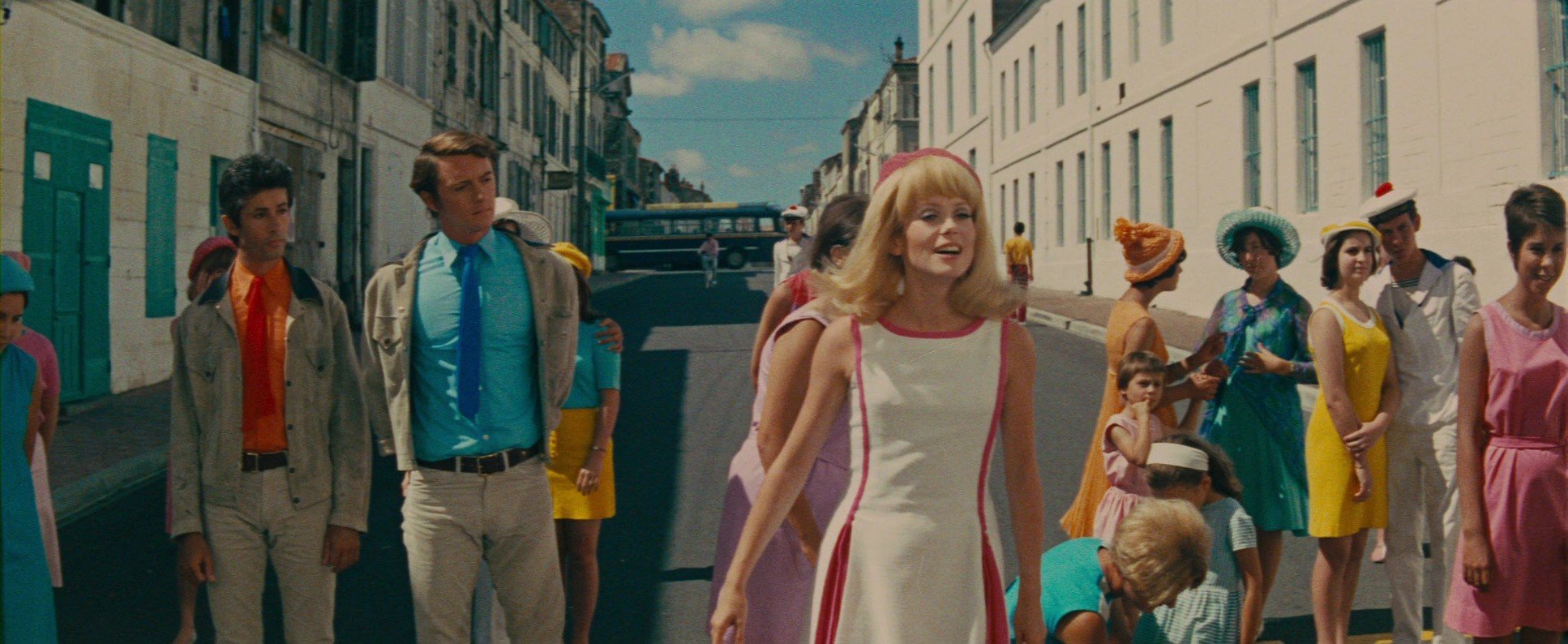
When you walk through the city streets of Jacques Demy’s imagination, it isn’t speeding cars and businessmen with noses buried in newspapers that one must watch out for. It’s smile-plastered strangers somersaulting on sidewalks, twisting off brick walls, hopping off windowsills.
That’s what we see in a sequence midway through Demy’s 1967 blast of Technicolor comfort, The Young Girls of Rochefort. Catherine Deneuve’s Delphine doesn’t just stroll on through it all; she surrenders to the freewheeling euphoria, intermittently entering and exiting flashes of dance with neighbors she may or may not know, giving in for moments at a time to the limitless possibility that forms the foundations of Demy’s vision of the French harbor city.
Even with all its carefully choreographed exuberance, the scene is rather casual compared to what precedes and follows, points in the story where song hastens along narrative development. Yet the images of Delphine’s simple walk across town are otherworldly in their optimism, and define how the embrace of life’s spontaneity is made thrilling, seamless, and communal in The Young Girls. Even the costuming emphasizes the delights of the collective; individual outfits pop with a single color, but they form a living rainbow when those wearing them are moving in sync with each other.
Paradoxically, that embrace of togetherness makes the scene, and the entire film, a particularly sobering one to watch in 2020, as we’ve turned to technology to replicate social experiences while a virus rages outside. Demy’s fourth movie – after Lola (1961), The Bay of Angels (1963), and The Umbrellas of Cherbourg (1964) – is a joyful musical in which casual interaction drives a sneakily labyrinthian story, a drama where lovers are united and reunited, and where every chance encounter bursts with possibility. Nearly every primary player crosses paths at some point, heightening the deadline-driven drama; The Young Girls of Rochefort might be easy to dismiss for its convenience of plot if Demy wasn’t so clearly romanticizing it.
In other words, it’s a fairy tale, one of the impossible not only made possible, but very much probable. But now, when chance encounter and communal experience is temporarily impossible, The Young Girls of Rochefort hews closer to pure fantasy. Its sense of shameless unguardedness plays like a cinematic ecstasy, at a moment in time when unguarded is something we can’t afford to be. And so Demy’s images are something to aspire to.
Movies have a cheeky way of showing what we’re missing out on. The medium is a mirror as much an escapist life raft, after all. And while the bureaucratic ineptitude and omnipresent possibility of cataclysm of the COVID-19 era have recontextualized many of the movies we thought we were so intimately familiar with, it wasn’t until a revisit of The Young Girls of Rochefort that I found myself confronting my internalized response to a pandemic. All the doing-nothing, going-nowhere, and seeing-no-one that has affected all our lives suddenly felt more acute.

Demy’s film endures because of the catharsis that balances out the early stages of his filmography, after the melancholy of Cherbourg and the prickliness of Bay of Angels. But it’s easy to forget that the film is just as much – and perhaps more – about things desired as things found.
Consider our introduction to the titular young girls. Launching themselves into that euphoric autobiographical number, we begin to understand what they’d rather be doing than leading classes for young(er) boys and girls. “Teaching piano is making me turn pale, I’ve had it up to here with the sound of bad scales,” sings Solange (Françoise Dorléac). “I’m bored of these provincial ways, it’s Paris for me where art really pays.” Delphine, meanwhile, dreams of being in Paris’s Opera Ballet. They’re both, as they lyricize, “ready to rhapsodize” (preferably, somewhere other than Rochefort, where they’ve been all their lives). The sight of the just-arrived carnies in the town square sparks their lust for freedom.
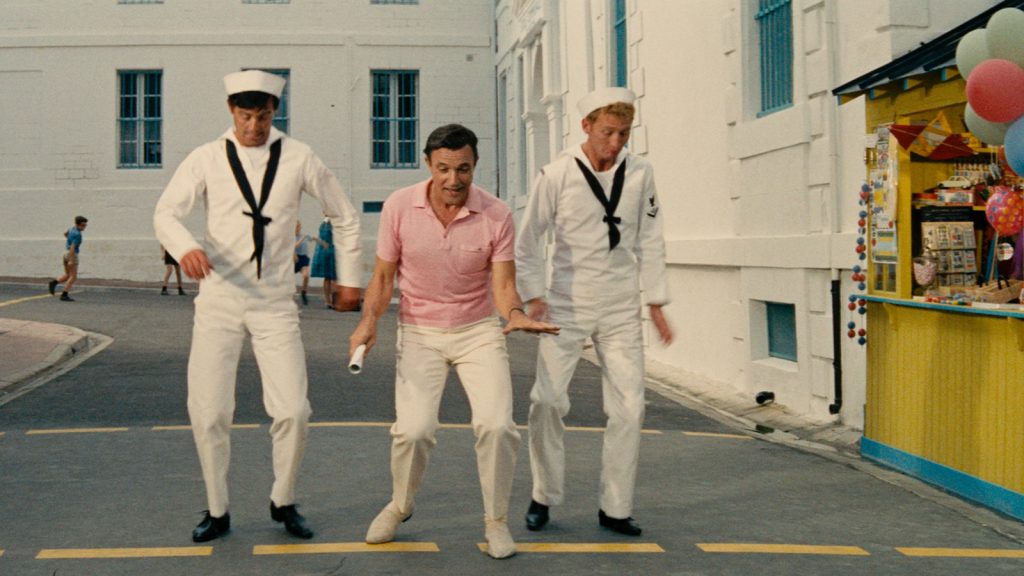
Demy makes clear that those desires are worth attaining. Another early number finds two carnies, George Chakiris’s Etienne and Grover Dale’s Bill, singing of freedom’s delights in the cafe. “We go from town to town, the future’s an unknown; a pretty girl lends a hand, and life is grand,” they croon, unaware that they’ll soon have to look for fill-in performers when two of their crew (and their romantic flings) head off with some sailors.
But that’s to come later; for now, their words about living every moment seemingly without consequence is the kind of stuff we’re aching for during the pandemic. “Our life’s a romance, a melody composed by chance” is a sentiment that stands in stark relief in a time when we can’t take any chances.
Meanwhile, there’s a reason one of the film’s most melancholy tunes is the sailor Maxance’s (Jacques Perrin) lament of desire, especially when contrasted against the duets of the young girls and carnie boys. A man who, like Delphine and Solange, is more preoccupied with what life could be than what it currently is, Maxence sings of searching for his “feminine ideal,” the true love he can envision in his art but hasn’t yet spotted on the street. He also turns the cafe into a stage, giving voice to his longing of a “Botticelli beauty with such eyes, such poise,” of a girl whose “hair pours down her brow like torrents of pure gold.”
“She is my only love, but what good is a dream?” he goes on. “I’ve searched all over, but she’s nowhere to be seen.” Perrin’s entrenched loneliness makes the performance, and the slightest hint of a smile proves Maxence is invested in his search.
Every character is searching for something. We live in a time of searching and escape as well, though it’s out of a need for normalization. The difference is, unlike the denizens in Rochefort, we’re prevented from acting on it by an invisible force. Liberation is something we can only look for in a world safe enough to compel our exploration of it, which makes the casual run-ins of Demy’s movie even more entrancing, especially as the encounters bloom into desires realized. These days, we’re more invested in staying away from those we don’t know than mingling with them.
And if we were worried that Demy wouldn’t provide us with an antithesis to that active exploration he so adores, he provides it in the form of Yvonne, who laments that she’s “confined to the aquarium” of her cafe. Now, more than ever, we know how she feels.
The carnival scenes belie another level of disconnect, images of revelers made eerie because we now associate large gatherings with petri dishes for disease. Who’s to say how long that will last? Demy’s camera flies over various dance numbers, allowing us to soak in the excitement while unaware how strange the scene would be to behold a few decades later. If there’s an antagonist in Rochefort, it’s geographical or emotional stasis. Characters triumph by breaking out of it, by running or dancing or stumbling into each other. Mutual needs and wants are met, new paths are opened. Was there ever a more romantic line uttered than “Take me, I want to see Paris!” as Josette proclaims in closing minutes?
If there’s one thing to take away from the movie in 2020, it’s that life can only be as exciting and as propulsive as those we run into, when we least expect to. At the very least, that gives us something to look forward to; a balm for the uncertainty, now made even more potent. “We’re not going to rot here,” Solange insists to Delphine early on. If we can help it, neither are we.