Jason Bailey
Justin Kurzel’s True History of the Kelly Gang opens with a title insisting, “Nothing you’re about to see is true,” even though “true history” is right there in the title; moments later, in a voice-over of the memoir he’s writing for his child, the protagonist announces what he’s written shall “contain no single lie.” So it’s clear from the opening minutes that although the subject of Kurzel’s film is Ned Kelly, the notorious Australian outlaw, what it’s really about is the very idea of “truth,” and the inherent contradictions of claiming to tell it. Kelly’s story has been told before, in books and paintings and murder ballads and in several previous films; if you’d like some idea of his cultural cache, the two most noteworthy of those films cast Mick Jagger and Heath Ledger in the role.
But Kurzel’s film doesn’t feel loaded down with all that cultural baggage; it has the ephemeral quality of family legends, of offhand stories that become more elaborate and grotesque with each new telling. The blood-soaked mythos of Ned Kelly originate in the Australian Bush in the late 19th century, where the young man was surrounded by so much everyday brutality and unapologetic crime that when he finally tumbled into a life of crime himself, it sort of seemed like an inevitability. (One of the neat tricks of Shaun Grant’s screenplay, adapted from Peter Carey’s novel, is how it carefully situates the character into the general hedonism of the time and place without making excuses for him.)
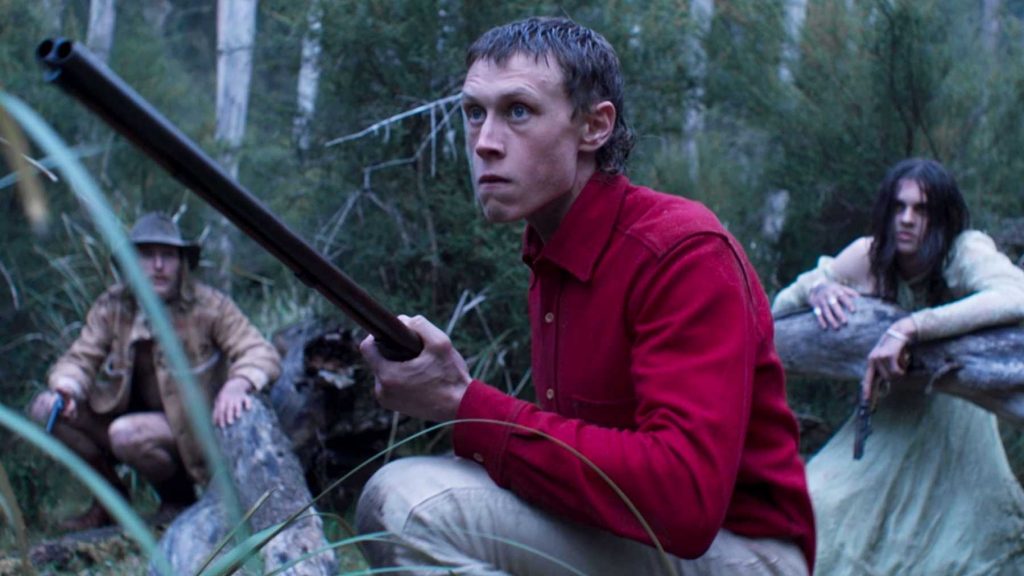
“That’s the business, mate,” his first teacher informs him. “That’s what we do.” Yet Ned Kelly takes it further, even than the (to put it mildly) colorful personalities that surround him; he crosses his criminal activities with a theatrical flamboyance and sense of nihilism that feels closer, by the third act, to full-blown madness. George MacKay (from 1917), who plays the role, doesn’t quite pull it off; he gets the character’s early hesitancy and later insanity, but he blows through the transition. It’s a two-part performance that needs a few steps in the middle.
But he’s chilling in those final scenes, and the supporting cast is absurdly good. Essie Davis, so tremendous in The Babadook, is unsettling here as another mother who’s a bit of a piece of work; Jojo Rabbit’s Thomasin McKenzie, in the film’s other important female role, is terrific (as usual). We also find Russell Crowe scurrying ever so closer to his natural, feral state: as a 21st century Orson Welles, rotund and extravagant, his folksy charm belying blood colder than ice water.

And as many a story of criminals does, True History gives us a “respectable” authority figure that is far more loathsome and reprehensible than the antihero, and thus lets the viewer off the hook for feeling empathy for the one that’s labeled the criminal. In this case, that’s Constable Fitzpatrick, brought to rather chilling life by Nicholas Hoult with the very specific sneer and gait of a man who’s used to doing whatever he likes, with no consequences.
This is director Kurzel’s first film since the unfortunate Assassin’s Creed, and it plays, in many ways, like a course correction for that big-budget studio video game adaptation. This is the opposite: a proudly provincial and personal, idiosyncratic and uncomfortable work of art. The filmmaking crackles; Ari Wegner’s camera glides over those vast Outback landscapes, and editor Nick Fenton keeps finding clever ways to sneak from one scene into the next. (The creeping, mischievous score is by Kurzel’s brother Jed.) The style is flashy, but it fits; too often such flair distances, but here, somehow it immerses. It probably helps that the violence is so brutal and unforgiving. Kurzel has a way of framing and cutting these shoot-outs and attacks that leans into their messiness and uncertainty, and as a result, they’re genuinely startling – neither fun nor thrilling, just scary as hell.
And they’re accumulating to something. Midway through, before Kelly takes that turn, he is unable to pull the trigger on the lawman, and his mother bellows to the heavens, “ARE THERE NO MEN OF SUBSTANCE IN THIS GODFORSAKEN COUNTRY??” It’s a dramatic gesture, yet one that speaks, with crystalline clarity, to the psychology of so many crime films, and so much of criminal life as well. And thus, by the time True History of the Kelly Gang, and Ned Kelly himself, comes to its bitter end, there’s nothing romantic or glamorous about it; it seems doomed to happen eventually, the doomsday conclusion of a life that’s bloody and painful and ultimately pointless. It makes for riveting viewing, though. 
B+
“True History of the Kelly Gang” is out Friday on demand.