Zach Vasquez
When Joe Don Baker passed away this May at the age of 89, the American cinema lost one of its last great tough guy actors. At 6’2, with his brick shithouse frame, off-kilter handsomeness, and Texas drawl, Baker was destined for the screen. Luckily for him, he came about at exactly the right time, making his big screen debut in 1967’s Cool Hand Luke before becoming a regular fixture of film and television over the coming decades.
Today, he is remembered as one of the character actor greats, imbuing the expected parts for a man of his stature—cops and thugs, soldiers and military brass, jocks and country bumpkins—with an air of charming amorality that made them instantly memorable.
But during the first half of his career, he had a short run as a leading man, mostly in exploitation pictures. One role in particular stands head and shoulders above the rest: his turn as doomed Tennessee lawman Buford Pusser in the 1973 true crime thriller Walking Tall.
There is a meme across social media that will use a picture of a fictional character and ask ‘Name a Character Who Went Through More Pain Than Her’. Annoying as it is, every time I see it, I can’t help but think of Buford Pusser.
A former Marine and professional wrestler in the Mid-Atlantic territories (where he performed under the name Buford the Bull), Pusser moved home to Adamsville, Tennessee in 1962 and was elected Sheriff of McNairy County following the sudden automobile death of the previous Sheriff that year (a scene that, in the fictionalized account, Pusser causes in self-defense). During his two-year tenure on the job, he waged a public war against vice—gambling, prostitution, moonshining—taking on the Dixie Mafia and State Line Mob. Known for taking the advice of Teddy Roosevelt (”walk softly and carry a big stick”) literally, Pusser carried around a giant stick which he used to smash up illegal stills, brothels and casinos.
During his short tenure, he was shot seven times (including in the face), stabbed seven times, and saw his wife murdered during a roadside assassination attempt. He suffered backlash as a result of the fame the first Walking Tall movie brought him, losing his bid for re–election in 1972, although he was elected Constable after that. He died in 1974 at the age of 36 in a car accident, the likely result of drunk driving, although conspiracy theories persist that it was an act of sabotage by one of his many enemies.
This all plays out over course of Walking Tall, as well as its two sequels Walking Tall Part 2 (1975) and Walking Tall: The Final Chapter (1977), although major liberties are taken with his story. The film version of Pusser is more humble in his origins—in real life he was the son of a former sheriff, but in the movie his father is a farmer and logger—and far more Christlike in his crusade and his suffering. In the film, he only runs for Sheriff after taking down mobsters who cheated him in dice and nearly murdered him when he exposed them (the scene of Baker absolute demolishing the gambling den, as well as the bodies of the thugs that try to stop him, with his giant hickory stick remains the most iconic across the series).
The Pusser of the film is presented as entirely justified in his actions, no matter how brutal or self-aggrandizing, although one character does scoff that he’s turned himself into a living folk hero, a la Paul Bunyan. His cause is simply too righteous, he has no choice but to dedicate himself to it, even as it continually puts himself and his family in danger.
Said danger is presented as a full-on conspiracy, the local criminal syndicate holding seemingly daily meetings about how best to rid themselves of this meddling Sheriff. This gets even more ridiculous in the subsequent sequels, where the head mobster spends all of his time thinking up plans to murder Pusser, only for him to duck them each time (up until that final, fateful car ride). The Walking Tall movies at times feel less like Dixiefied versions of the movies it was clearly inspired by—The French Connection and Dirty Harry—than dour, country bumpkin versions of the James Bond series (appropriate, considering Baker would go on to play two entirely different characters across two separate iterations of Bond).
This being a ‘70s cop movie, there’s plenty of blame directed at liberal judges and laws too, with the movie presenting the newly cemented Miranda rights as just as bulwark against peace and justice as the vicious gangsters terrorizing the honest townsfolk. On the other hand, Pusser is also presented as a progressive when it comes to race, his best friend being a Black civil rights activist who he eventually brings onto the force as the first Black deputy in the county. (In the sequel, this character will end up collateral damage in another assassination attempt against Pusser, natch.)
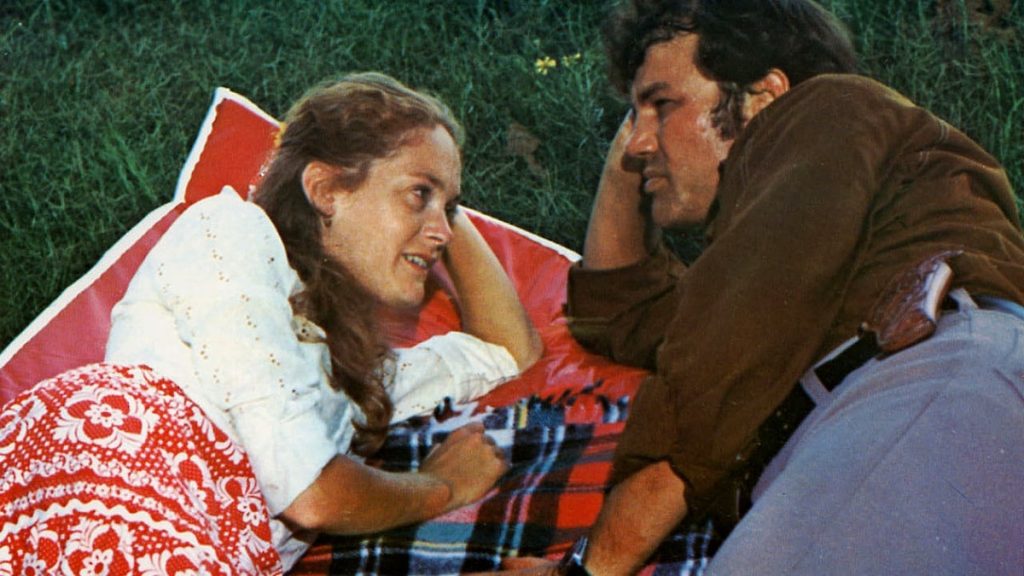
While less ideologically shaky than the Dirty Harry movies, Walking Tall is still very much a reactionary and authoritarian film. It is also, as with so many cop/vigilante movies of its day, completely awesome. Much of that is due to Baker, who has never been more physically imposing than he is here—his stick-led rampages are legitimately frightening—and yet, he’s truly tender during the scenes with his wife and young children. The film was a massive hit in its day, earning over $40 million off a $500,000 budget. It was Baker’s breakthrough performance, and it’s a shame he wasn’t able to parlay it into a few more leading man turns (although he did headline a couple other films, some more notorious than others).
Credit must also be paid to director Phil Karlson. An Old Hollywood veteran best known for his work in film noir, most notably the shockingly harsh (for its time) The Phenix City Story—another true crime account of a crusading lawman who took on the Southern mob only to be assassinated by them—Karlson doesn’t exhibit the viscerality of the young turks of New Hollywood, and is not as masterful at tone and tension as his peer Don Siegel. But he brings a real sense of gravitas to the material, both in its softer, pastoral moments focusing on familial drama, and then especially the bursts of brutality throughout. Walking Tall is by no means a Peckinpah-like bloodbath, but the violence within it is unnervingly tangible.
This is something that’s missing from the two sequels, along with the presence of Baker and Karlson (though they would reteam in 1975 for Karlson’s final picture, Framed). Bo Svenson, another star of ‘70s genre cinema, stepped into the big boots of Buford Pusser, and while he makes for an imposing giant and square-jawed hero, he’s missing that dangerous glint in his eye that Baker had. The Walking Tall sequels are decent action-crime dramas and fascinating in their own right—especially as they wrap around to the creation of the first film, becoming a meta-commentary on the series as a whole—but they never live up to the first film. (The less said about the subsequent TV movie, starring Brian Denehy, short lived TV show, and especially the modern day remakes with The Rock or, god help us, Kevin Sorbo, the better).
As with so many genre films and figures from the ‘70s, Walking Tall and Baker have constantly been talked up by Quentin Tarantino (much of Leonardo Dicaprio’s performance in Once Upon a Time in Hollywood was inspired by Baker’s turn as the antagonist in the Western series Lancer). In the case of the former, this has ensured the film remains a cult classic amongst a certain demographic of film nerds, even as the legend of Buford Pusser has receded from the larger public consciousness.
Baker, meanwhile, was a regular presence onscreen up to 2012, when he gave his final performance in the critically acclaimed Southern gothic drama Mud. While not a household name at the time of passing 13 years later, he was very much one of those “that guy” actors that all moviegoers prior to Gen Z immediately recognize.
But for those who have seen the real Walking Tall, he was much more than “that guy.” He was Buford Pusser.
“Walking Tall” is streaming on Plex and available for digital rental or purchase.