Sara Batkie
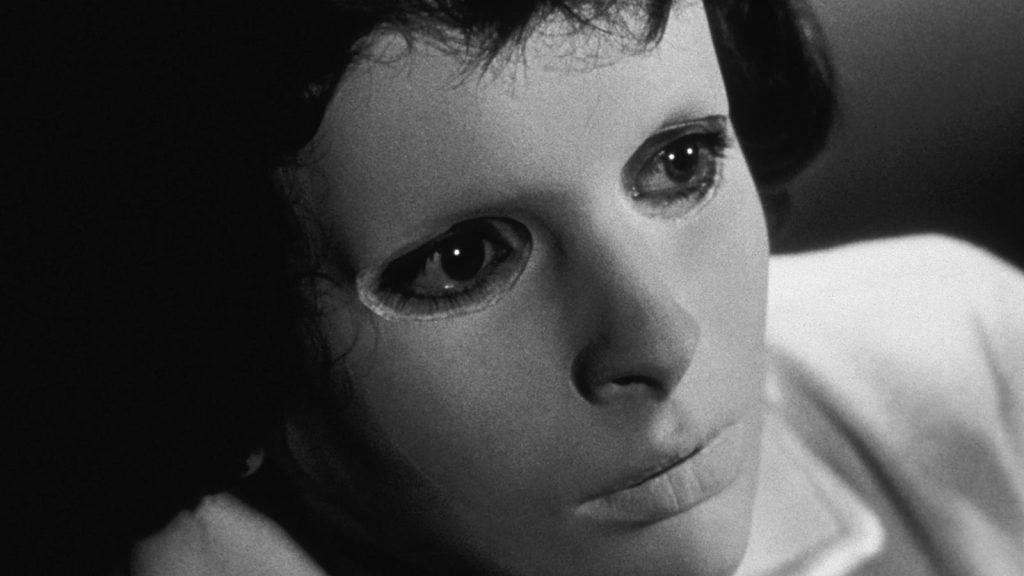
Walk into any Halloween store and the masks of cinematic serial killers will be ubiquitous. There’s the blank slate of Michael Myers and the gnarly sutures of Leatherface. There’s the hangdog ghostface from the Scream series. All are distinctive and nightmarish in their own right, but one that’s never made the leap to tie-in merchandising is arguably the most eerie: the featureless plastic replica from 1960’s Eyes Without a Face. The most obvious reason is that memorabilia from a cult French-language film isn’t as likely to turn profits as something from a multimillion dollar franchise. Another might be that – as color photos of the black and white production demonstrate – it’s a concept that doesn’t really work visually beyond the dreamy hermetic seal of the film. Or maybe it has something to do with the fact that it’s worn not by the villain but one of his living victims.
Director Georges Franju once described Eyes as “horror in homeopathic doses,” which suggests someone who isn’t particularly interested in the tropes of the then-nascent genre. The film bears that out from the beginning: the opening credits unspool over footage that seems to be taken from a car traveling along a darkened road. But the view we get is backward, as if recorded by someone facing the wrong way on a train. We pass by the spindly tree branches as if evading their grasp. Meanwhile the tinkly score, which sounds a bit like a carousel in the process of breaking down, augments the oddness of what we see, even before the anxious woman driving the car dumps a body in a nearby river.
Hollywood horror often gooses similar tension from such mysterious preambles, but Franju paces Eyes with a much more stately and mournful rhythm, more comparable to Nosferatu than Dracula. It’s almost twenty minutes – in a film that runs only ninety – before we even see Christiane, the girl afflicted with the titular condition, played by Edith Scob. In the meantime, we’re introduced to her father, the well-regarded Dr. Génessier (an imperious Pierre Brasseur), giving a lecture on the “heterograft,” an experimental procedure he believes will alter the course of medical history. He is then called in to identify the body we saw dumped earlier as his missing daughter. This, along with almost everything about him, will soon be revealed as a lie.
Instead Christiane has been stowed away in her father’s isolated mansion in the wooded Parisian suburbs, where the ubiquitous sound of barking dogs intensifies the ominous atmosphere. She was disfigured in a car accident that her father caused and is forced by him and his secretary Louise (Alida Valli, in perhaps the film’s trickiest role) to wear a white mask to conceal her injuries, leaving only her anguished eyes visible. Mirrors, so often deployed in the horror genre to build unease, have been entirely removed or covered up so she can’t see her face. Bereft at the loss of her old self, Christiane wanders her surroundings like a ghost haunting its own life.
Meanwhile Louise is regularly deployed to the city to befriend and lure young women with similar facial features to the Génessier estate. It’s then that Eyes’ true horror bonafides become evident: the doctor has made it his mission to successfully transplant another girl’s facial tissue onto his daughter’s, thus allowing her to regain the existence she deserves. His methodical attempts at the operation are captured in unstinting detail, something Franju got around the French censors by ironically not including too much blood. Here again he subverts the expected conventions of the genre: the nearly ten-minute sequence unfolds with no music at all, heightening the queasy repetition of Génessier’s calls for forceps and his increasingly labored breathing. Tight framing is also employed, but while most horror directors use the technique to exploit negative space, Franju wants to draw out the emotional responses of the characters rather than stoking a physical reaction in the audience. By focusing on the sweat building up on Génessier’s brow and the exchanges of glances between him and Louise, he elevates the scene from the merely brutal to a kind of hysterical poetry. It’s more Cocteau than Cronenberg.
Eyes further distinguishes itself from its genre contemporaries by its refusal to condemn its antagonist, or even to unequivocally portray him as evil. There is more than a little grandiosity and self-aggrandizement in Génessier’s solution to his guilt over his daughter’s suffering, and his complete lack of remorse for the fate of the young women he kidnaps and mutilates is troubling to say the least. But there’s also something deeply human in his single-minded pursuit of a cure. It’s this certainty that he will prevail in an illogical and capricious world that makes him vulnerable. Christiane will eventually become an angel of vengeance, but Franju leaves us with no clear resolution to her sad tale. Last seen wandering the murky woods near the estate, she’s as much lost as found.
To say Eyes had a mixed reception would be an understatement. Seven audience members reportedly fainted during its premiere at the Edinburgh Film Festival. One critic for The Spectator called it, “the sickest film since I started film criticism.” The English Monthly Film Bulletin deemed Franju’s direction “inept.” In America, the film was edited, dubbed, re-titled The Horror Chamber of Dr. Faustus, and released on a double-bill with something called The Manster. But it’s been reclaimed in the years since and influenced directors as diverse as Pedro Almodóvar and John Woo. Such longevity suggests that its interrogation of our obsession with identity remains potent, along with its insistence that beauty is never merely a superficial quality, or one easily replicated once it’s gone. That’s a good thing. Some masks conceal a monster. Some, in the space between the seams, reveal a soul.
“Eyes Without a Face” is streaming on the Criterion Channel and Max.