Jason Bailey
Sometimes you stumble upon a contemporaneous review of a film we’ve all agreed is a classic, and the incongruity can blow your hair back. For instance, while prepping to write about “The Magnificent Seven” – newly streaming on Amazon Prime Video – I stumbled upon Howard Thompson’s New York Times review, circa November 1960, which dismissed the picture as “pallid, pretentious and overlong,” criticized director John Sturges’s “stately, overly detailed direction,” snickered at the “philosophical talk on all sides,” and “easy clichés,” and merely granted that such supporting players as Steve McQueen, Robert Vaughn, and James Coburn “are okay.” (Steve McQueen! “Okay!” Imagine!)
It’s easy to work yourself into a lather about these things (okay, it’s easy for me to work myself into a lather), but it’s also, I suppose, important to remember the breathtaking volume of big-screen Westerns around 1960 – and how truly special one had to be to stand out to a critic who might have been exhausted by them. Then again, The Magnificent Seven is pretty special, a film that, yes, embraces clichés, but does so with wit and style, and with one of the best ensemble casts of the era.
As even the casual classics fan knows, and as the opening credits admit, “This picture is based on the Japanese film ‘Seven Samurai,’ Toho Company Ltd.” The setting has shifted, halfway around the world and three hundred years later, but the bare bones of the story remain: a small Mexican farming village is regularly looted for food and supplies by a band of banditos, led by the ruthless Calvera (an unfortunately brown-faced Eli Wallach). The farmers are powerless and terrified, but they must defend themselves, so three of the village leaders take their meager funds and head off to a border town to buy some guns.
But they soon realize that their funds are better spent hiring gunmen, so they do that, with the help of man in black Chris Adams (Yul Brenner). He rounds up a crew, heist movie style, of tough guys with varying skills; once assembled, they hit the trail, accompanied by Elmer Bernstein’s soaring main theme. They have two jobs in the village: to defend it and to teach its residents to defend themselves, and there’s a wonderful training sequence (again, expertly scored by Bernstein) as they show these farmers how to cock, aim, and squeeze.
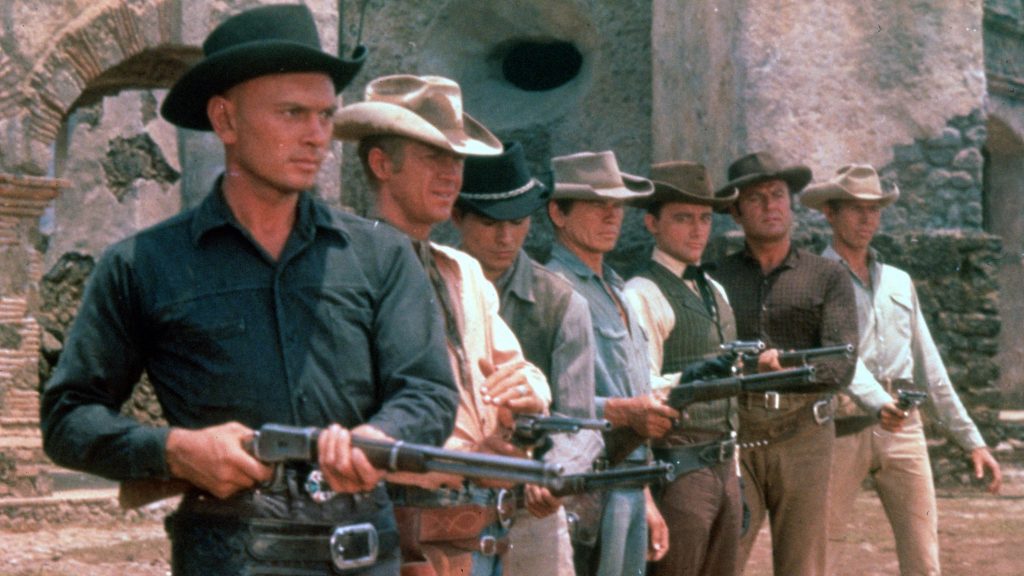
What’s most striking about The Magnificent Seven – and what, in retrospect, it absolutely had to get right – is the equilibrium of the ensemble. Brenner is frankly a bit baffling at first; it’s such a peculiar bit of casting, to put his gait and his speech, so inescapably regal, into the character of a cowboy. (A friend not-too-casually mentions that he’s a Cajun, which I guess is meant to at least explain his clipped speech). Yet the slight air of the outsider works in the narrative’s favor, and that regal quality gives him a firm authority, even when the others waver. (When Calvera scoffs, “How many of you did they hire?” and he confidently replies “Enough,” well, that shuts that guy down, and quick.)
More importantly, his formality contrasts nicely with McQueen’s offhand charisma and naturalistic line readings; Brenner moves deliberately, and effectively, but there’s something just as pointed about the way McQueen casually moves his hand around his belt as the banditos surround him. They’re different guys, and have occasional disagreements, but they’re fundamentally in the same business, which is why their first scene together, making casual business chat as they ride into a hostile mob, is so funny (“New in town?” “Yeah.” “Where you from?” “Dodge. You?” “Tombstone.”) The entire crew is well cast and on point – Coburn, cool as cumber, and Charles Bronson, looking (dare I say) young and handsome, are the standouts – and Bert Henricksen’s marvelously specific costume choices underscore their personalities, with Brenner in form-fitting black, McQueen in casual duds, Bronson in dirty denim, and Robert Vaughn resplendent in his vests and black gloves.
Screenwriter William Roberts isn’t just adapting and interpolating, but he’s certainly lucky to work with such a well-built narrative; we know they’ll prevail, but they’re backed into seemingly inescapable corners, and head into the big final battle with mighty long odds, so we’re invested in how they’ll overcome them. (There’s real wit in the dialogue too, particularly for Wallach’s colorful villain, who growls dastardly pronouncements like, “If God didn’t want them sheared, he wouldn’t have made them sheep.”) And Sturges, who’d been directing Westerns since 1949’s The Walking Hills, adeptly juggles the potentially messy choreography of the big group sequences, whether they’re action or just dialogue, and moves his camera elegantly when the shooting starts. It’s a thrilling movie – no matter what those old fuddy-duddies at the Times thought. 
“The Magnificent Seven” is now streaming on Amazon Prime Video.