Craig J. Clark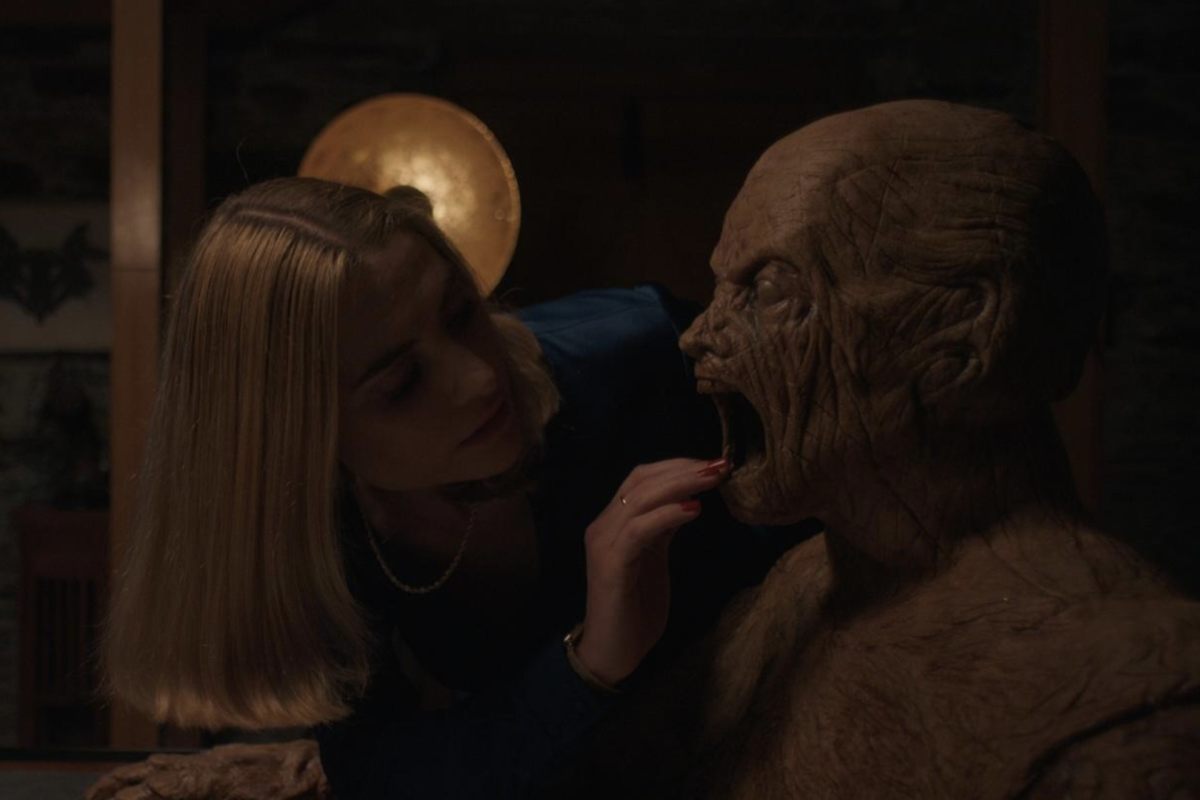
With only two features on his CV, writer-director Damian Mc Carthy has already shown himself to be a keen practitioner of the art of slow-burn psychological horror. Viewed from a certain, well-chosen angle, 2020’s Caveat and this year’s Oddity – now streaming on Shudder – are parlor tricks, with Mc Carthy the skilled magician employing misdirection to prevent the viewer from guessing how he’s pulling them off.
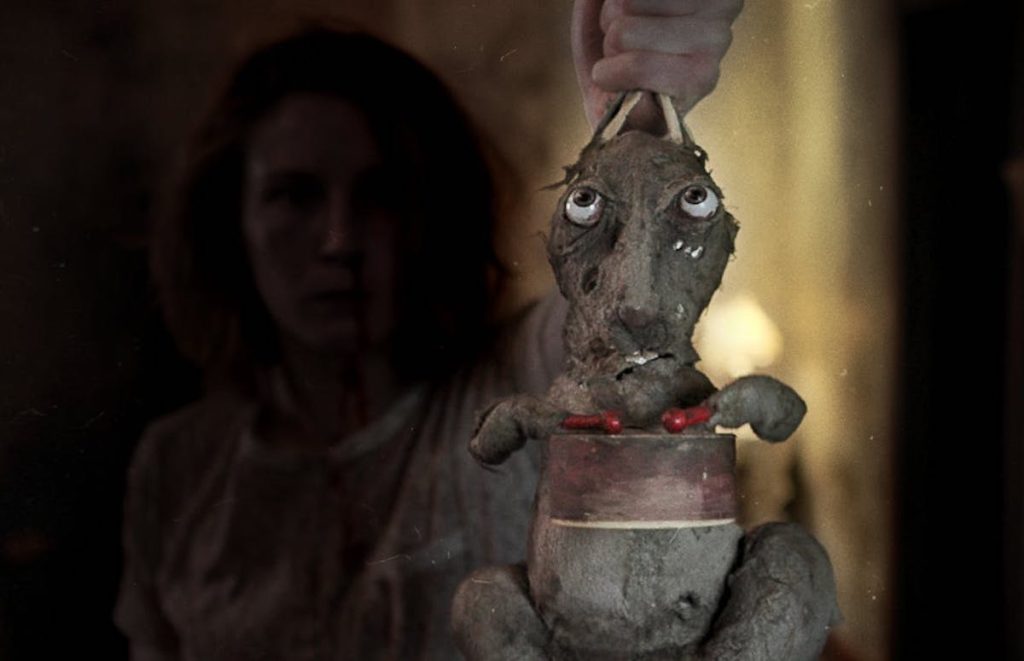
Both films open with an unsettling scene that sets the tone for what’s to come. In Caveat, a dazed-looking woman with a bloody nose explores a dimly lit basement, holding out a stuffed rabbit toy that periodically beats on a drum, leading her to a wall she cuts a hole into. Mc Carthy doesn’t show what she sees right away, but instead performs a match cut to a man with a heavy beard looking through a circular window. This is Isaac, who accepts the job of “babysitting” the woman, whose name is Olga and who is uncharitably described as having “some psychological problems” by her uncle. Naturally, he waits to tell Isaac about some of the other conditions of the job (like the fact that the run-down house where Olga is staying is on an island) until it’s too late to say no.
A similar dynamic is at work in Oddity, which is also primarily set in an isolated house. (Mc Carthy wrote the script with the location in mind since it’s where the sets for Caveat were built.) An unusual structure with an enclosed courtyard (revealed by drone shot), all seems well enough in the daylight hours while Dani (Carolyn Bracken) is doing some renovation work, which she takes a break from to call her husband Ted (Gwilum Lee), who works nights at a nearby mental hospital.
The mood changes after night falls, though, since the house has no power; she depends on an electric lantern to illuminate the tent where she sleeps and a flashlight for the rest of the mostly empty house. A frantic knock at the door brings her face to face with a drifter who warns her that someone else is inside with her. His glass eye and wild look doesn’t exactly scream “trustworthy,” but his insistence and seeming concern wears Dani down until she puts her hand on the key in the lock. As in Caveat, Mc Carthy cuts away before revealing what happens next, circling back to the scene (and the fatal consequences of Dani’s decision) later on.
This narrative strategy is common to both films, with Mc Carthy withholding key pieces of information from the viewer and/or his characters. In Caveat, this reflects Isaac’s fractured state of mind, since he suffers from memory loss following an accident the year before. A year has also passed in Oddity when Ted visits Dani’s twin sister Darcy (also played by Bracken), who doesn’t let her blindness prevent her from running Odello’s Oddities, the antiques store stocked with cursed objects she inherited from their mother (among other things, including the ability to “read” objects). Eager to get to the bottom of Dani’s death, which was blamed on the drifter with the glass eye, she turns one of Ted’s offhand comments into an invitation to dinner on its anniversary. This blindsides Ted and his new girlfriend Yana (Caroline Menton), who’s already uneasy about staying at the house while Ted is at work, and that’s even before Darcy produces another family heirloom – a full-size wooden man, its face contorted in mid-scream – sent by trunk ahead of her.
While scaling up from his first feature (apart from a few flashbacks, Caveat is essentially a three-hander that plays out in one location), Mc Carthy still limits Oddity’s main cast to six and confines the action to a handful of settings. He makes the most of them, though, especially Darcy’s shop, which is chock full of interesting bric-a-brac, but the back room is where she displays the most cursed items, including a hare with cymbals to match Caveat’s drummer. (When Ted asks if she has a problem with theft, Darcy replies with a knowing smile, “You’d be surprised how many stolen items are returned to me.”)
Mc Carthy does a great deal with the power of suggestion as well, employing off-screen sounds and letting the viewer divine what’s going on just out of frame, and limiting the characters’ field of vision so it’s impossible to know who (or what) might be lurking in the shadows. He also knows the value of a well-timed cut, with Oddity’s closing shot demonstrating that a jump scare is only as good as the buildup to it. That’s a lesson filmmakers who command colossal budgets could learn from this modest film – and one Mc Carthy would do well not to forget as he moves on to bigger projects.
“Oddity” and “Caveat” are both streaming on Shudder.