Julia Sirmons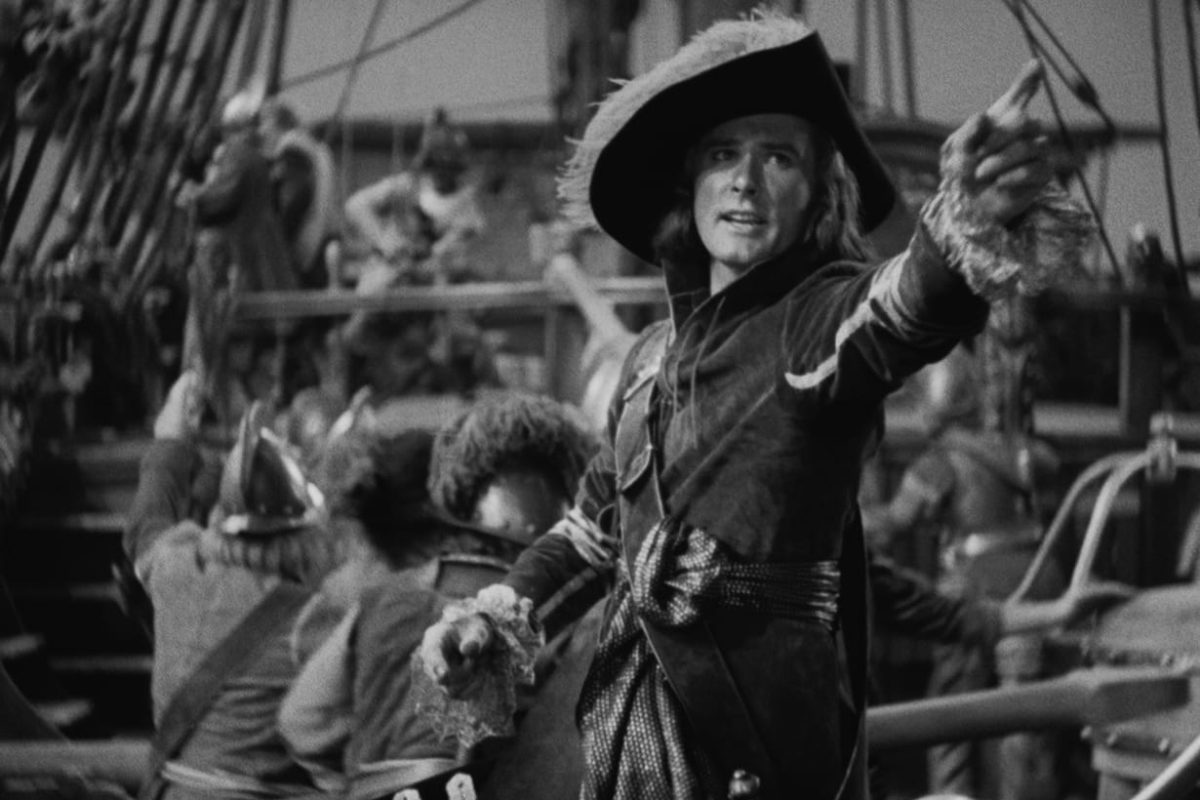
The title Captain Blood may conjure up a vague impression of an old-timey pirate flick, serving up some sea battles, sword fights, and winky charisma. It is undoubtedly a breezy romp that delivers on all those scores. But the film (which will be released in a 4K restoration by the Criterion Collection this week) is also something more complex and more pleasurable. Its arch wit can shift deftly into unexpected depth when considering weighty things like loyalty, liberty, and love.
The dashing captain is played by Errol Flynn, in his first outing as a Hollywood leading man. Whatever its other pleasures, the whole picture rests on the darts of his eyes and the flash of his smiles. Sure, he’s plenty handsome: he’s got the arched eyebrows and broad shoulders of a romance novel hero. He also has an appealing leanness and graceful strength. If his nose were a smidge smaller, he’d be just another pretty boy.
But like all the true stars, minor imperfections only add to the allure. And Flynn’s got things that hum and radiate from within. Keen intelligence surfaces when his eyes shift back and forth in a cool, bemused appraisal of sticky situations. Between his steel-cored goodness and a mere touch of impishness, Blood is something more than a preening swashbuckler. His upright, almost goofy demeanor forges a compelling arc that spans across the film’s two halves.
When we first meet Blood, he’s a doctor in 17th-century England whose loyalty to medical ethics leads to a wrongful conviction for treason. He strikes you as an affable man with his wits about him. Sex appeal is (slightly) muted in favor of his righteous defiance. Still, there are already glimpses of what Blood will become–who else could sound a bit cheeky when he’s reminding his elderly maid to water the geraniums?
The piracy itself doesn’t start until the second half; the first is an origin story about a noble, if sometimes saucy, man in search of justice as he battles to free himself from the enslavement he has been sentenced to. Yet his latent raffishness is waiting to surface. Blood likes subterfuge and playing games. So when he is more or less forced into piracy as he attempts to flee, it’s not a complete surprise that he takes to it like a duck to water. There is pleasure in watching the dominoes stack, and tracing Blood’s evolution.
Yet even after Blood takes to the sea, he evinces little of the louche, swaggery vibe of the pirates of lore. (For that, you get Basil Rathbone as Levasseur, Blood’s rival-turned-partner, who has cheesy-sleazy energy that is not without its charms.) Blood is hardly a simple lothario dreamboat. Beneath a thin veneer of swagger, he’s still a wholesome hero whose Wheaties-box-ness often borders on the goofy.
Captain Blood serves up the desired pleasures of the typical swashbuckler. There are extended, dynamic sea battles. There is also a breathtaking, graceful sword fight. But these elements hit harder because they are grounded in Blood’s fundamental goodness. He’s a thrillseeker and doesn’t mind the shiny perks of the job, but is fair with his crew, whom he loves as much as any proud Papa. He seduces with his virtue; it’s easy to see why this ragtag group will follow him anywhere. Director Michael Curtiz depicts Blood’s ascendance to the top of the pirate game with a montage of raids and battles. His face is superimposed over all the footage; he cheers his men on with jolly cries from jaunty angles. This is the way to tell the tale: it is his enthusiasm that keeps the ship running and keeps us watching him.

Blood is also hanging on to his shreds of nobility because he pines for Arabella (Olivia de Haviland), the woman he’s left behind. Only nineteen when Captain Blood was shot, de Haviland already knew how to shade her angelic luminosity with a fierce self-possession. On the strength of their chemistry here, she and Flynn would go on to star in seven more films together. But this doesn’t mean they fall easily into witty banter or are consumed by fire. Their romance is a knotty thing with roots. They meet in a, shall we say… provocative tableau. Arabella purchases him at a slave auction to spare him from hard labor. (Blood is a victim of what was once quaintly called “white slavery.” The film requires us to understand slavery as a pretext for questions of justice or sexual tension. The greater brutalities that Black victims of slavery surely suffered are kept out of frame.) The scene is provocatively perverse, and Curtiz doesn’t shy away from this, but the situation is still treated with the gravity it deserves. He is humiliated, and she is confused at his lack of gratitude. Later, Arabella’s moral qualms about loving a pirate are reasonable, even if we doubt they will last very long.
Of course, we know that the two will wind up together, and that coupling is achieved very hastily by a tendentious deus ex machina. But taking the long route to that happy ending adds unexpected richness to typical fluffy genre fare. The layers beneath the period trappings make Captain Blood urgent and alive, and well worth revisiting.