Zach Vasquez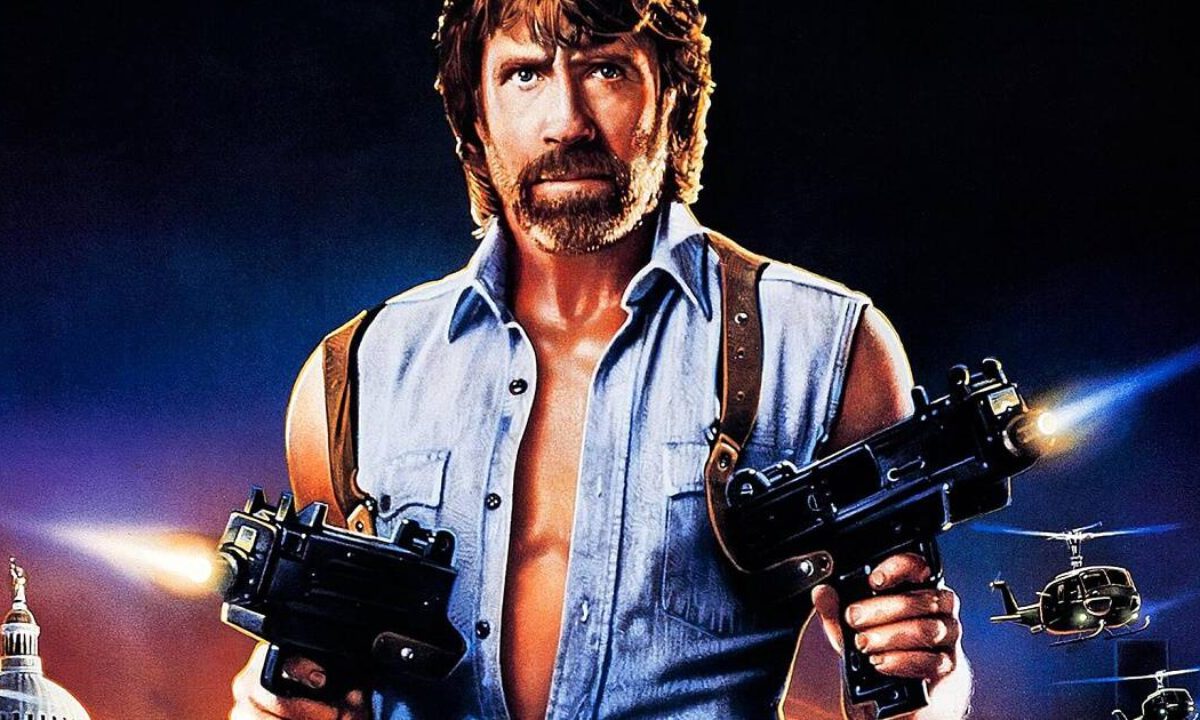
You shouldn’t speak ill of the newly dead, but I’m just going to say it: I’ve never cared for Chuck Norris. Even as an action-hungry, kung-fu obsessed kid (my middle name is Lee, after Norris’s mentor Bruce), I always found him utterly bland as both a fighter and an actor. This was the case long before those unbearably obnoxious Chuck Norris Facts memes sprouted up, and before he went full-on Christofascist nutcase.
But just because I was never a fan of Chuck Norris the man, that doesn’t mean I don’t enjoy the hell out of some Chuck Norris movies.
That’s an easier distinction to make with Norris than it is any of his peers. You take Arnold out of The Terminator, it’s a totally different experience. Ditto Sly in any of his blockbusters. Bloodsport isn’t Bloodsport without Van Damme. Dolph Lundgren’s characters are defined by the fact that they look like Dolph Lundgren. Hell, even Steven Seagal’s scuzzy weirdness feels inextricable from most of anything he’s ever made, from the handful of fun features of his heyday to the bottom-of-the-barrel slop he churns out today.
But Chuck Norris? God loves a laconic badass, but there’s a point where stoicism crosses over into woodenness. You can tell he’s going for a Clint Eastwood thing in a lot of those ‘80s movies, but all that does is remind you how good Clint is. I always felt like you could replace Norris with any actor and so long as they could deliver a decent roundhouse kick, you’d get basically the same movie.
That said, there is one film in which Norris’s lack of personality not only worked in his favor, but enhanced the overall experience. Fittingly, for all of Norris’s blandness, it happens to be the most batshit insane movie he ever made: Invasion USA.
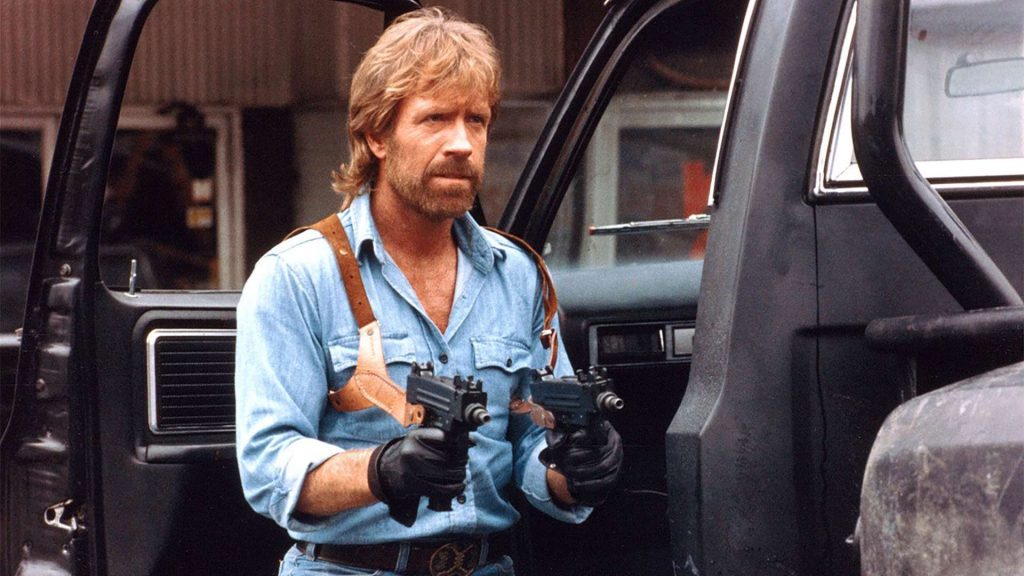
Released in 1985 by uber-schlockmeisters Cannon Films, Invasion USA may just be the most Cannon movie ever made. Norris—who had steadily risen to prominence as a martial arts movie star since his breakout in 1972’s The Way of the Dragon – was signed to a six-picture deal by Cannon’s cousin moguls Menahem Golan and Yoram Globus. Invasion USA followed the successful Vietnam POW action pictures Missing in Action (1984) and Missing in Action 2: The Beginning (1985), with the first film’s director, Joseph Zito, reteeming with Norris to bring the latter’s idea to screen.
(Zito’s Missing in Action was initially shot as a sequel to as-of-yet released first film, but when everyone involved agreed his was the better picture, they swapped the order of release and retooled the other one as a prequel.)
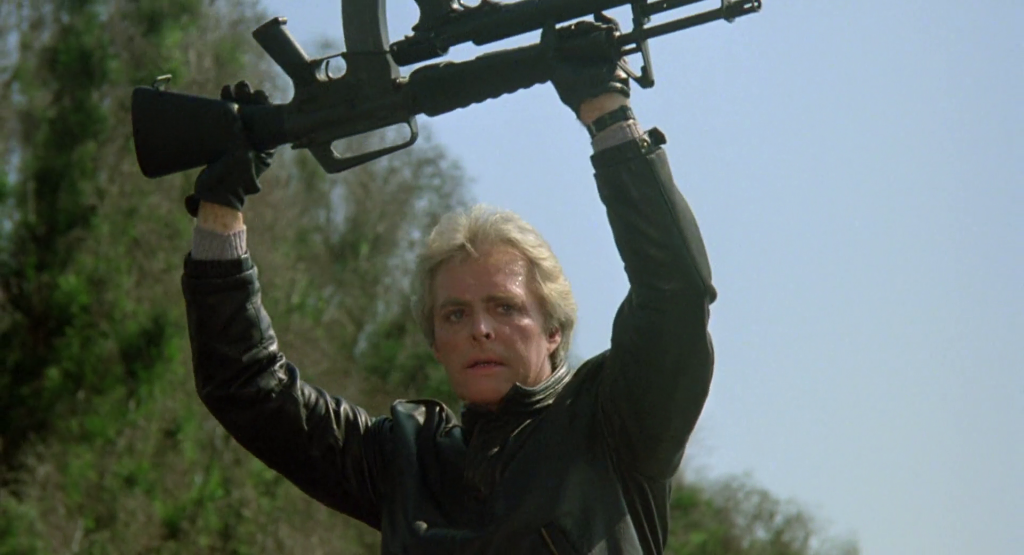
In Invasion USA, a force of multinational terrorists, lead by a Russian commander named Rostov (Richard Lynch) sneak into the U.S. through the shores of Florida before dispersing across the country committing random acts of violence. The only man who can stop them is Norris’s retired CIA agent Matt Hunter, with whom Rostrov has been obsessed ever since he was nearly killed by him during a mission years back. (Hunter would have happily dispatched him were it not for orders to take him alive by the wishy-washy suits in Washington, natch).
Hunter tracks Rostov through the country, dispatching his goons along the way. You would assume that Hunter’s journey would make the heart of the story, but you would be wrong. Invasion USA blunders into a far more interesting narrative by making Rostov’s arc its true focus. Lynch’s nervy performance, combined with his scarred visage (the result of the actor lighting himself on fire during a drug-induced freakout 20-some years earlier), give him a wounded quality that is far easier to empathize with than the cold, remorseless Hunter, whose memento mori refrain of “It’s time to die” and seemingly supernatural invulnerability more closely resembles a slasher movie villain than a squared-jaw G.I. Joe.
(Hunter’s slight, unconsummated flirtation with Melissa Prophet’s indefatigable reporter is the closest he comes to seeming human, and perhaps this aspect of the film would have been more memorable if Norris’s first choice for the role, Whoopi Goldberg, hadn’t been nixed by Zito—a decision that made Norris refuse to work with the director again.)
While Norris does put in a lot of good stuntwork—particularly during a jaw-dropper of a demolition derby through a shopping mall that gives the similar set piece from The Blues Brothers a run for its money—he does almost no martial arts, delivering only one roundhouse kick in the final few minutes. Mostly, he dispatches his enemies with dual mini-uzis. By stripping Norris of his Eastern skillset and instead just making him a gun-toting automaton, Invasion USA stumbles yet again into subversiveness.
The idea of Invasion USA came straight from Norris (he was heavily involved in the writing of the script) who was inspired by an article in Reader’s Digest that theorized there were hundreds of sleeper cell terrorists hiding in the country. The paranoid fear of an American ground invasion by Soviet-backed forces was prevalent during the Reagan era, with Invasion USA coming out one year after John Millius’s similarly-plotted (and similarly more subversive than it’s given credit for) Red Dawn. But here, Norris and co. threw in plenty of urban nightmare fearmongering for good measure, depicting regular city living as nearly indistinguishable from an active warzone.
And yet, for all its jingoism and racial stereotyping, one can’t simply dismiss Invasion USA as pure right-wing fantasy. The 9/11 attacks, ongoing epidemic of mass shootings, and regular mobilization of militarized police forces in American neighborhoods make the film play as tragically prescient, so much so that something as recent and urgent as Alex Garland’s Civil War plays as woefully late in comparison.
All of this would make Invasion USA an ever-relevant film regardless of quality, but what truly moves it up a level is the scope of destruction on screen. The biggest budget, by far, of any movie Norris had made up to that point, the filmmakers certainly got their money’s worth. Along with the aforementioned mall car rampage, as well as a quick shot of a security guard getting absolutely wrecked by an exploding door (a stunt that left the stunt man severally injured and led to a lawsuit), the most stunning set piece in it sees Lynch and co. bazooka several suburban houses, blowing them to smithereens. There’s no sleight of hand here—a real suburban neighborhood in Atlanta had been scheduled to be bulldozed in order to expand the Hartsfield–Jackson Atlanta International Airport. Somehow, Golan and Globus got the go ahead to blow it all up for prosperity.
Norris’s output post-Invasion USA moved into more comedic and family-friendly territory (Sidekicks, Top Dog), before he settled into a basic cable comfort zone with Walker, Texas Ranger and eventually moving into full-on pastiche during the last few decades of his life. Time will not be kind to Norris’s legacy, but the further we move into—to quote author Philip Roth (not someone I was expecting to cite when I first started writing this article)—the American Berserk, the more it becomes clear that Invasion USA will be his most lasting and prescient piece of work.
“Invasion U.S.A.” is streaming on Tubi and Amazon Prime.