Steve Erickson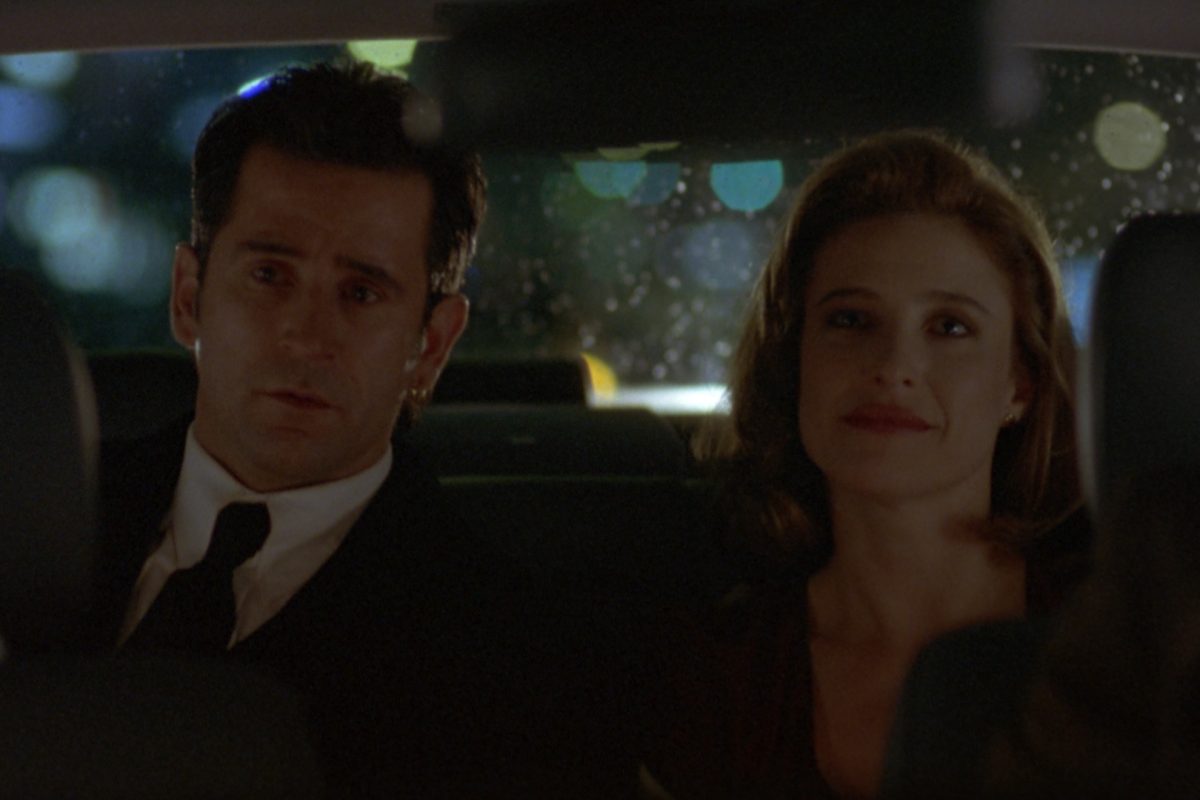
Bulletproof Heart is a product of its time, yet it stands out for how much it differs with its competitors. (It has also been released under the duller title Killer.) A neo-noir released in America on March 31st, 1995, it’s set in a milieu of hitmen and casual violence. Men wear fedoras and overcoats, women look as though they just returned from the beauty parlor. Yet it’s also a movie reflecting on how other films have treated its themes, hinting that the iconography of cool and the notion of a threatening femme fatale conceal real depression. Its two protagonists yearn desperately to feel real emotions and connect with other people intimately.
Its commentary on cinema is displayed most explicitly in the opening scene. Mick (Anthony LaPaglia) hides in the closet of a man he’s been hired to kill. The man relaxes in bed, watching an old gangster movie on TV. As Mick emerges to bludgeon him with a club to the head, his actions are intercut with the film’s images. Afterwards, Mick sits on the end of the bed, looking forlorn. It’s as though he were staring into a vision of his own life, finding himself estranged from it.
Bulletproof Heart takes place over the course of a single night. Following the first murder, Mick receives a massage. He and the masseuse begin making out, as she invites him to cut her clothes off, but instead of getting turned on, he contemplates stabbing her with his scissors. He retains enough of a moral center to be disturbed by this thought and wonder what he’s doing. Mick’s boss George (Peter Boyle) immediately asks him to go kill another person. This time, the target is Fiona (Mimi Rogers), who owes George $650,000. Mick heads over to her home. He finds a party underway, but once he arrives, she kicks everyone out. Her psychiatrist, so drunk he’s barely conscious, is the last to leave. It turns out that the suicidal woman desires her own murder. She and Mick have kinky sex, which leads him to an epiphany about the value of his life. But her desire to die is no less strong, and when they go outside, she disassociates.
Bulletproof Heart bears a slight resemblance to movies and TV shows which came after it. Its dreamlike ambience, during which a man explores his sex drive in a nocturnal underworld, is a precursor to Eyes Wide Shut. Some of the plot developments add to a feeling of unreality – Fiona is improbably able to shut down a bustling party in a minute. While the setting is never named, it was shot in Vancouver; as with so many films made in Canada, the end product is an anonymous Everycity. Malone and cinematographer placed out-of-focus lights in the background to liven up the nighttime. Even interiors are doused with a deep blue glow.

While it may be unlikely Kubrick ever saw the film, it’s quite possible Bulletproof Heart went on to influence The Sopranos. It presents the same concept of a gangster who needs therapy after suffering mental harm caused by his violent life. (George suggests Mick go see a shrink and even recommends one.) Mick can recognize that he has a problem, but until he meets Fiona, he’s unable to articulate it. After all the murders he’s committed, he’s grown burnt out and exhausted.
Bulletproof Heart uses the tropes of film noir to speak about mental health. While real-life hitmen don’t actually exist, Mick’s struggles with work-life balance and the numbing impact of the worst elements of his job are exaggerations of common problems. After he and Fiona have sex, he’s able to think clearly about his unhappiness. Rather than a cliché from banal song lyrics, Bulletproof Heart presents romantic love as a shattering, potentially redemptive force.
This was Mark Malone’s directorial debut, and he’d only go on to make four more movies. (His biggest credit was producing the TV series The Last Ship.) Two are also gangster films. Back in 1995, Bulletproof Heart received a limited release, heading quickly to video. Jonathan Rosenbaum called it “almost certainly the best American genre film of the year,” viewing it as an alternative to the gleeful bloodshed of Tarantino. Roger Ebert, who gave it three stars, singled out Anthony LaPaglia’s performance for praise. But few other American critics saw anything special here, and Bulletproof Heart languished on video store shelves (where I first came across it 30 years ago). It may take a degree of distance to see how unusual the film really is, especially in its deconstruction of the femme fatale archetype. Rather than threatening Mick, Fiona’s sex appeal aids him to see the value of life. The overall arc is laden with doom, yet the possibility of self-knowledge exists. The film starts out in a place of chilly disconnection and winds up just short of a sentimental, if pessimistic, flowering.
“Bulletproof Heart” is streaming on Plex.