Sean Burns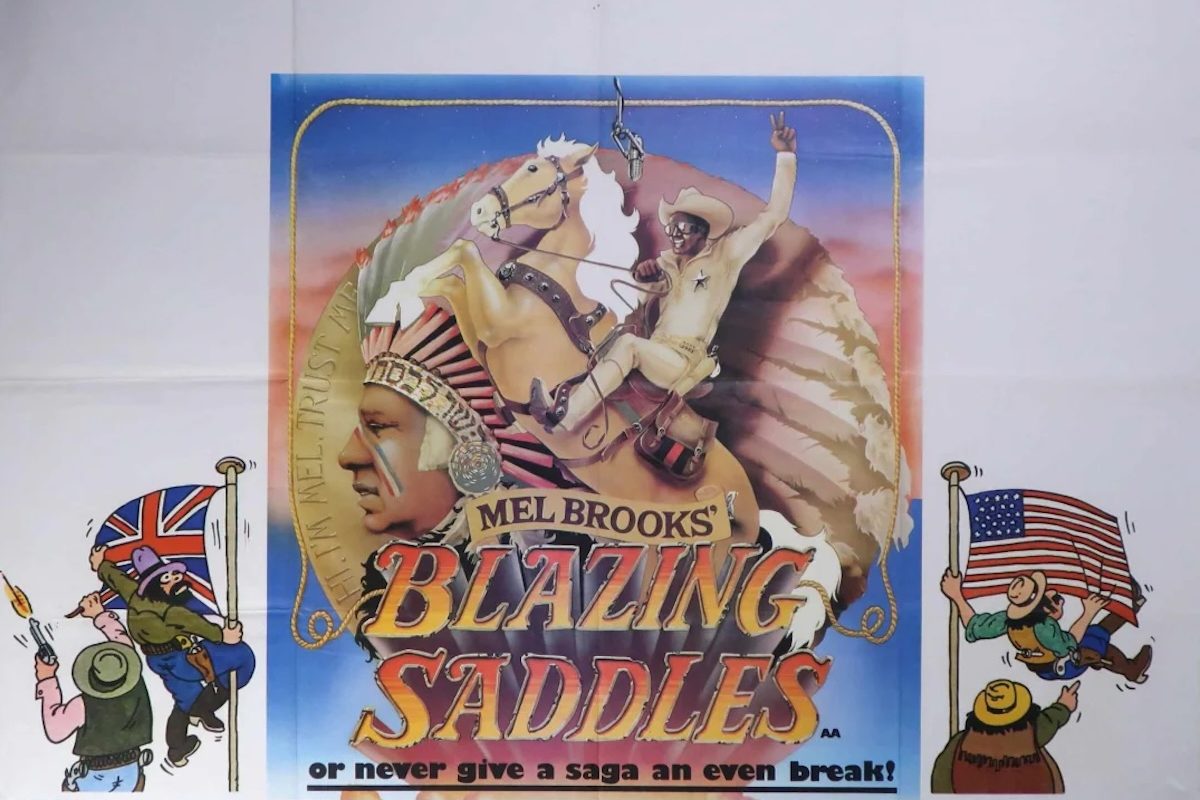
When people talk about movies that could never be made today, number one on the list is usually Blazing Saddles. Mel Brooks’ gleefully irreverent 1974 Western satire tap-dances on third-rail subject matter and throws around verboten language with such gleeful insouciance, watching the film in 2026 makes you feel like you’re getting away with something. We’re not used to movies being this unabashedly naughty anymore. When I talked to John Waters last year, he laughed about how his Pink Flamingos feels even more outré and offensive today than it did half-a-century ago. This is also true for Blazing Saddles, which features more n-words than a Quentin Tarantino film festival and a rape joke that still makes audiences gasp.
The thing is, it’s also a deeply moral movie that uses these things to call out the racism and violent hypocrisy undergirding America’s most cherished frontier myths. Blazing Saddles is as powerful a revisionist Western as Unforgiven or Little Big Man, it just happens to be incredibly silly about it. Cleavon Little stars as a day laborer sentenced to hang after walloping his foreman (Slim Pickens) with a shovel. Railroad baron Hedley LaMarr (Harvey Korman) wants to clear out the town of Rock Ridge to make way for his train line, and when his gang of hired thugs can’t kill, rape, and run the people off fast enough, he bamboozles the corrupt, nitwit governor (director Brooks, in one of four roles) into appointing our condemned hero as the West’s first Black sheriff. That ought to scare them away.
Despite being greeted with nothing but hostility and slurs from the local townfolk, Bart does his duty and protects the people of Rock Ridge from Hedley’s vicious goon squad. He enlists the help of the Waco Kid, a drunken gunfighter played with bone-dry wit by Brooks’ regular accomplice Gene Wilder. The comic actor was a last-minute replacement for actual movie cowboy and real-life alcoholic Gig Young, who according to Brooks, showed up and vomited on his first day of shooting. (“I’m not directing The Exorcist,” the filmmaker quipped. Brooks says he’d previously offered the role to John Wayne, who turned it down because the movie was too dirty. Given the Duke’s politics, I can’t imagine he was as enthusiastic about the script as the filmmaker claims.)
“Here we take the good time and trouble to slaughter every last Indian in the West, and for what? So they can appoint a sheriff that’s blacker’n any Indian!” bemoans Pickens’ peckerwood henchman, sending up his roles in a thousand early Hollywood Westerns. The illicit-feeling thrill of Blazing Saddles lies in how bluntly such ugly American truths are stated, the equivalent of “saying the quiet part out loud” amid a barrage of surreal sight gags, Borscht Belt schtick, vaudevillian cavorting and the undisputed champion of movie fart jokes. One of the film’s five credited (and Oscar-nominated) screenwriters was Richard Pryor, whom Brooks credits with giving him permission to push the racial humor into increasingly edgy territory. This was around the same time Pryor released an album called “That Nigger’s Crazy.”
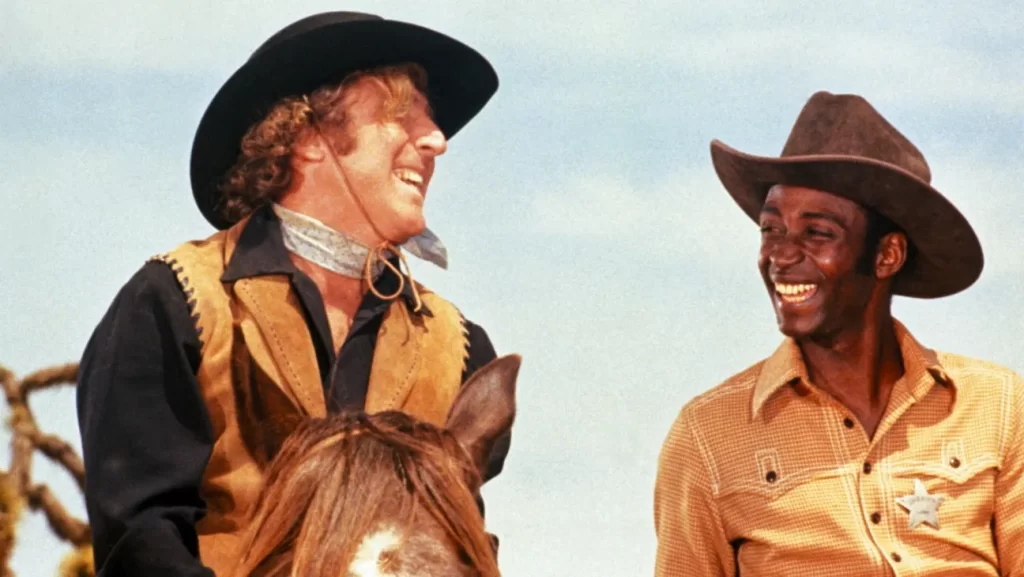
The comedian was Brooks’ first choice to play Sheriff Bart, but Warner Bros. didn’t want to trust the lead role to an untested up-and-comer whose drug issues weren’t exactly a well-kept secret. Little gives a warm, ingratiating performance, but he’s got a surprising lack of chemistry with Wilder, who seems off in a loopy movie of his own during their jailhouse bonding scenes. (Watching the film again recently was the first time I realized how much Ryan Gosling’s comic persona is indebted to Wilder.) It’s tough not to wonder what Pryor might have done with the part, especially considering how well he and Wilder wound up working together in films that were nowhere near as good as this one.
Blazing Saddles is about how racism is the idiotic ideology of pig-ignorant buffoons who have done nothing but hinder this country’s progress since its earliest days. This is the kind of message that solemn, prestige pictures pretend is some kind of revelation they’re piously delivering to audiences in need of enlightenment. Brooks simply takes it as a given and has fun with it. It’s a movie full of childish humor, but it treats you like an adult. The jokes are all at the expense of characters Wilder’s Waco Kid reminds us “are just simple farmers, people of the land, the common clay of the new West. You know, morons.” Brooks once said that his movies rise below vulgarity. After all, this is the man who brought you “Springtime for Hitler” a mere 22 years after WWII ended. He’s not exactly precious about things. (The Producers was historically closer to Adolf Hitler’s defeat than we are now from the final episode of Friends.)
The film’s frequent fourth-wall breaks eventually topple it altogether, with the action spilling out onto the Warner Bros. backlot where the movie is being filmed. It’s not enough that the country’s foundational myths are mocked with the sight of a man punching a horse, Brooks also explodes the Hollywood artifice of these stories America tells itself. The Dada-esque sight of Sheriff Bart and the Waco kid walking into a movie theater to see how their story ends is topped a few minutes later, when Bart’s noble “for your consideration” speech about justice is interrupted by the crowd literally calling B.S.
It’s amusing to see how gingerly Blazing Saddles is handled by critics and academics these days. The version currently streaming on HBO Max is preceded by a skittish introduction from a TCM host placing the film in historical context. Whenever it screens at rep theaters, warnings and disclaimers abound. I always assumed the movie’s righteous intentions were so obvious as to be self-evident. But I suppose one should never underestimate the common clay of the new West.
“Blazing Saddles” is streaming on HBO Max.