Will DiGravio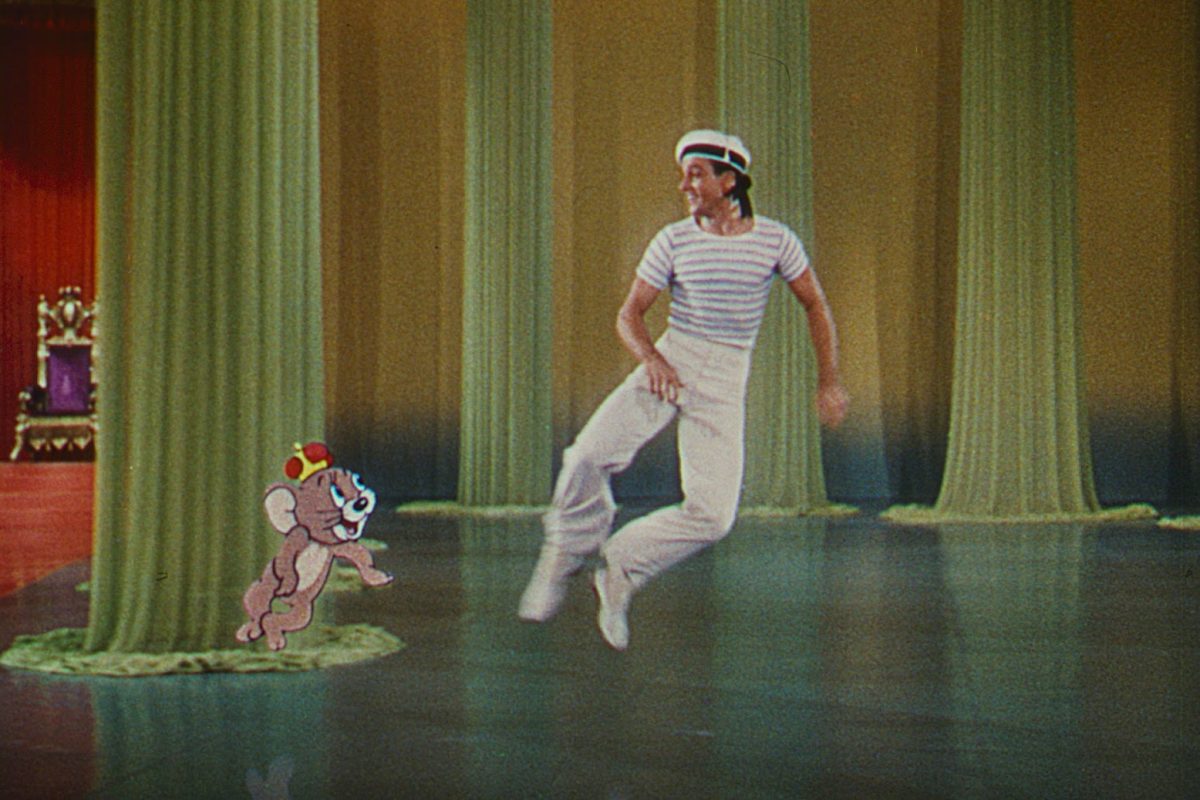
It’s one of those sequences that, encountered devoid of context – say, on YouTube – might just make you think you’re watching some kind of trippy fan edit. You may even have first seen it spoofed with Stewie Griffin on Family Guy. The scene in question, of course, concerns Gerald Jinx Mouse (known globally as, simply, Jerry) and Eugene Curran Kelly—you know him as Gene.
The film was Anchors Aweigh, directed by George Sidney and released on July 19, 1945, in the time between the respective ends of the Second World War in Europe and Japan. The young heartthrob Frank Sinatra, then just 30 years old, received top billing and later an Academy Award nomination for the role. This was Sinatra at the top of his game, in the years before the slump that would ultimately end with his Oscar-winning work in From Here to Eternity (1953). The Comeback, so the legend goes.
Kelly, 33 at the time, was on his way up. Though he had a few successful performances under his belt, opposite the likes of Judy Garland and Lucille Ball, he was not yet the polymathic filmmaker he would become the following decade. The trailer for the film makes clear that Kelly will handle the “dancing” and Sinatra the “singing.” Though let us be fair: Kelly is a far better singer than Sinatra is a dancer.
In the film, Kelly and Sinatra play Brooklyn and Joe, a pair of United States Navy sailors. Both aspire to careers in show business. And lo and behold, their ship docks in … California! The two take advantage of their time off and venture to Hollywood, eager to show off their talents. It is there they meet Susan (Kathryn Grayson), an aspiring singer, who dreams of performing with conductor José Iturbi, who makes an appearance as himself.
This tale of chasing dreams (and, naturally, love) in a nearly-post-war America was a huge hit at the box office and with critics. Even Bosley Crowther in the New York Times had praise for the film’s producer, Joe Pasternak, noting that he has “accomplished an even greater wonder” than the film itself: “He has made Frank Sinatra look good.”
Crowther had even more praise for Kelly, writing that he had proven himself “the peer, if not the superior, at rigadooning, of Fred Astaire.” Is higher praise possible? Among the dance sequences Crowther cites is “a bright adagio with a little cartoon character in a trickily fanciful sequence (a la Disney).”
‘A la Disney’ is precisely the kind of praise the creators of the film were likely looking for. At this time, Disney was king. There was also Leon Schlesinger Productions, which created a lovely cast of characters named Looney Tunes (the company was sold to Warner Bros. in 1944). Then, struggling to keep up, was Metro-Goldwyn-Mayer. In 1940, MGM’s three-year-old cartoon studio launched a new series of short films under the title Tom and Jerry, created by two of the studio’s heads, William Hanna and Joseph Barbera. Both pairs were an immediate hit.
By the time of Anchors Aweigh, Jerry was arguably the most successful movie star in the production. He acted in three Oscar-nominated shorts, winning two for The Yankee Doodle Mouse (1943) and Mouse Trouble (1944). It was only natural that Jerry helped out the rising star Kelly on Anchors Aweigh, another MGM property. (Remember the next time you watch a Marvel movie: this is what cross-promotion used to look like).

The lead up to the scene is simple enough. Joe (Kelly) visits the classroom of Susan’s nephew, Donald, played by seven-year-old Dean Stockwell (yes, that, Dean Stockwell). Donald asks Joe to share with the class how he received his medals. Joe asks Donald and his friends to imagine the most beautiful day they have ever seen …
What follows is an Alice in Wonderland-like sequence. Joe meets a group of animated animals who inform him that singing and dancing are against the law. He promises to go to the castle and convince the king to overturn the law. The king, it turns out, is a boy mouse by the name of Jerry, who is sad and “lonesome.” King Jerry banned singing and dancing because he, himself, doesn’t know how to sing, dance, or be happy. Thankfully, the king of all three has just walked in.
What ensues is a fabulous tap number, the pair moving in tandem, holding hands, and moving about a lavishly colored place set. Even today, those of us untrained in the art of animation wonder just how they did it. As visual effects artist Bill Taylor brilliantly explains, the secret begins with the staging. Kelly is shot on a live action background—he is not matted in, Taylor emphasizes—that is made to look a bit cartoonish. Then, Kelly’s silhouette is traced frame-by-frame onto animation paper in a process called rotoscoping. By tracing, according to Taylor, more than 10,000 frames, Kelly is able to move into the “animation world.”
Jerry begins with the usual series of hand drawn sketches. The artist then places an animation cell over the images, traces them in ink and fills in the eight colors that comprise Jerry and his crown. Now, Jerry exists as a “transparent cell,” meaning he can be photographed against anything. The problem, though, is that if the image were simply double exposed through the optical printer, Jerry would come to resemble something more like Casper the friendly ghost. The trick, according to Taylor, is in the front- and back-light animation process.
First comes the creation of an opaque, back-lit silhouette of Jerry—an all-black image in the shape of the mouse. This, via the optical printer, can in turn be used to create a black hole the size of Jerry in whatever background the filmmakers desire. Then, with the Jerry-sized hole, what is referred to as the “silhouette matte,” the filmmakers can, via a double exposure, now place the front-lit exposure of Jerry onto the image in its full-color glory. Taylor likens the process to placing in the missing puzzle piece. (Seriously, if you have the time, watch Taylor’s explanation of this).
The layering of images, combined with the cartoon-like set design, achieves an effect that is a blending of worlds: half-real, half-animation. Has Jerry Mouse become real, bouncing from one of Kelly’s biceps to the other? Or has Kelly become a cartoon character himself, a perfect distillation of the delightful aura that would make him one of the greatest movie stars to ever live? As one gobsmacked reviewer at the time simply put it in the pages of The Hartford Courant, “the animation sequences are far and beyond …”
“Anchors Aweigh” is available for digital rental or purchase.