Roxana Hadadi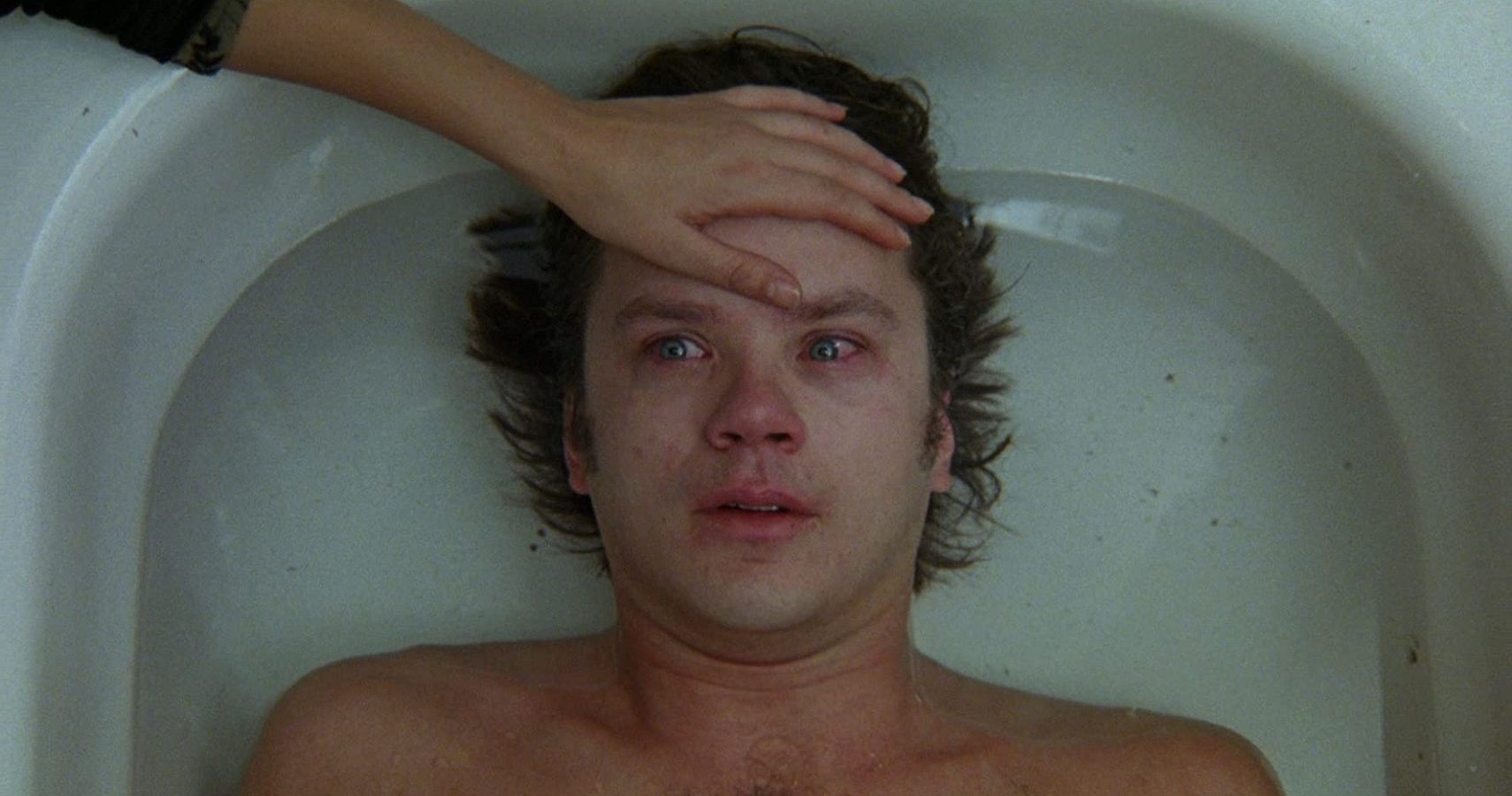
American cinema has long grappled with the carnage, destruction, and senselessness of the Vietnam War, and some of the most heralded films in our canon focus on the myriad impacts of the conflict. What did the men who served in Vietnam live through? What were they forced to do? What guilt did they carry back with them, and what trauma transformed them? An entire generation was shaped by the U.S. government’s amoral choice to begin, and then stubbornly stick to, this war (for Cold War posturing more than anything else), and that impact is seen throughout a number of classics from the 1970s and 1980s: Francis Ford Coppola’s Apocalypse Now, Martin Scorsese’s Taxi Driver, Michael Cimino’s The Deer Hunter, and Stanley Kubrick’s Full Metal Jacket; more recently, Robert Zemeckis’s Forrest Gump (we hate on it now, but its commercial and critical popularity are undeniable), and Spike Lee’s Da 5 Bloods. For the most part, those films follow a linear structure and a cohesive narrative: Men go to war, men are destroyed by war, men come back to a society in which they no longer fit. That familiarity doesn’t make the films’ explorations of pain and otherness any less engaging, but for the most part, there’s a formula to this.
Perhaps that refusal to abide by an established methodology is what makes 1990’s Jacob’s Ladder, released 30 years ago this week, stick out when compared with other films in the Vietnam War subgenre. It’s not the violence here that’s different; Apocalypse Now, Taxi Driver, The Deer Hunter, and Full Metal Jacket have their fair share of bloodshed, with “the smell of napalm in the morning” and all that. Nor is it the film’s depiction of post-traumatic stress disorder, with which protagonist Jacob Singer (Tim Robbins) is clearly struggling; PTSD symptoms appear in Da 5 Bloods, too, during an altercation between Delroy Lindo’s Paul and a Vietnamese merchant trying to sell him something—a scene that ends in traded curses and a panic attack. What is most notable about Jacob’s Ladder is the film’s relentless insistence that life is a nightmare, our sins are irredeemable, and death is our only escape. There are no second acts, neither through war (no overcoming of fear, no purpose found in military service) nor in “normal” life (no romantic possibilities, no familial reunion). Our only absolution is found in finality. Profoundly bleak and deeply surreal, the narrative messiness of Jacob’s Ladder isn’t a flaw; it’s the point.
When Jacob’s Ladder begins in the Mekong Delta in southern Vietnam in October 1971, 50,000 Americans had already died in the war, and the men we see on the ground are exhausted. They’re bruised all over their bodies; blood is clotted in their hair and on their faces; they keep their eyes closed as a helicopter hovers low to drop off more soldiers. Nothing is very surprising anymore. They pass a joint around, impressed by its quality (“This shit’s something else”), and bust each others’ balls. “The Professor” is what they nickname the easy-going, smile-prone Jacob, and their ribbing of him is wide-ranging in its comfortable vulgarity. When they hear news of an enemy force on the attack, they spring into action, grabbing their guns and preparing themselves for the onslaught they all know is coming—and then everything goes sideways.
“Something’s wrong. It’s my head,” one of them groans, and then one after another, each man seems to disintegrate. They collapse. They gag. They seize. They throw up blood. One of them whirls around in a circle, unable to stop, like a Sufi mystic gripped in faithful ecstasy. In only a few minutes’ time, their entire compound is overtaken by enemy forces, bombed, and left to burn, and Jacob is one of the only survivors. As he flees into the jungle, he hears a twig snap—and turns toward the interloper, who buries his bayonet deep into Jacob’s stomach.
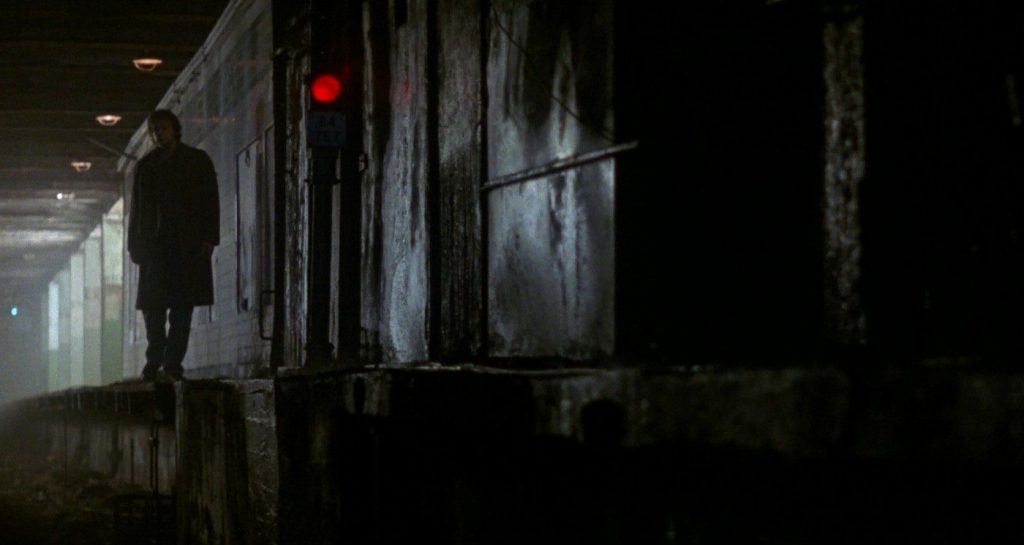
Is this a memory? A hallucination? Whatever it is, Jacob awakens from it while riding on a positively filthy (and hence fitting for the time) New York City subway car. The year is 1975. Jacob’s hair is shaggier now, his tall frame is encased in a United States Postal Service uniform, and his hands grip a copy of Albert Camus’s nihilistic classic The Stranger. (If you know how this novel ends, the inclusion of it by screenwriter Bruce Joel Rubin, who also wrote Ghost and won the Academy Award for Best Original Screenplay for that film, is already a tell toward how this movie will progress.) In a film full of allusions to the Christian conceptions of creation and the afterlife, from its title to its characters’ names, this scene’s details are immensely assertive. Side-by-side ads on the train car call New York City “a crazy town” and living in it “HELL”; Jacob can’t find a way out of the train station, essentially trapped in a sort of purgatory; and when he ends up standing in a split in the train tracks, he is bathed in a bright, all-enveloping light, the kind of glow that suggests divine intervention.
Equally immediate, though, are the signs of Jacob’s troubled mind. Director Adrian Lyne is unmerciful in his steady incorporation of horror after horror, all paced perfectly to draw us into the depths of Jacob’s unsteadiness. He thinks he sees tentacles poking out from a homeless person’s body. When he jumps out of that train’s way, he spots monstrous, faceless figures writhing and flailing about inside, one of whom waves goodbye at him from the caboose window. He bursts into tears when he comes across a photograph of his dead son, Gabe (Macaulay Culkin). A car tries to run him down, and he sees another vibrating figure in the backseat; the psychiatrist he had been seeing for years has mysteriously died; at a party with his girlfriend, Jezebel (Elizabeth Peña), he sees her writhing against and humping a demon with massive teeth, wings, and a thrusting tail. At the moment of climax, the creature impales Jezzie through the mouth. This Lovecraftian blitz builds up to a positively gruesome sequence at a hospital where Jacob is immobilized and wheeled past pools of blood, piles of limbs, and more damaged, antagonistic strangers before being strapped into what looks like a human-sized hamster wheel. “This isn’t happening,” Jacob insists, but it’s hard to argue with a literally blank-faced doctor injecting something into your brain against your will.

Yet for as unsettled as his mind is in the present—as much as Jacob seems to be living two parallel lives, and existing in two realities at once—his memories of Vietnam, which he calls “weird flashes,” are more concrete. Lyne places us both alongside Jacob in these flashbacks, allowing us to see what he does (the glow of an American soldier’s red flashlight illuminating a spiderweb with an insect immobilized at its center; a field doctor hovering over Jacob before he’s lifted into a helicopter), before switching to an outside perspective that lets us observe how Jacob is acting in these moments (his eyes, frozen wide, in shock). “After ‘Nam, I didn’t want to think anymore,” Jacob had told his chiropractor Louie (Danny Aiello), but the only times he seems coherent are in these scenes that no one would want to remember. If those are the memories Jacob’s subconscious allowed him to hold onto, what has it made him forget?
Until Jacob’s Ladder, Robbins had been most known for his supporting roles in action movies and comedies: Top Gun, Howard the Duck, Bull Durham. His work here demonstrated the intensely contrasting desperation and determination Robbins can communicate in a single look; although Jacob is a naturally sympathetic character as a traumatized war veteran, Robbins imbued him with additional, understandable anguish. He is searching for a home that seems impossible to find, and for answers that no one is willing to provide. Not Jezzie, who laughs off his concerns about demons (her response of “lowlife, that’s all they are; the streets are crawling with them” is very ‘70s New York). Not the palm reader Elsa (S. Epatha Merkerson) at that strange party, who notices something very unusual about Jacob’s lifeline. Not Jacob’s fellow veteran Frank (Eriq La Salle), who dismisses Jacob’s concern that something strange happened in Vietnam (“War’s war. Things happen, man”), nor two men who take Jacob hostage and threaten him (“Let it lie”). Robbins’s Jacob is shut down over and over again, but the impact of his performance is in how unyielding he is in pursuit of an explanation for what the Army did to them in Vietnam, and what is still plaguing them so many years later.
War, of course, is never easy to understand or comprehend, and there’s a certain fruitlessness to Jacob’s journey. Would having a concrete answer about whatever Jacob and his fellow soldiers were subjected to make their pain any less? Would it bring back his dead friends? Would it return Jacob to who he was before Vietnam? All of this is impossible, and Jacob’s Ladder knows this; that’s why trying to understand the film’s plot turns is its own kind of folly. What matters more about Jacob’s Ladder is how its pervasive sense of dread and lurid, terrifying imagery combine into a sort of silent scream, a cry of agony that no one cares to hear. The destructive spread of war is uncontainable, and the damage it inflicts on the soul is irremovable. “You’ve done it to yourself this time, haven’t you?” Louie asks Jacob, but what Jacob’s Ladder underscores is how often the evils forced upon us are the most impossible ones to transcend. 
Jacob’s Ladder is available through Cinemax and digital rental.