Fiona Underhill
A child has been sold to a criminal by a desperate mother. Holed up together in a lonely shack, the dubious mentor gives the young protégé advice that he will hold onto for the rest of his short life: “When a man farewells this world, all he’s got left is his story.” The child will grow up and pass on, to his own disciples, the message that “every man should be the author of his own history” – for the truth is important to the outlaw Ned Kelly.
Australian director Justin Kurzel’s latest work, True History of the Kelly Gang, builds on themes established in his previous films The Snowtown Murders (2011) and Macbeth (2015). All three are based on real people and events, from 11th century Scotland to Australia in the 1880s and 1990s. Three of the central figures in these films – Ned Kelly (George MacKay), Macbeth (Michael Fassbender) and John Bunting (Daniel Henshall) – are acutely aware of their legacies, and all wrestle with their place in their country’s history. The protagonists of all three films (including Jamie Vlassakis in Snowtown, played by Lucas Pittaway) are murderers, but in at least two of these cases, we are encouraged to have some sympathy for these ‘villains.’ Once Ned Kelly achieves notoriety, he strives to assume control of his own narrative, but is aware that a “myth is more profitable than a man.” Kurzel makes us aware from the get-go (via an opening title) that the tale is being told by an unreliable narrator: “Nothing you’re about to see is true.”
In the opening passages of True History of the Kelly Gang, Ned is a kid (played by Orlando Schwerdt) desperately trying to prove he is a man. Attempting to avoid repeating the mistakes of his Irish convict father, he’s searching for father-figures, a role most prominently filled by Harry Power (Russell Crowe). Power is a bushranger, modeled on the outlaws of the Wild West or the highwaymen of 18th century England – a romantic ‘Robin Hood’ archetype. Though constantly let down by those in a paternal role, Ned seems doomed to relive the past and walk their same paths. Jamie in Snowtown is in a similar position; he has been abused by one of his mother’s boyfriends and his older brother. When the seeming ‘nice guy’ John comes along – he cooks meals and is caring towards Jamie’s younger brothers – Jamie gravitates towards him as a mentor. But he’s groomed and peer-pressured, helping to escalate the cycle of abuse into a ‘crusade’ against gay men and perceived pedophiles.

Ned Kelly’s manliness is constantly challenged by his mother Ellen (Essie Davis). At the start of the film she refers to him as “my little man” and the “man of the house,” and when she sends him off with Harry Power, she encourages him to “go out there and be a big man.” George MacKay’s entrance as the adult Ned is blisteringly provocative and aggressive; MacKay has never been this physical, visceral or animalistic on-screen before. But Ned is a mass of contradictions, reluctant to fully commit to the criminal life. When he returns home after a long absence, Ellen immediately manipulates him into stealing horses with her young boyfriend George (Marlon Williams) and Dan Kelly (Earl Cave). She does this while touching her face to Ned’s, in a manner similar to Lady Macbeth in the infamous “screw your courage to the sticking place” scene.
Kurzel emphasizes the oedipal nature of Ned’s relationship with his mother; he also has Lady Macbeth (Marion Cotillard) lay out her plan for King Duncan’s murder while making love to Macbeth, taking emotional blackmail to a physical level. She calls him a coward: “When you durst do it, then you were a man.” The feminine pressure in The Snowtown Murders comes mainly from Verna (Aasta Brown), who lays out in graphically violent detail what she would do if she caught a pedophile, and berates her husband as a “p*ssy.” She will go on to pay the ultimate price for her insolence.

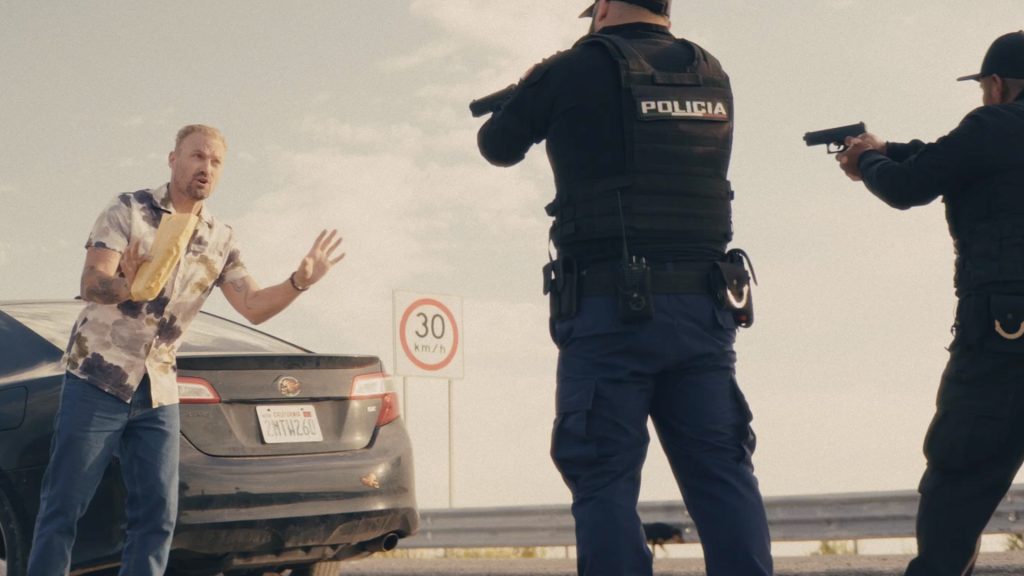
In True History of the Kelly Gang’s most pivotal scene, Ned has a gun trained on Constable Fitzpatrick (Nicholas Hoult), but instead of displaying fear, Fitzpatrick sees right into Ned’s soul. “You’re not… the man your mother wished you were,” he sneers. “You’re a boy… looking for a Captain to tell him what to do.” Jed Kurzel’s haunting, rueful woodwind score drops in, while Ned’s eyes shine with tears, followed by an overhead shot of Ned and his gang riding through the snow. Dan and Steve Hart (Louis Hewison) then tell Ned that they are the “Sons of Sieve (Ireland). We’re rebels. Bandits. Warriors.” Once again, the romantic notion of the outlaw is conveyed, not just through the dialogue, but through the beauty of the score and the vast, stunning High Country of Victoria, which is shot reverently by Ari Wegner. Kurzel infuses the film with nostalgia, as if we are already watching an inevitable past unfold, aided by Ned’s wistful narration. This is the point at which Ned rises up as a leader of the gang and takes the decision to ambush and kill the policemen who are pursuing them. Kurzel presents Ned as taunted and provoked into becoming a killer, just as Jamie and Macbeth are.
Both Ned Kelly and John Bunting replicate military structures and hierarchies, treating their followers as ‘lieutenants.’ Bunting compares himself to the soldiers celebrated on Anzac Day and asks, “where’s my parade?” Ned calls himself an “ironclad monitor,” comparing himself to the small warship with outsized guns, as a challenge to those who underestimate him. The irony is that Ned makes a rousing ‘pre-battle’ speech while he is surrounded by his gang wearing pastel-colored dresses. The dress-wearing is something that disgusted and shamed Ned about his father, but he later adopts them as a kind of uniform, complete with charcoal warpaint. The soft dresses in pale pinks and yellows (expertly designed by Alice Babidge) are juxtaposed with the handmade armor that the gang crudely fashion, as well as the harsh, cold landscape around them and Ned inciting violence; once again, the chaotic and contradictory nature of Ned and his gang is laid bare.
Through his examinations of four notorious figures in the histories of Scotland and Australia, Justin Kurzel has exposed the vulnerabilities inherent in toxic masculinity, and how pressures on men to stand up and defend others from perceived dangers can lead to catastrophic results. Of course, it is frequently not about noble intentions, but seizing, wielding, and abusing power, and going to any lengths not to lose it. Macbeth and John Bunting are at one extreme of this, whereas Jamie Vlassakis and Ned Kelly could be perceived more sympathetically; their complex portrayals mean it is left to the viewer to draw their own conclusions. When we see the men of history through the prism of the myths of their own and others’ making, we can choose whether they are heroes or villains – or more likely, something in between.