Kimber Myers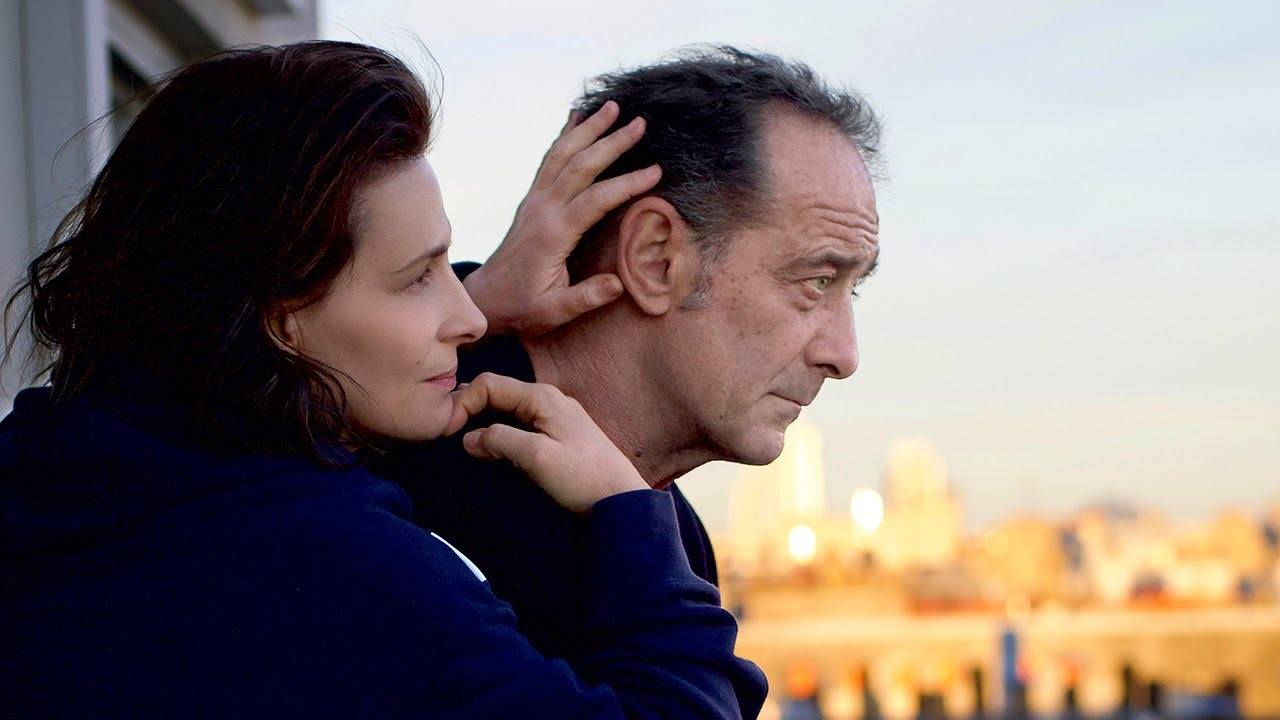
Even without knowing that the oft-bleak Claire Denis is at the helm, Both Sides of the Blade gives early hints that the joy present in its opening scenes isn’t going to last. Sara (Juliette Binoche) and Jean (Vincent Lindon) appear to have an ideal relationship that goes even beyond the happiness they display while on a beach vacation. They kiss in the ocean, holding hands beneath the surface of the water, but Stuart Staples’ melancholy score points toward a darker undercurrent. Once they arrive home in Paris, the romantic bliss continues, with playful interactions and enthusiastic sex broadcasting their close connection in their studio apartment. By all evidence, the couple has a solid relationship, but a single moment is all it takes to inch toward annihilation. For anyone surprised by the relative lightness of Let the Sunshine In (the first collaboration between Denis and Binoche), Both Sides of the Blade tips the scales back in the other direction.
The catalyst finds Sara seeing her ex, François (Grégoire Colin), while walking on the street. She is immediately undone, murmuring her former lover’s name on repeat. François and Jean were friends before Sara and Jean left their partners for one another, and they soon reconnect too, but their interaction largely serves as an opportunity for Sara to indulge her desire. She’s swinging wildly for something better, but also just for something different, even if it destroys the good thing she currently has. The film’s original French title, “Avec amour et acharnement,” is translated “With love and fury,” and Sara vacillates between the two with dizzying speed, kissing and screaming with equal abandon. She’s impetuous, intoxicated by the promise of another life.
The passage of time is unclear in Both Sides of the Blade; has it been days, weeks, or months since Sara first glimpsed Francois on the street? In some films, this lack of clarity would be a criticism, but here it keeps everything grounded in the present even as the reemergence of history threatens to upend three lives. There are shadows of the past — hints at the marriages before Jean and Sara’s current relationships, echoes of Jean’s time in prison and its impact on his life now — but these aren’t fully carved out in dialogue, just as they wouldn’t be in real life. A sense of immediacy propels Both Sides of the Blade forward, though it’s unclear exactly toward what, in a way that is indeed compelling.

Shot during the pandemic, Both Sides of the Blade is heavy with claustrophobia, though COVID isn’t central to its plot. Instead, it just shows up on the fringes and on occasionally masked faces. Though the worst of the isolation has passed, there’s still a sense of being trapped with this one person in a confined space, creating the desire to do something — anything — to break out and find freedom. Denis and DP Eric Gautier shoot the three lead actors with startling intimacy; an early scene has the couple speaking on either side of an ajar door, getting uncomfortably close to the actors. Denis has worked with each performer before, and there’s a palpable trust here, which leads to raw performances that work as well when the actors are yelling as when they’re saying nothing at all.
This isn’t the first movie to deal with infidelity — it’s certainly not the first French film to touch on the subject — but it doesn’t feel like it’s treading the same water. Both Sides of the Blade has elements of the classic erotic thriller, but this one is largely set on simmer, rather than the full boil of many of its American counterparts of the ‘80s and ‘90s. Other than a screaming match or two, it’s quieter, with a more naturalistic approach to sex. The genre often focuses on men’s experiences with cheating, but centering a woman’s feelings sets Denis’ movie apart. Sara’s moments of elation feel most familiar to Diane Lane’s all-too-brief thrills in Unfaithful. Unlike that film’s director, Adrian Lyne, Denis isn’t interested in morality or in punishing her female lead for her pleasure, whether derived purely from passion or from merely getting to make her own decisions. There’s no judgment here from the filmmaker (even as I frequently wanted to ask Sara, “What are you doing?!” as she sets fire to her own life).
Both Sides of the Blade is in conversation with the aforementioned Let the Sunshine In, but while that film tipped toward hope for Binoche’s character, this one is far cloudier for her counterpart. Both were written by Denis and Christine Angot and deal with questions of the nature of who we are in relationships, but each points toward a different conclusion. These stand as two of Denis’ most straightforward films, but they still leave questions lingering for days.
B+
“Both Sides of the Blade” is out Friday in limited release.