Kimber Myers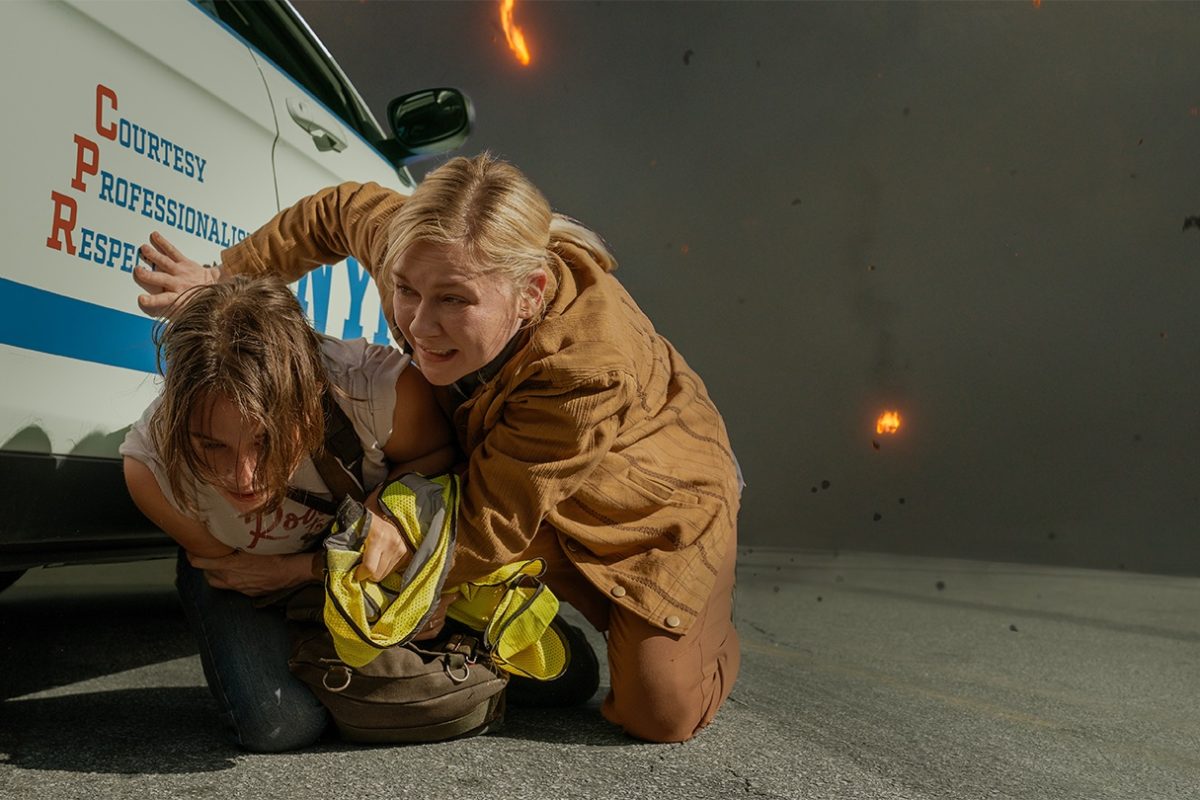
Civil War is Alex Garland’s most straightforward film, lacking the pure mindfuckery and utter batshittery of his previous work as a director — except that the audience is expected to accept a future where California and Texas find common ground to battle the rest of the United States. Other than that little ludicrous detail, this dystopian movie lacks the WTF trademarks of Men, Annihilation, and Ex Machina, but that’s not to say that Civil War doesn’t challenge its audience. This may mark an intellectually leaner effort from the filmmaker, but there’s still meat on the bone for the viewer to chew on. That is, if they can stomach anything after watching its brutal violence on American soil.
Garland’s script imagines a near-future America where the Western Front (aka California and Texas) are attacking the rest of the states, though the film is never explicit on the “why” of their secession. The British director will confound some people with his refusal to engage with U.S. politics (or even the basic facts of reality) in a story that seems so inherently political as it pits Americans against Americans in battle. Instead, Garland centers his story and its perspective on a cadre of war journalists intent on documenting the action, despite the personal risk.
Veteran photographer Lee (Kirsten Dunst) and reporter Joel (Wagner Moura) plan to travel from bomb-battered New York City to Washington, D.C. for the promise of interviewing the president (Nick Offerman), in the limited time he has left before the Western Front forces remove him from office. Lee agrees to let aging writer Sammy (Stephen McKinley Henderson) tag along on the trip, but she is infuriated when Joel invites young Jessie (Cailee Spaeny) to join on their dangerous journey as well. The quartet travels across state lines, giving Civil War the episodic feel of a road movie as they encounter horror after horror as they get closer to Washington, D.C.
Civil War doesn’t just focus on the critical role of journalism in capturing and sharing what is actually happening in war with both citizens and the broader world; it argues how truly awful and pointless it all is. In not offering insights into the cause of the conflict, it gestures towards how meaningless all the reasons for war are. The “why” doesn’t matter in the face of all this violence and mass death.

Additionally, Garland’s English birth marks him as an outsider who hasn’t bought into the myth of American exceptionalism (and who may be less concerned with mapping to current political realities), so he can envision that this kind of destabilization and the resulting atrocities could happen here. In Civil War, the version of the United States is not so different from all those other countries we’ve seen on the news or in documentaries. It can be easier for some to ignore the horrors when they’re in an unfamiliar place, but Garland stages this conflict across American big cities and small towns that are instantly recognizable, making the action resonate more deeply for those who can separate themselves from conflict that is far from home.
With Civil War, the director has made his most emotionally effective film to date. This may be less cerebral than its predecessors in Garland’s filmography, but it knows how to drive anxiety and empathy in the audience. My heart was in my throat throughout, with the tension only breaking for me to get choked up. Yet even with the potential for tears, no one should worry that the cynicism present in Garland’s earlier work is gone. He still offers a bleak view of the world, where most people are driven by self-interest and self-preservation.
Though Garland partners again with cinematographer Rob Hardy, Civil War is less visually striking than his previous work. In contrast with the futuristic or fantastical images in his other movies and the TV show Devs, this is set firmly in the real world, which is where its power lies. It contains indelible images, fitting for a film that focuses on the power and importance of documenting war as it happens.
Civil War has its thrills and some sly humor, but this is a grim, gripping view of war. Its barrage of blood and bodies feel like something out of a nightmare, but it is real life for so many as conflicts rage across the globe. Though it has some breathless action sequences, this isn’t mindless entertainment that feels like fantasy; every bomb and bullet hits close to home.
B+
“Civil War” is in theaters Friday.