Kimber Myers
Heist movies are driven by the thrills and pleasures of their crimes for the audience. The genre is propelled by our investment in the question of if the thieves (who we’re ostensibly rooting for) will be caught in the act or if the long arm of the law will eventually catch up with them before they can enjoy the spoils of the steal. What makes The Mastermind so fascinating is that while it has the basic trappings of a heist film—the planning of the crime, the assembly of a team, the act itself, and the getaway—it undermines the frissons of those traditional elements at every turn, from the structure of its screenplay to how each of those pieces plays out. And while The Mastermind has a sly sense of humor and isn’t entirely a downer, it’s still a Kelly Reichardt film. Don’t go in expecting a breezy Soderbergian caper where the victorious crew peels off on their own to the lovely sounds of Debussy.
As one might expect from the director of First Cow, Certain Women and Wendy and Lucy, The Mastermind is a deliberately paced, character-driven drama with plenty of down-beat moments and a low-key energy. It does have the requisite jazzy score of the genre, composed by Rob Mazurek, but it’s not backing up banter, action sequences, or elaborate plotting. Instead, The Mastermind is mostly character beats and dialogue, with a growing desperation as the film progresses.
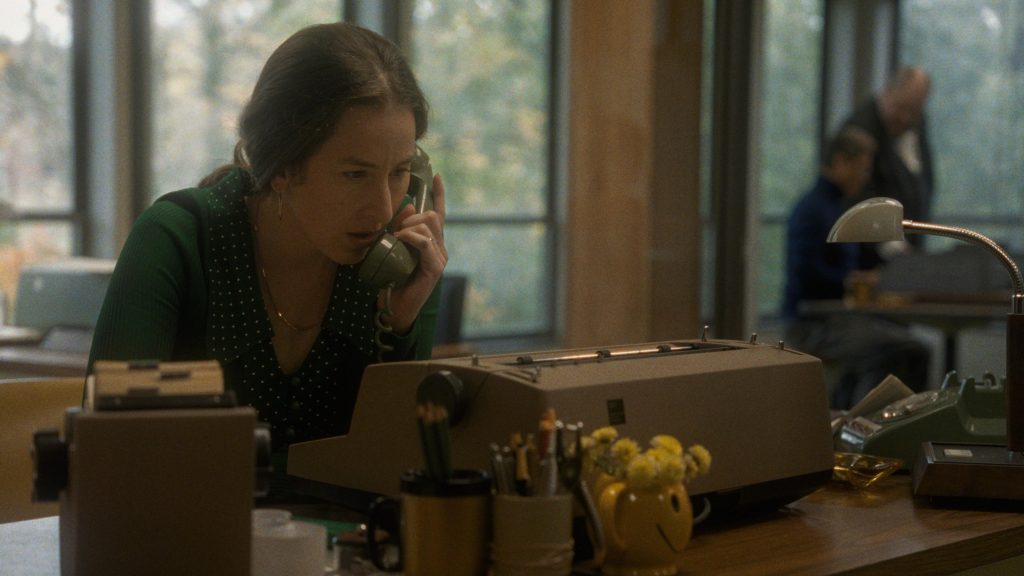
The Mastermind is set in Massachusetts in 1970, but we don’t learn that thanks to explanatory dialogue or a title card as we might in a more traditional studio movie. Instead, Reichardt offers clues to the year with unremarked-on details, set in the corner of the frame. She trusts that the audience is smart enough to catch on. The ‘70s setting allows elements of the story to function that wouldn’t work today, but Reichardt also has fun with the production and costume design with elements like a brown corduroy suit, an out-of-focus Rock ‘Em Sock ‘Em Robots playset in the background, and the omnipresent wood paneling in a finished basement. It also has the feel of a ‘70s movie in its approach, particularly in its shaggy lead character and his arc.
The Mastermind begins at the Framingham Museum of Art, where our protagonist—who is notably not our hero —J.B. (Josh O’Connor) is visiting with his wife (Alana Haim) and two sons (real-life brothers Jasper and Sterling Thompson). He surreptitiously palms a small carving and walks out with it, setting the stage for a larger theft. Harangued by his father (Bill Camp) for his lack of success in his career as a carpenter, he borrows money from his mother (Hope Davis) to pay a team to help him steal a quartet of abstract paintings by Arthur Dove. Yet the title winks at the audience, and J.B.’s scheme doesn’t go according to plan, with something going wrong at every step for the man who orchestrated the crime.
The art theft itself isn’t the climax. Instead, it’s executed in the first act, and everything that happens during the heist and after doesn’t follow the genre formula. The Mastermind refuses to indulge in the beats and scenes that usually make these types of movies entertaining. For example, Reichardt doesn’t show the fight between a museum guard and one of the thieves, leaving the action off screen while the rest of the crew waits in the car. Yet this is Reichardt’s most mainstream and accessible film to date, even with its diversions from what audiences might expect from the genre. It’s more melancholy than these types of movies are allowed to be, in keeping with Reichardt’s oeuvre, but there are still some quietly funny moments.
O’Connor has made a career out of playing characters who are varying degrees and types of pitiable, and J.B. fits in with his roles in movies like Challengers, La Chimera and God’s Own Country, while not feeling like he’s repeating himself. He plays men who are just a bit pathetic so compellingly. We’re never quite sure what he’s going to do next as he self sabotages, but we have to keep watching as he does it.
The Mastermind may not be Reichardt’s best film, but it hooks you in from its first moments to its Shakespearean ending. The title might be laden with irony for its main character, but it’s fitting for a director who is entirely in control of her craft and vision.
B+
“The Mastermind” is in theaters Friday.