Chelsea Spear
The music of Elvis Perkins streaked through the blog music era like a rare and beautiful comet. With his preppy good looks and New Hollywood upbringing, he brought an aristocratic elegance to concert stages and college radio airwaves. His evocative lyrics, plainspoken melodies, and homespun production suggested a missing link between post-Bob Dylan singer/songwriters like Leonard Cohen and Dennis Wilson and the 1990s indie rock collective Elephant 6 Recording Company.
After the release of his 2009 album Elvis Perkins in Dearland, Perkins balanced his solo work with collaborative efforts. One of his most notable collaborators is his brother Osgood Perkins, who transitioned from acting to directing with a string of stylish horror movies that effectively portray a creeping sense of dread. Drawing on the folk horror influence in Osgood’s movies, Elvis Perkins expands upon his background in folk music to expand upon the unsettling moods of his brother’s films.
The first voice we hear in The Blackcoat’s Daughter, in fact, is that of Elvis Perkins. As the opening credits roll, he trills a singsongy nursery rhyme-sounding verse at the top of his register: “deedle, deedle, blackcoat’s daughter/what was in that holy water?” This acapella performance, swaddled in a blanket of tape hiss and wind chimes, sets an expressive tone for the elliptical narrative that’s about to unfold, one that involves a pair of outcasts (Kiernan Shipka and Lucy Boynton) abandoned at boarding school the week before semester break and a young woman (Emma Roberts) who recently escaped a mental hospital.
As with the younger Perkins’s music, audiences who know about Osgood Perkins’s background can probably intuit some autobiographical details lurking in the corners of The Blackcoat’s Daughter. The feeling of desolation experienced by the two protagonists is so palpable and at times so specific, and the violence in the film’s final act can seem on first viewing as so random, that those who come to the film with a greater knowledge of the Perkins brothers’ lives might believe these moments were inspired by what happened to them. At the same time, Osgood Perkins is able to elide any self-indulgent impulses by grounding the specificity of some moments in the realities of the schoolgirls at the heart of the film.
The score for The Blackcoat’s Daughter was the younger Perkins’s first outing as a film composer. “The producers were intrepid enough to believe as staunchly as I did that he would somehow just know how to do it,” Osgood Perkins told Matt Fagerholm at Roger Ebert in 2015. “It was difficult for him to sort of get his bearings, but once he did, he would send me pieces of music, and they were just correct, at the drop of a hat. It was a pleasure for me to just slip the music in at the precise places where they belonged in the picture, and they all fit really well.” Early on, Elvis Perkins shows an innate skill for how film scores work, as in the first appearance of Rose, one of the main schoolgirls. When she enters the frame, a wordless choir and a stringed arpeggio play as she glides across the room. A skittering harpsichord and what sounds like a cymbal played backwards complicates the heavenly sound, foreshadowing that all might not be well with her.
In other scenes, Perkins goes against the expectations for a film score. His use of distortion flourishes throughout the second act, underscoring the sense of unease without lapsing into clichés. A repeated motif film is a wide shot of Katherine, the other student waiting for her parents in the dorms. When Osgood Perkins cuts to this shot for the last time, Katherine stands in shadow, facing the hallway with a fluorescent light above her. As the camera presses in on her and a deep voice speaks with her on the phone, a rumbling of distortion builds to a crescendo behind their conversation, and a scratchy bowed violin plays as Osgood Perkins and editor Brian Ufberg shuffle through a montage of scenes that led Katherine to this point.
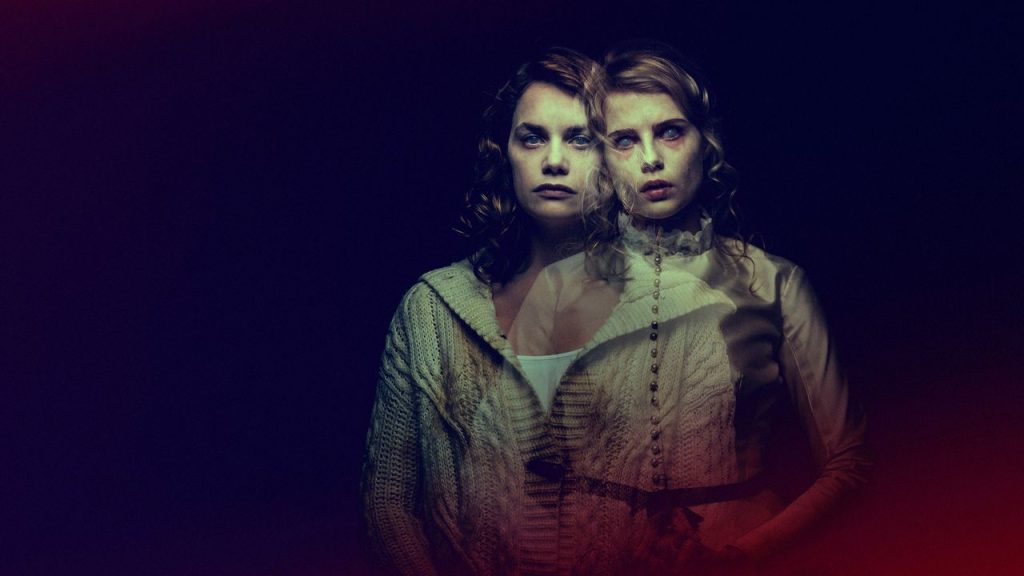
The Perkins brothers’ skill for establishing an unnerving mood through evocative sound design and anachronistic imagery flourishes through their next collaboration, I Am the Pretty Thing that Lives in the House. Narrated from the perspective of Lily (Ruth Wilson), a nurse living with retired horror writer Iris Blum (Paula Prentiss) who is in the final stages of dementia, the film is a reflection of Osgood Perkins’ attempts at connecting with his late father, the actor Anthony Perkins.
Appropriately for a film about memory care, the use of sound and music in I Am the Pretty Thing recalls the work of Leyland James Kirby, an ambient musician and engineer who used diegetic sound and library music to depict the progression of Alzheimer’s. As with Kirby’s project Everywhere at the End of Time, Osgood Perkins pulled a song from the archives to play throughout the film; Anthony Perkins’s version of the Irving Berlin standard “You Keep Coming Back Like a Song” floats through the film like a ghost in a haunted house.
The parallels between Kirby’s music and the sounds of I Am the Pretty Thing extend to Elvis Perkins’s score. A meandering melodic line floats through the opening scenes, echoing the groan of the footboards and the squeak of the door hinge. Chords from what sounds like a pipe organ hover over the opening scenes, offsetting the sunlit kitchen and parlor of Iris Blum’s cottage with the sense that something isn’t right.
Osgood Perkins has become one of the most prolific directors in contemporary horror, directing six feature films to critical acclaim and a devoted cult following. After the release of I Am the Pretty Thing, meanwhile, Elvis Perkins released his fourth album, Creation Myths, which applied his gifts for songwriting and production to a suite of stately folk-pop songs. Whether working separately or collaborating on a film project, the Perkins brothers have created a body of work that reflects the anxieties and melancholy of mortality.