Sara Batkie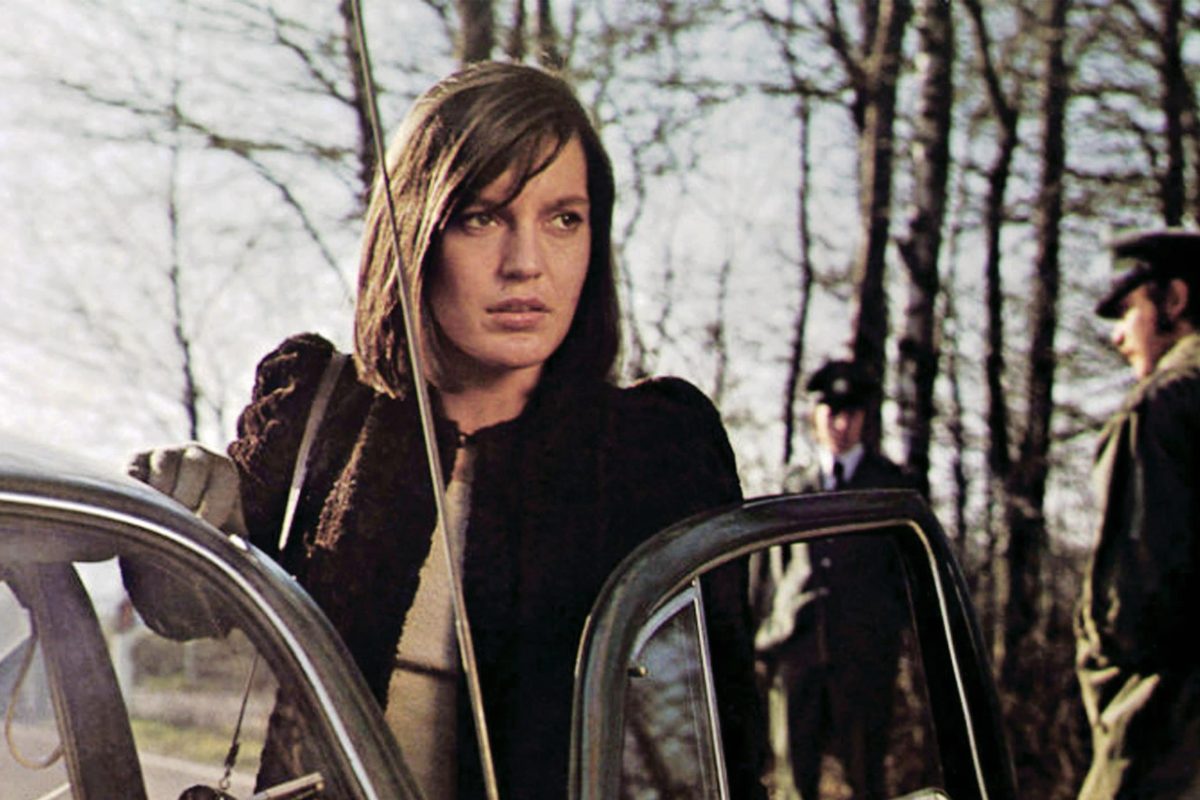
Midway through the 1970s, it must have felt like the world was on fire. The first half of the decade saw a steady increase in crime and political violence: Patty Hearst was kidnapped by the SLA; serial killers like Ted Bundy and the Zodiac were claiming their first victims; Nixon was in the White House. And that was just in America. Over in West Germany in 1975, all eyes were on the Stammheim trial as four founding members of the Red Army Faction were prosecuted for a series of bank robberies they undertook to fund their militant terrorism. The group’s activities were the inspiration for Heinrich Böll’s 1974 novel The Lost Honour of Katharina Blum. When the film adaptation appeared a year later, public opinion on the repressive government was nearing an all-time low. Even citizens with no radical ties were fearful of reprisal. Arriving in theaters fifty years ago with the force of a molotov cocktail, Blum has lost none of its incendiary power in the decades since. It might even have gained some.
Co-directors Volker Schlöndorff and Margarethe von Trotta waste no time thrusting viewers into the story present: the first thing we see is a title card stating it’s Wednesday, February 5th, 1975. They also waste no time setting up that this is a surveillance state: when we’re introduced to Ludwig (Lynch mainstay Jürgen Prochnow), we don’t know exactly who he is but we know he’s being watched, and not especially subtly. He’s tracked to a carnival party where he crosses paths with Katharina (Angela Winkler), a woman of such impeachable character that her friends call her “the nun.” Their connection is instantaneous, so much so that an undercover agent characterizes it as “a reunion” to his higher-ups. She invites Ludwig home with her but we see nothing of the time they spend together. It’s the only bit of privacy they’ll get. By morning, the police are assembling outside her door to arrest her, though he has already slipped away. The rest of the action unfolds with a similar breakneck intensity.
Böll’s source novel was told from a first-person plural perspective, which Schlöndorff and von Trotta, who also co-wrote the script, dramatize by steadily expanding the cast of characters caught in the crossfire. Aside from Katharina herself, there’s the police interrogation team, led by Kommissar Beizmenne (Mario Adorf) who seems to take a sadistic pleasure in maximizing Katharina’s humiliation. She’s forced to strip naked in front of the officers searching her apartment. When questioned about her relationships with men, Beizmenne spins out wild insinuations that make her attempts at honesty seem ridiculous in comparison. “Did he fuck you?” is one of the first things he asks. “That’s not the word I would use,” she replies. The same language becomes weaponized or meaningless depending on who’s speaking it.
The scope of damage widens with the introduction of Tötges (Dieter Laser), an unctuous reporter for tabloid rag The Paper. While operating under the auspices of a free press, Tötges pursues his leads relentlessly, cornering Katharina’s friends, neighbors, and ex-husband, many of whom prove only too eager to throw her reputation under the bus for a bit of fame. He even sneaks into the hospital where her mother is recovering from surgery, fabricating a malicious quote from her as she’s dying. All the while he’s exchanging information with Beizmenne, which draws the ire of Katharina’s wealthy employer and causes much hand-wringing for her “gentleman caller,” a political leader who has a vested interest in – and the privilege of – keeping his name out of the whole affair.
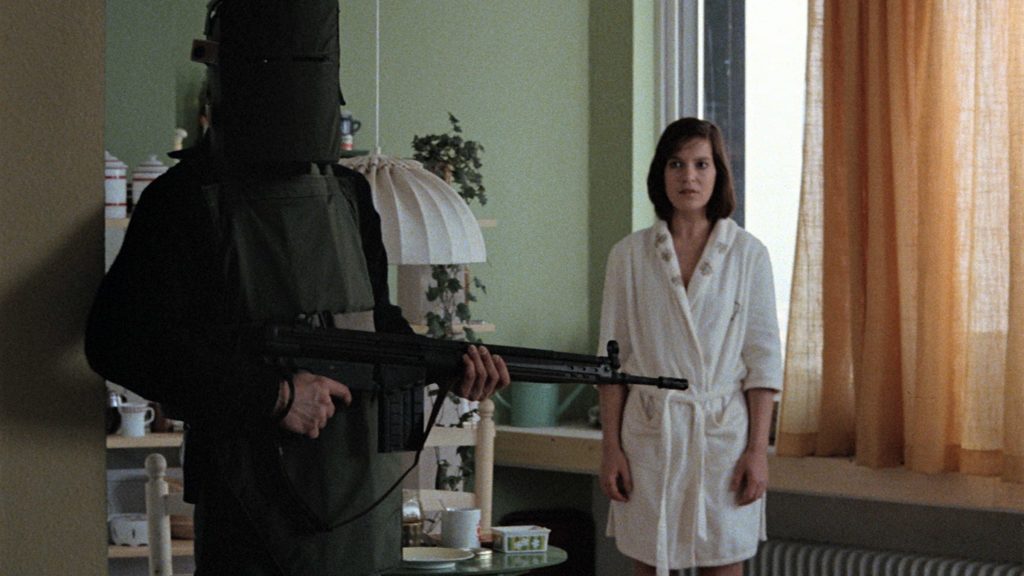
As the film’s subtitle – How violence develops and where it can lead – indicates, all of this is heading nowhere good, but who exactly are the victims and who the victimizers is continually being upended. What’s clear is that the atmosphere itself makes it possible for anyone to see themselves as either. Cinematographer Jost Vacano employs a documentary style, largely made up of unadorned stationary shots, to convey this. The grainy footage heightens the increasing direness of Katharina’s situation, bringing us into physical immediacy with her even as Winkler’s enigmatic performance reveals as little to the audience as it does to her jailers. We never feel she’s lying to us, and yet it’s hard to know what’s entirely true, either.
Many of the sets, particularly those in the police station, are also intentionally empty and abstracted, an endless series of winding white spaces. The occasional splatter of blood or vomit are the only indicators of what’s happening behind closed doors. When Katharina trashes her apartment after her release, leaving similar streaks of food and coffee on her walls, it underscores the prison her own home has become to her. This may be a particular week in 1975, but it could also be anywhere, at any time.
Fifty years on, it feels increasingly like the collective warning of Böll, Schlöndorff, and von Trotta hasn’t been heeded, especially in America. A country where the government, the police, and the press collude together against civilians can be democratic only in name. To become inured and jaded to mistruths and abuses of power is an even greater sign of cultural failure than being shocked by them, but it’s often the most vulnerable people who will be most hurt by the consequences. As The Lost Honor of Katharina Blum indelibly reminds us, collateral damage is still damage to someone.
“The Lost Honor of Katharina Blum” is streaming on the Criterion Channel and HBO Max.