Jason Bailey
There are a couple of moments in Joachim Trier’s new film Sentimental Value that played as if they’d been placed in the picture specifically for the TIFF audience — sly little side jokes pertaining to Stellan Skarsgård’s Gustav, a filmmaker of some note, though it’s been quite some time since he’s been able to put the money together for a narrative feature. I heard actual cackles when hot young American starlet Rachel Kemp (Elle Fanning), who has invited him to dinner after one of his retrospective screenings at a film festival just like this one, tells him what a masterpiece it is; her “team” nods and grunts in agreement, without taking their eyes off their phones. Later, her participation in his new film gets it financing — but at Netflix, where he’s horrified to learn it might not get a theatrical release.
But Sentimental Value is no inside-baseball show-biz satire; in fact, it’s perhaps not only his most moving picture to date, but one of his most relatable, concerned as it is with the complications of a tense familial dynamic. But the best movies are those that start about one thing, and by their end, you realize they’re about every thing. Sentimental Value is about family, yes. And then it’s also about depression and art and God and resentment and sex and longing and love and beauty and movies. Y’know — the important things.
The most admirable quality of Wake Up Dead Man, Rian Johnson’s latest Knives Out sequel, is how adroitly he manages to both deliver what audiences are expecting, and take real risks in the process of that delivery. This new mystery belongs to a different subset of the murder mystery, the supernatural-tinged Gothic stories of Poe or Wallace; this one is set in the small New York village of Chimney Rock, where Monsignor Jefferson Wicks (Josh Brolin), the head priest of Our Lady of Perpetual Fortitude, has been murdered — on Good Friday, no less — and the newer, younger Rev. Jud Duplenticy (Josh O’Connor) is the chief suspect.
Enter Benoit Blanc (Daniel Craig), but it’s a late entrance, a good 30 minutes in, following a complex setup that methodically introduces a sprawling cast of characters – not only who they are, but how they’re broken. But it’s never less than involving, thanks to the trust Johnson has earned in these previous installments. We put ourselves in his hands, and those of his tip-top cast; all are good, but Glenn Close may be the MVP, holding our attention in long, key scenes where she has to spin a yarn.
Some cringed at the explicitly online-political pieces of Knives Out, and they’ll feel the same about some of this material, but to tell a story about modern religion without getting political would be wildly dishonest. More importantly, when you least expect it, Johnson nimbly navigates a turn into genuine grace and empathy; Benoit Blanc may be a “proud heretic,” but I don’t think Johnson is, and that matters. Wake Up Dead Man does everything you want the third Knives Out movie to do — and then it goes deeper, which is some neat trick.

The funny thing is, when she was starting out in West Virginia in 1989, Christy Salters (Sydney Sweeney) wasn’t even a trained boxer; she was a college basket-baller who entered a Toughman competition “for fun.” She has no idea what she’s doing, no form or style — all she knows how to do is punch, but boy can she ever do that. Director David Michôd tells her story in Christy, which starts out looking like your typical sports underdog story, and plays well enough on that level; I dug the how-it-works of this corner of the pro sports world, where her initial bouts are held in the middle of a speedway on off-nights. And it appears to set up the standard relationship between the underestimated fighter and the tough-as-nails but ultimately saintly corner man. And then it takes a turn.
That turn is what makes Christy special, as her trainer Jim Martin (Ben Foster, whom it took me three full scenes to recognize) sees her soft spots, and goes in for the kill. He’s a manipulative monster, which creates parallel tracks of doom and dread as she fights tooth and nail to stay on top of the burgeoning world of women’s boxing, all while eyeing the door of a physically and emotionally abusive marriage. Sweeney’s choice to star (and produce) a de-glammed “physical transformation” vehicle feels calculated, and it probably is. But it’s a genuinely excellent and complicated performance, and she has a gut-punch moment near the end that absolutely made a mess of this viewer. You’ll know it when you see it.
No one is out there doing it like Park Chan Wook, who makes films that are all but unclassifiable, save for the common quality of their visual flair. His technical prowess — the precision of his compositions and camera movements — is all but unparalleled, and he’s worked so impressively in so many genres that it’s hard to say what a “Park Chan Wook movie” even is. But it’s impossible to deny that his latest, No Other Choice, feels influenced by the success of his countryman Bong Joon-ho’s Parasite, since it’s so explicitly about class and adopts a similarly satirical tone. Park’s hand isn’t as steady as Bong’s, though, tipping so often into outright slapstick that No Other Choice feels just as influenced by the Three Stooges as Hitch. And if that sounds like a tough combo to pull off, well, it is.
It’s never less than fascinating, though; the narrative, inspired by a Donald Westlake novel, is so narratively playful, so light on its feet, that you can’t predict where it’s headed. There is residue of A Shock to the System here and there, as well as flashes of film noir and even martial comedy-of-manners (our hero and his wife have a fun, frisky, supportive dynamic, though it gets put through the wringer). In other words, like much of Park’s filmography, it’s distinctively his, which is part of why a late plot point concerning AI seems so pointed — since his work is so singular and inimitable.
Kokuho is one of the most commercially successful films in Japan’s entire history, and it probably speaks poorly of our respective cultures that they can make a three-hour drama about kabuki actors into a Marvel-sized blockbuster. It covers 50 years in the lives of these two actors, who we meet as young boys. One is the son of the legendary kabuki actor Hanai Hanjiro (Kan Watanabe, excellent as always), so the stage is in his blood. The other is the son of a powerful yakuza, who is killed in front of him in the electrifying opening. But Hanjiro has seen the boy perform, and is impressed, so he takes him on as an apprentice.
Kokuho and Hanjiro’s son Shunsuke are bonded by the fire of their intensive, exhausting physical training, but as they get older, and gain fame together as “The To-Han Duo,” the father who brought them together ends up tearing them apart. Kukoho follows the broad strokes of the showbiz rise-and-fall narrative, but it’s told with such specificity and sensitivity that it busts out of the formula. It’s a quiet, observant picture, taking us into these backstage and rehearsal spaces with an insider’s knowledge and sense of shorthand. Most of all, director Lee Sang-il shows a fierce respect for the form of kabuki, demonstrating its artistry and difficulty, and capitalizing on the tremendous vulnerability of this style of acting. By the end, you’re as caught up in their performances as the off-stage story that leads them there.
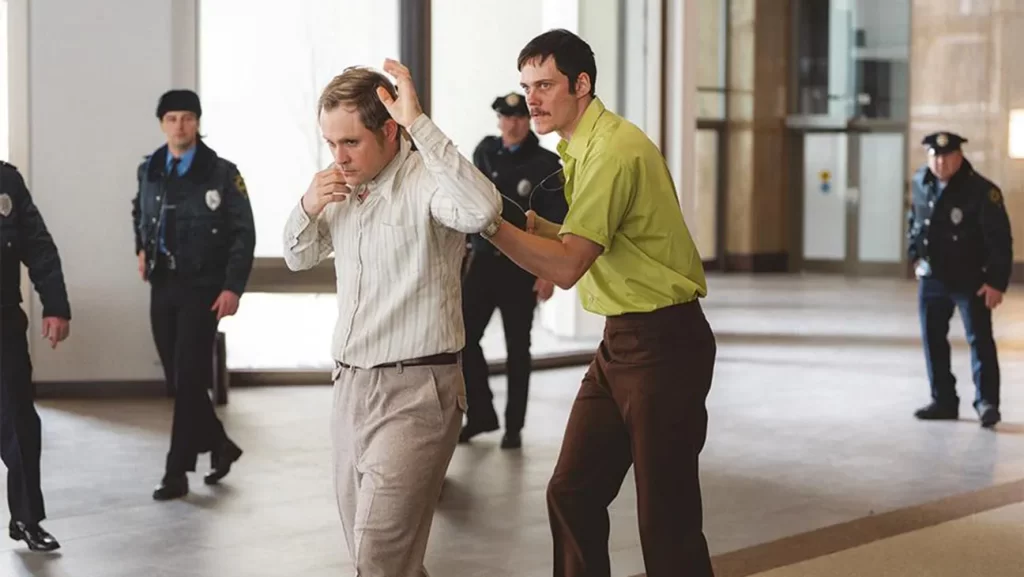
I didn’t think of the story of Tony Kiritsis (which I’d seen in the fine 2018 documentary Dead Man’s Line) when the Luigi Mangione story was in the news, but it’s hard not to connect it. In February of 1977, frustrated and deeply in-debt Indianapolis resident Tony Kiritsis marched into his mortgage holder’s office and wired a shotgun to his broker Richard Hall’s head, taking Hall hostage until his mortgage debt was forgiven. It became a media sensation, unsurprisingly, turning Kiritsis into a folk hero, and if you don’t believe those feelings persevere, consider the TIFF audience’s response to the story’s outcome in Gus Van Sant’s new dramatization, Dead Man’s Wire.
Van Sant does his best to make the story come to life, primarily by making it look like a ‘70s drama, with freeze-frames, still photos, a period-reminiscent score by Danny Elfman, and archival (and convincingly faux-archival) video footage. But Austin Kolodney’s script doesn’t really hold together; the portraiture of local media is heavy-handed and cartoonish, the procedural pieces are fairly compelling but mostly generic, and he can’t find a consistent tone or even approach to the central two-scenes between Hall and Kiritsis, played by Dacre Montgomery and a badly miscast Bill Skarsgård, who is too young for the role and plays him far too comic. And not to second-guess Mr. Van Sant, but if I were making a ‘70s-set hostage thriller that’s based on a true story, I might not cast Al Pacino, because reminding audiences of Dog Day Afternoon only makes Dead Man’s Wire suffer in comparison.
The story goes that at one point during its long trip through development hell, Good Will Hunting was turned into a kind of paranoid thriller, in which Will’s next-level math skills were put to use by the federal government. Cooler heads prevailed, thank goodness, but I kept thinking of that phantom version during Tuner, the narrative debut of documentarian Daniel Roher (Navalny), a very good story of a preternaturally gifted young man who finds his considerable gifts are of interest to nefarious types.
Niki (Leo Woodall, off-handed and understated) was once a piano prodigy before he was hobbled by hyperacusis, a hearing sensitivity that makes him “allergic to loud noises.” Now he’s a piano tuner, the kind of hyper-specific profession that can make for fascinating viewing; he works as an apprentice to old-timer Henry (Dustin Hoffman, delightfully cantankerous), until he discovers that his sensitivity to sound makes him a first-class safecracker.
Complications ensue, none of which are much of a surprise, but it’s hard to complain when it’s such a jazzy, good time. Roher’s direction is stylish as hell, with a sense of musicality to his montage (reminiscent of early Aaronfsky) – appropriate to the material, obviously. His visceral, immersive sound design put us right into Niki’s head (often uncomfortably), and Will Bates’s four-star score really gets you going. Tuner is a crowd-pleaser in the best sense — satisfying entertainment that doesn’t insult the intelligence. And its closing line is one for the books.
The lovers-on-the-run flick was one of the staples of ‘90s indie cinema, and I, for one, would welcome its comeback. A persuasive case is made by Carolina Caroline, the latest from one-to-watch director Adam Carter Rehmeier (Snack Shack, Dinner in America), who displays real confidence and swagger in both his style and his patience as a filmmaker. The opening sections are the best, reveling in small town America Badlands vibes, as Caroline (Samara Weaving, further staking her claim as the B-movie Margot Robbie, complimentary) connects with Oliver (Kyle Gallner, fast becoming one of the most reliable actors in indie film) after catching him pulling the old making-change con at the counter of the gas station where she works.
She’s stuck in the nowhere Texas town where she was born; he’s just passing through, but something happens between them. Their chemistry (and Weaving and Gallner’s) is electric, and Rehmeier beautifully bottles the hazy, half-drunk, horny energy of a brand-new relationship. As he pulls her into his orbit, we see why his pitch, his approach, his philosophy is so attractive to her — but Gallner’s masterful performance also lets the mask slip occasionally, so we can catch the tiny indications that this is a practiced act. Some of the dialogue sounds like dialogue, the self-satisfaction of the post-post-post-modern screenwriter, and you can feel the narrative gears grinding in the back half, which blows the picture’s considerable spontaneity. But Rehmeier (and his camera) push in tight and intimate as the walls close in, and the Guncrazy energy of the last climax is awe-inspiring.
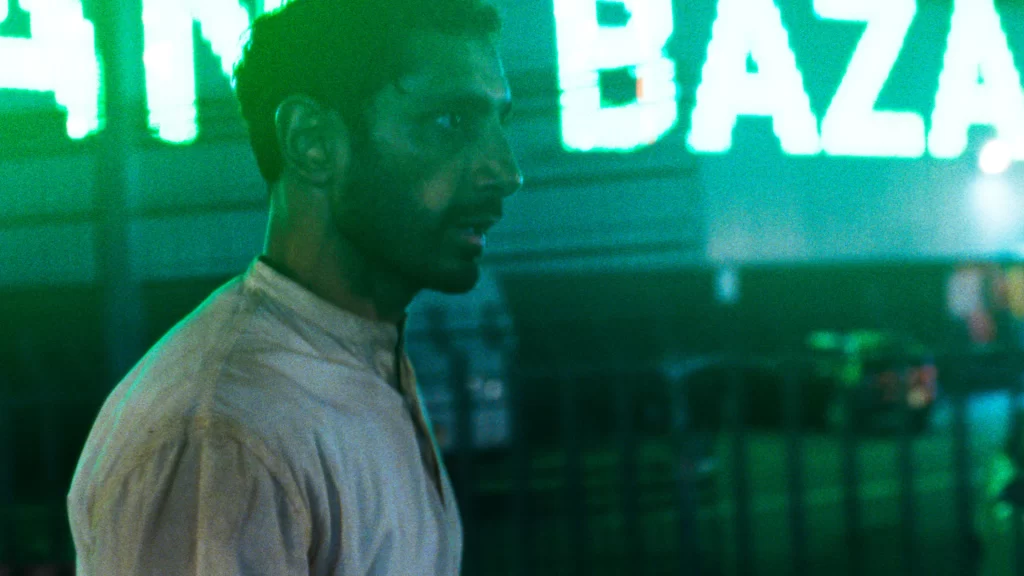
If you live long enough on this earth, you’ll see enough interpretations of Hamlet that you can start to make little spreadsheets in your head as you watch a new one, checking off the similarities and noting the differences. Aneil Karia’s new modern-dress version, with Riz Ahmed starring as the melancholy (no longer) Dane, is one of the boldest I’ve seen, in terms of futzing with Shakespeare’s text; it features an inspired rejiggering of the timeline, folding the wedding of his mother Gertrude and uncle Claudius into the narrative, rather than having it precede the events therein. This allows us to see Hamlet’s first reaction to the union (a priceless take by Ahmed), turns his curtain speech for the damning play into a cringe wedding toast, and the play itself into a wedding performance, all smart shifts that allow us to consider the events anew.
Other interpolations are equally clever; I’ll do a bit more intel on this, but this is likely the first Hamlet adaptation to feature the title character doing bumps in a strip club. Yet it totally makes sense as the incitement for his conversation with his father’s ghost, and is a fine example of Karia and screenwriter Michael Lesslie’s intentions. They’re not just doing this stuff to be clever — they’re heightening, and even strengthening, the text.
Ahmed plays the character as the jittery neurotic he’s always been, and it proves an ideal vehicle for the burning intensity this actor conveys so deftly. It’s an extraordinary performance, not just in the big moments (though he delivers on most of those) but in the quiet way he spins his line readings, making some of the most familiar dialogue in the English language into something fresh and spontaneous. That goes for this entire adaptation, which taps into the raw, emotional core of the play, and strips it to the marrow.