Cian Tsang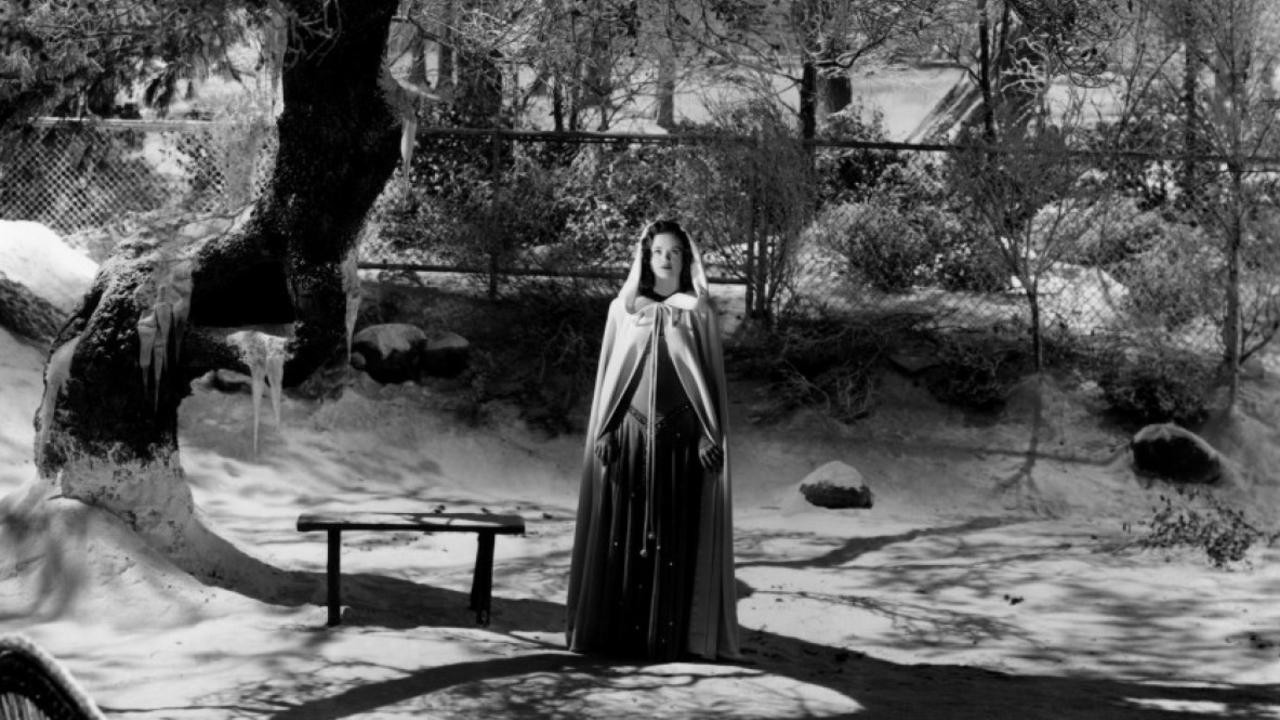
When we first see young Amy Reed (Ann Carter), she’s in a world entirely of her own. Slipping into an almost trancelike state, she silently abandons her classmates as they play in the woods, preferring the company of a butterfly by which she’s captivated. “You’re my friend,” she says to the delicate creature, “come play with me.” But then reality shatters her reverie—a young boy catches and kills the butterfly, and Amy’s only grief-stricken impulse is to strike the perpetrator in retaliation, landing her in trouble with her anxious father Oliver (Kent Smith). “Amy has too many fancies and too few friends,” he says, “and it worries me. It doesn’t seem normal.”
So begins The Curse of the Cat People, a film whose elegantly conjured atmosphere of wintry wonder, and boundless empathy for its lonely, sensitive young protagonist, make it so much more than just the festive oddity to which it could so easily have been reduced. There’s something quite miraculous about this film—a lean, low-budget horror sequel, which somehow manages to articulate better than any children’s film the pangs of melancholy that come with being a misunderstood daydreamer. In true holiday spirit, the horrors inflicted upon the innocent here come not from extrinsic forces, but from within the ostensibly immaculate family—the imaginative child is punished for the sins of her father, whose failure to process loss has a lacerating effect on his loved ones.
When the studio executives at RKO greenlit a follow-up to Cat People, hoping to capitalise on the financial success of the chilling B-movie masterpiece, they surely could never have anticipated that the result would be anything like what they got. The original film, a startling exploration of sexual repression conveyed through director Jacques Tourneur’s eerie shadow plays, tells the story of Irena (Simone Simon), a Serbian in New York City who lives in constant fear of her own desires—she believes that if she succumbs to her basic appetites, she’ll transform into a monstrous panther. She weds Oliver, but the marriage is unconsummated, and as her frustrated husband falls into the arms of his pining friend Alice (Jane Randolph), Irena kills herself, refusing to capitulate to her devastating bestial urges.
The Curse of the Cat People is an almost entirely different species, carrying characters over from its progenitor only as conduits through which to explore its own separate emotional preoccupations. Oliver and Alice are now married, but Irena’s essence seems to linger ominously over their new life, clinging like a miasma to their superficially picture-perfect domesticity. Oliver keeps photos of his first wife, refuses to get rid of her favourite painting, and sees in Amy the same proclivity for fantasy that he believes drove Irena mad. “It’s almost as if there were a curse on us,” says Alice, as she ponders the growing fissure that threatens to alienate her and her husband from their child, “I wouldn’t care if it were on me, but it seems to be directed against Amy. I sometimes think Irena haunts this house.”
The curse, though, isn’t on Amy, but on Oliver, the bereaved husband who fails to confront the past, allowing his unresolved grief to fester and poison his relationships. Oliver buries the memory of Irena shallow, his resentment towards what he still believes to be her supernatural feline delusions curdling into cruelty towards his daughter. There’s a thorniness to the idea of a man whose denial of the past drives him to force his child to deny her own self, and indeed the film is never more distressing, even frightening, than when Oliver is castigating Amy for her tales of companions who elude his detection, resorting to corporal punishment when verbal reprimands prove ineffective.

For Oliver, the explanation that Amy might simply be extremely imaginative isn’t good enough—there must be something self-destructive about her need for private solace. A daydream is a pernicious lie, a grim harbinger that must be smothered in its infancy. The irony, of course, is that the more Oliver strains to eradicate Amy’s dependence on conjurations, the further away she drifts from him, and the stronger her coping mechanism grows. Oliver is even responsible for giving Amy’s closest companion its shape—it’s only when she stumbles upon one of his photos of Irena that her ghostly guardian, at first a mere amorphous shadow, gains a name and a face. Oliver invites the apparition in, gives it substance and personality, and can then do nothing to purge its presence.
Gunther von Fritsch and Robert Wise are the credited debut co-directors on the project, and both do sturdy work here, especially for neophytes. But it’s legendary writer and producer Val Lewton, who worked on the original film, who’s the primary mind at work again here, smuggling his signature psychological contraband under the radar. There’s an autobiographical current flowing through the film’s veins—Lewton grew up not far from Tarrytown, New York, where the film takes place, and was himself prone to oneiric lapses as a child, hence the film’s intimate understanding of Amy’s inner life and escapist impulses.
From first frame to last, the film tethers us to Amy’s perspective, sculpting a fairy tale aesthetic out of light and shadow, affording us access to the child’s world of magic, which remains invisible and impenetrable to the adults around her. Cinematographer Nicholas Musuraca, who alongside Tourneur crafted the original Cat People’s look of shimmering, expressionistic dread, returns here to give The Curse of the Cat People its tangible sense of liminality, weaving an atmosphere that straddles the threshold between reality and unreality, between Christmastime cosiness and otherworldly anxiety. The film is astonishing at times, containing images of striking sublimity and poignancy: Amy’s hand trembling and swaying in the cloudy water of a pond; her wish for a companion causing the sun to drop and a sudden breeze to whip up dead leaves into a glittering flurry, turning the backyard into a storybook illustration; Amy blanketed in the shielding shadow of a compassionate spectre; and the emotionally wounded girl fleeing from her father’s tyranny, wandering the forest in a snowstorm, tiny and vulnerable against a backdrop of uncanny beauty.
For all of its visual splendor, the success of the film still hinges almost entirely upon Ann Carter, whose work here surely ranks amongst the pantheon of great child performances. Just seven years old at the time of filming, making her fifth appearance on the big screen, Carter is a remarkable discovery, with a glassy gaze that’s at once innocent, inquisitive, and ever so slightly unnerving. It’s Carter who crystallises the film’s psychological preoccupations, who imbues Amy with the sense of a raw soul who’s forced to negotiate and grapple with the sort of growing pains that no child should be made to endure. Watch how Amy’s face changes as she summons Irena to protect her from the menacing, murderous Barbara Farron (Elizabeth Russell), who sees in Amy her younger self—a perfect target for cathartic rage after years of suffering at the frosty hands of her self-deceiving mother. Watch how instinctively Carter transforms fear into hope, into elation, and finally into unadulterated tenderness, reaching out with eyes that peer right into the depths of a kindred spirit.
Carter is totally singular, of course, but whenever I watch her work here, I still can’t help but think of two other miraculous child performances. I think first of Fairuza Balk as Dorothy Gale in Return to Oz, Walter Murch’s sinister, enchanting sequel to the indelible Christmas classic The Wizard of Oz. Balk, like Carter, captures with remarkable clarity the inner life of an imaginative young girl whose sense of security has been torn away from her, who’s forced by the adults around her to come to terms with the idea of her own insanity. I think also of Linda Manz in Days of Heaven, whose piercing narration brims with the sense of innocence lost too soon. And in thinking of Days of Heaven, I then think of the last sentence of Roger Ebert’s essay on that Terrence Malick masterpiece, which I believe gets right at the heart of The Curse of the Cat People too: “This is a movie made by a man who knew how something felt, and found a way to evoke it in us. That feeling is how a child feels when it lives precariously, and then is delivered into security and joy, and then has it all taken away again—and blinks away the tears and says it doesn’t hurt.” 
“The Curse of the Cat People” is available for digital rental or sale.