Jason Bailey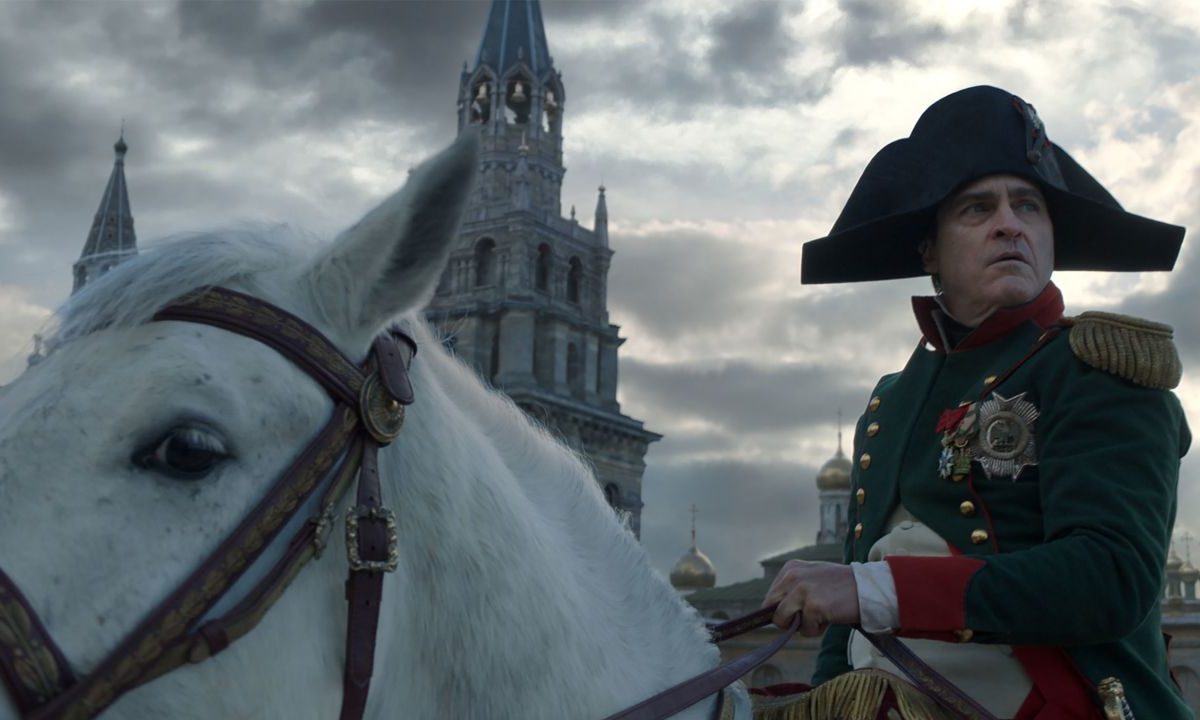
As moviegoers, we often leap to the immediate assumption that films about historical figures and events must be dry, dull, homework; this is just a case of leftover prejudices, memories of squirming impatiently in world history classes, battling boredom and hormones. Ridley Scott’s Napoleon has no interest in being (or perhaps even, doing) homework. It’s a ribald, spirited, bleakly funny epic, noteworthy primarily for focusing on a Napoleon who is played as barely less of a weasel than he was in Bill & Ted’s Excellent Adventure.
To be clear, Scott does the expected stuff well, too. Spanning from the 1789 French Revolution (lingering, with perhaps uncomfortably loving detail, on the beheading of Marie Antoinette) to the general-turned-dictator’s death in 1815 (in a sequence that pays surely intentional homage to the death of Don Vito in The Godfather), David Scarpa’s screenplay keeps the expositional text and dialogue brief and to the point, and the political and military material clear and direct.
There are, of course, large-scale battle sequences — though not as many as you might expect, and Scott does a yeoman’s job of keeping movie battle fatigue at bay. Each sequence has a distinct setting and feel, both narratively and cinematically; the first, for example, the taking of a harbor fort, is impressively outsized, but also messy and bloody. It doesn’t feel “staged,” but has an improvisational energy that matches what we’re told, before and after, about Napoleon as a military strategist. A later battle against Russian and Austrian forces on a snow-covered battleground is aesthetically opposite, a gorgeously horrible bloodbath, brutal yet elegant, brilliantly executed by both general and director.
Those are the scenes we expect Scott to slay. The welcome surprise is that Napoleon is just as compelling off the battlefield. There are some troubling signs early on; it takes a few scenes to properly orient who is what to who, and Scott has made the perhaps dubious decision to make the picture as an old-fashioned dialect soup, with his actors keeping their native accents. It spares us the possibility of Joaquin Phoenix making like Johnny Depp in Tusk,, a pointed choice of viewer alienation over immersion.
Once things take off, however, it hardly matters. Chief among his achievements, Scott has finally given moviegoers the kinky Napoleon and Josephine we’ve been waiting for, and as the latter, Vanessa Kirby comes on like a brewing hurricane. A widow when they meet, she purringly warns him of her previous “indiscretions,” and when we take in her bored expression when he’s behind her, we know more are in the offing. When he discovers she has “taken a lover,” he initially laughs (“You expect me to believe my wife would do this to me?”), but then it’s literally in the newspapers, so he must deal with a humiliation he was all but expecting.
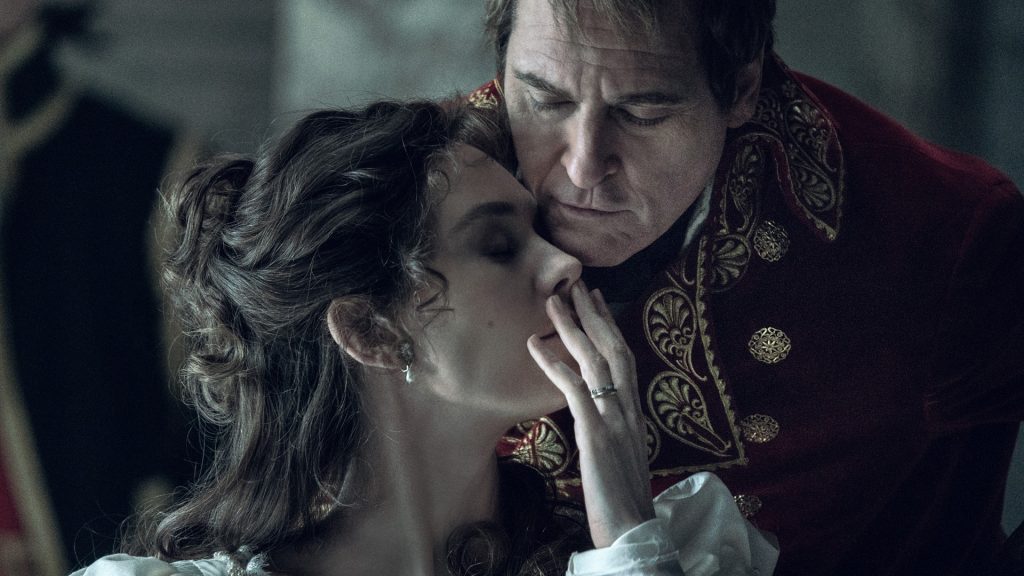
“I am not subject to petty insecurities,” he insists (uh huh) and will only take her back if she begs: “You are nothing without me,” he insists. “Say it.” But in the very next scene, she turns the tables, and makes the same command. Their sexual mind games and power plays become a part of their relationship (“Can you feel that? That’s yours.” “Thank you.”), and folks, battles are battles, but this stuff is the real juice. One can complain that Napoleon suffers from indecision of tone, and that’s not invalid — the moves from giggling sex comedy to bloody war chronicle can invoke a bit of whiplash. But the contradictions of the film are arguably a meeting of medium and message; Napoleon himself was a man of contradictions (blithering idiot, but brilliant strategist), so why wouldn’t his biopic be rife with them?
Scott traditionally gives his actors tremendous freedom, which can sometimes mean hanging them out to dry (witness Jared Leto’s sub-Mario work in House of Gucci). But the performances are all on the mark here. Kirby is quite good in a nearly impossible role — she finds the inner truth of even Josephine’s wildest vacillations — and Phoenix digs into the role with relish, though (at risk of sounding like one of those fuddy-duddies who complained about Brando), a couple of seemingly good moments are marred by the difficulty of understanding his dialogue. Articulate, marble mouth!
Scarpa’s script has a sly sense of situational humor; he’s deeply amused by the court’s various anglings and machinations to produce an heir, but some of the biggest laughs are off-hand ones (watch for the scene of Napoleon nonchalantly grabbing any old sword). The biggest surprise about Napoleon is how funny it is, though that shouldn’t be; the Ben Affleck scenes in The Last Duel were laugh riots, and the best comic material here is directly reminiscent of that. Napoleon Bonaparte is gleefully written and played as a petty little bitch, and you haven’t really lived until you’ve heard him wail, “YOU THINK YOU’RE SO GREAT BECAUSE YOU HAVE BOATS!” Scott, Scarpa, and Phoenix mine all of the cringe comedy of his pettiness, his selfishness, his silliness; it’s not often you see a big-budget historical biopic depict its subject as a tantrum-throwing child. Then again, such contradictions are essentially timeless. I’d never do anything as 2017 as noting a character’s Trumpian qualities, but as I watched Napoleon wading through his thinning, freezing troops, bellowing “WE’RE WINNING,” well, it was hard to think of much of anything else.
B+
“Napoleon” is in theaters Friday.