Marya Gates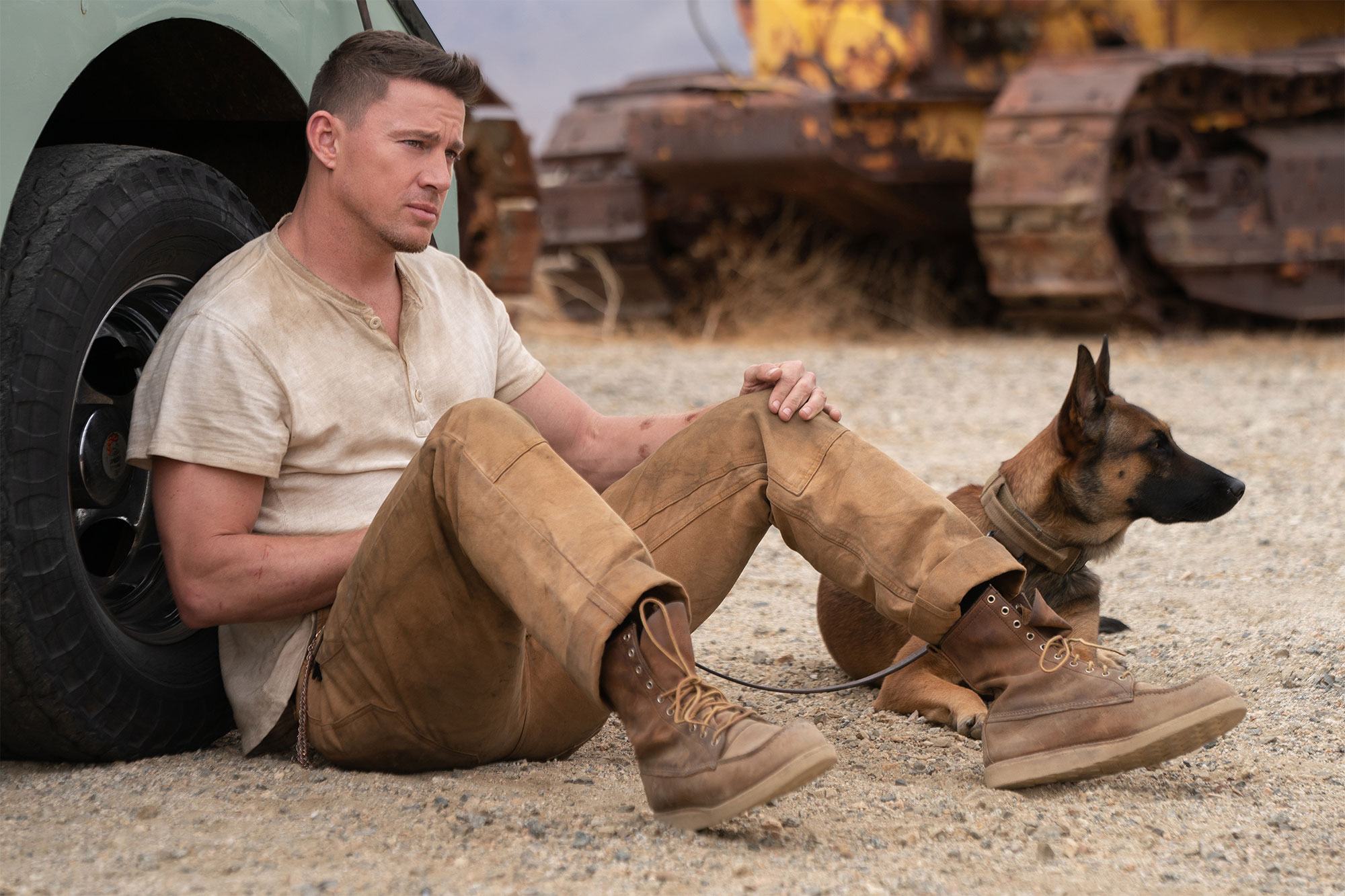
We first meet Lulu, the titular Dog, through a montage of her as a puppy, in training with her soldier owner Sergeant Riley Rodriguez (Eric Urbiztondo). This scrapbook, known as an I Love You Book, is also filled with harrowing drawings of the dog in battle, accompanied by letters from Rodriguez to his canine companion. “You are more than just a dog,” one reads. From the start it’s clear that Dog has higher ambitions than to just be a Channing Tatum-led buddy road trip.
Co-directed by Tatum and his longtime creative partner Reid Carolin, and co-written by Carolin and former soldier Brett Rodriguez, Dog finds its origins in the 2017 HBO documentary the trio produced called War Dog: A Soldier’s Best Friend. This authenticity pulses throughout, although the film is resultantly overstuffed with too many surface level observations of their reality, without much deeper insight.
As former Army Ranger Briggs, Tatum is charming as ever, equally at ease with comedy one-liners as he is with the heavier psychological aspects of the role. Still reeling from PTSD and debilitating migraines, Briggs works at a deli while trying to get back on active duty. He’s been out for three years, and despite his emotional issues and probable brain injury, he’s somehow got himself a full bill of health. His C.O. will only sign off for him to join the last rotation of the year if he takes Lulu the 1,500 miles from their base in Washington state to Rodriguez’s funeral in Arizona. Lulu has “every combat trigger in the book” and is set to be put down after attending the funeral.
Early on the filmmakers draw a parallel between the fate of this hero dog and Briggs. after Lulu’s montage, the film begins with a heavy panting through the darkness of dawn. But they pull a fast one and reveal not the dog, but an anxiety-ridden Briggs on the floor in the midst of an attack from his lingering PTSD. As the two make their way down the Pacific Coast Highway in an 84 Bronco, Briggs says to Lulu, “the Army has no place for liabilities, but that’s what you are now.” It’s not subtle, but it works. Briggs needs just as much time and attention and love to heal from his combat trauma as Lulu does. They’re both warriors who were trained for one thing, then abandoned by the system that trained them when they were no longer capable of doing the work.
Briggs repeats the line “rangers find a way to die” three times: when he first learns Rodriguez has died, when he’s told Lulu will be put down after the funeral, and when it’s revealed how Rodriguez really died. This examination of the toxic and addictive cycle of service Briggs has found himself in is reminiscent of The Hurt Locker. But also could be seen as the flip-side of Stop-Loss, which also co-starred Tatum, and its exploration of an exploitative policy that trapped soldiers in extended duty. Although Dog does tackle the psychological fallout of serving like those earlier films, it’s clear Tatum and Carolin are determined to show not just the darker side of their reality, but find hope in it as well.
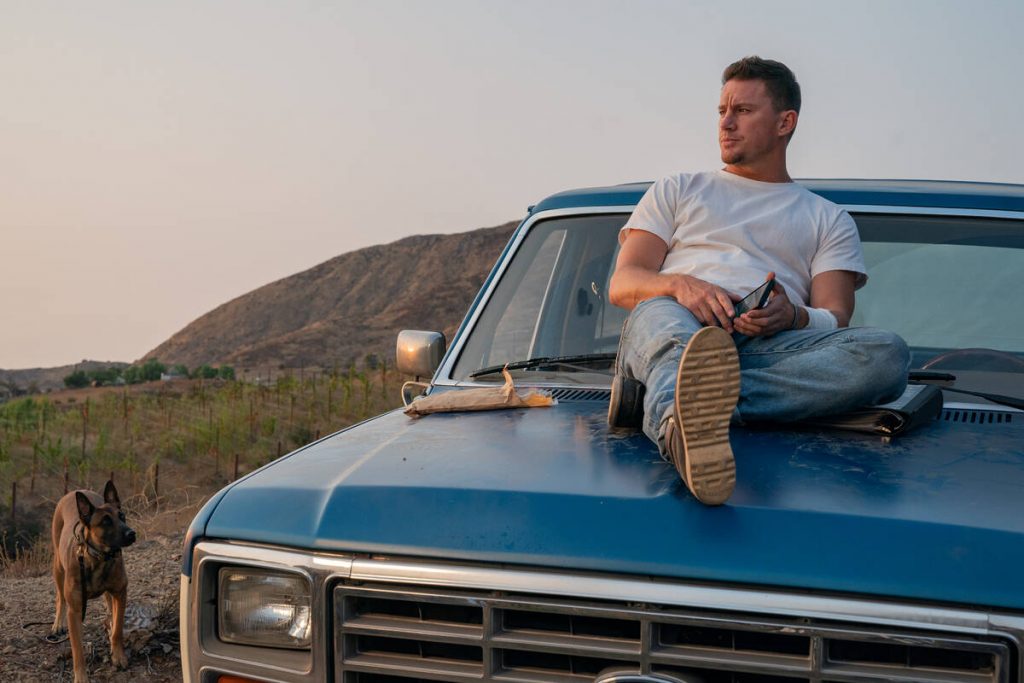
The chilling way Briggs nonchalantly reminds Lulu of how they used to “get their murder on,” or says that no one takes the art therapy after a brain injury seriously, is contrasted when the two meet up with fellow former Ranger Nathan (Ethan Suplee). Living in Los Angeles, Nathan has adopted and rehabilitated Lulu’s brother Nuke, and through this meeting Briggs sees another path. Rangers may find a way to die, but it’s also possible for them to find a way to live. Again, the filmmaking here is not subtle, but it’s affecting. Nathan offers Briggs a mirror of himself – what can be if he chooses to do the work. Like Tatum, Suplee is an actor capable of great range, here tapping into a deep well of complex emotions. Under his calm demeanor belies the same storm in which Briggs is still caught.
It’s in these moments of pathos in which the film finds its greatest strengths. However, it teteers too often into the straight comedy, which undercuts its potency. Early on Briggs makes a detour into Portland, where a series of women find his veteran status mostly something he must overcome, before almost engaging in a threesome with tantric healers Bella (Emmy Raver-Lampman) and Zoe (Nicole Laliberte). Between this and Niki (Q’orianka Kilcher), the underwritten mother of Brigg’s three-year-old daughter, the filmmakers want to say something about the sexual and romantic lives of soldiers, but it’s incredibly muddled.
Somehow in the mix there’s also jumbled commentary on ACAB military police, racial profiling, and the often hidden veteran status of Los Angeles’ houseless population. While it’s admirable that the filmmakers want to show as many angles of post-military life as they can, their approach lacks cohesion and pulls focus from the main theme of rehabilitation.
Dog works best when it sticks to the emotional journey of Briggs and Lulu. The compelling chemistry Tatum crafts when acting opposite just the dog showcases his undeniable star power and allows him to push himself as an actor. While the filmmaking itself is unshowy to a fault, there is enough good stuff here to hint that Tatum as director has an even better film yet to come. 
C+
“Dog” is in theaters Friday.