Chloe Walker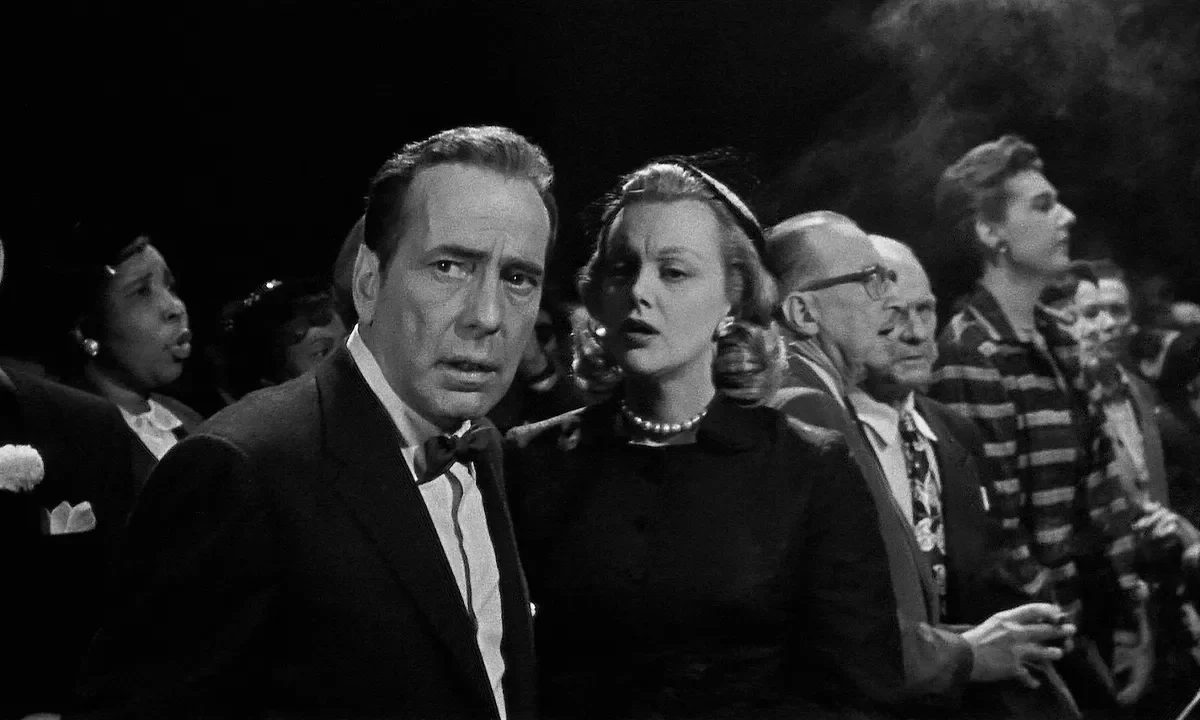
Few would include 1956’s The Harder They Fall in their top ten of Humphrey Bogart’s filmography. (On Letterboxd, it’s merely his twenty-second most popular movie.) Nevertheless, it proved the perfect capper to a career spent spanning the moral spectrum in such entertaining style. He plays Eddie Willis, a recently out-of-work sportswriter hired by nefarious boxing promoter Nick Benko (Rod Steiger) to make a star of the huge but untalented Argentinian Toro Moreno (Mike Lane). Eddie’s new gig pushes him into an escalating series of predicaments, as all Toro’s competitors on his way to the top are paid to take dives.
Bogart is by no means the only selling point of The Harder They Fall. Philip Yordan’s adaptation of Budd Schulberg’s story is bracingly spiky and psychologically astute. Rod Steiger turns in one of his most captivating early performances. Mark Robson stages the fight scenes with a sweaty brutality that earned it a rightful place amongst the best boxing movies of the era.
Still, Bogart is the big draw here. The vicissitudes of the writing life have squeezed his Eddie into a position where it pays to disobey his better instincts. When those who knew him in his prime question his thinking, Eddie professes a shrugging nonchalance; because he’s smart, he tends to pull it off. But he suffers for it, as we see whenever he’s forced to do something dubious, and Bogart wears the face of a man trying to hide that he’s passing a gallstone.
There’s a passivity to Eddie that recalls Bogart’s turn in 1948’s Key Largo as Frank, an ex-GI caught up in a hostage situation. Stuck in an off-season hotel with his fellow hostages, gangsters, and Edward G. Robinson’s peacocking chief villain, Bogart’s hero ducks a big chance to be heroic, and is subsequently scorned by the good and bad guys alike. Yet that passivity by no means made him a boring character. As he sits eyeing the situation, Bogart telegraphs Frank’s interiority with electric legibility, showing us his thought process without saying a word.
He’s asked to do that often in The Harder They Fall, a movie that repeatedly puts him in rooms filled with disreputable characters, where he silently emotes his intense discomfort. But because Bogart had spent so much of his career on the wrong side of the law – just his previous film, 1955’s The Desperate Hours, had seen him hold Frederic March’s family hostage – or at least straddling both sides of it, there was no assurance he’d do the right thing in the end. That ambiguity played out most dramatically in In A Lonely Place six years earlier, where audiences spent the whole duration being teased as to whether or not he murdered a woman.
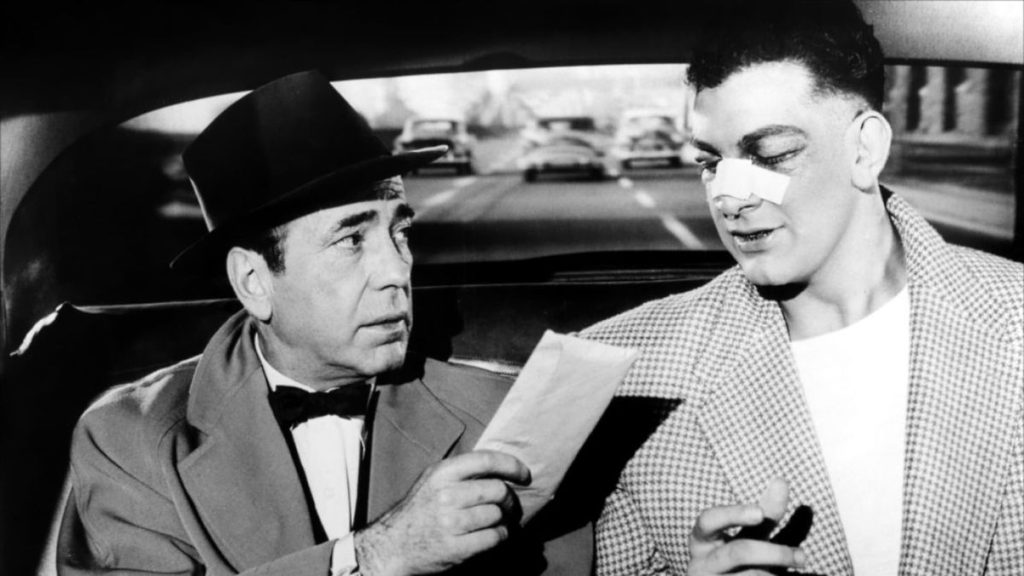
Eddie isn’t one of Bogart’s many villainous roles, but neither is he heroic. “Other men lose their job, and what do they do?” his wife, Beth (Jan Sterling) asks during one of the numerous times he tries to pass himself off as a simple victim of circumstance. “They get another job!” She thinks this whole thing is an excuse for him not trying harder to find a new, worthier path.
And Eddie does want to seem powerless here; he wants to seem like he had no choice in the matter. “Why do you think I took this job? I took it because I don’t like sleeping in the park!” he says defensively to an old friend (Harold J. Stone)who knew him in better days . Yet at the same time, his wounded professional pride leads him to earnestly try his best at this corrupt endeavor. He knows he’s too good for this, but he still wants to be good at this.
Then, as he gets to know gentle giant Toro – alone in a foreign country, surrounded by men claiming to be his friends who are lying to him – guilt enters the mix. With his wife sidelined by Nick and his colleagues unanimously shady, Eddie’s relationship with Toro is the warmest here. The protectiveness it inspires evokes Bogart’s tenderness towards Walter Brennan’s vulnerable alcoholic fisherman in 1944’s To Have and Have Not . A Bogart character’s ire was rarely more provoked than when someone was picking on the little guy, even when ‘the little guy’ happened to be six foot eight.
Though Bogart has endured as a legend, he was the most mortal of the pantheon. Between that malleable morality and his hangdog, weathered face, he always seems to belong down with us, rather than up in the celestial realm with the righteous cinematic beauties; that was especially true here, as the cancer that would soon claim him was already adding a visible extra heaviness to his performance. No classic movie actor of his level was as effective at balancing a recognisable humanity with the secret sauce of stardom. It was an irresistible combination. It still is.
While Bogart made more dramatic, romantic, grander movies over the course of his three decades in Hollywood, so many of those characters can be found jostling within Eddie; the heroes and the villains and the morally murky, fighting it out to decide who’ll come out on top. There are plenty of bruising battles in The Harder They Fall, but that internal one remains the most riveting. It’s the fight of Bogart’s life.
“The Harder They Fall” is available for digital rental or purchase.