Edwin Arnaudin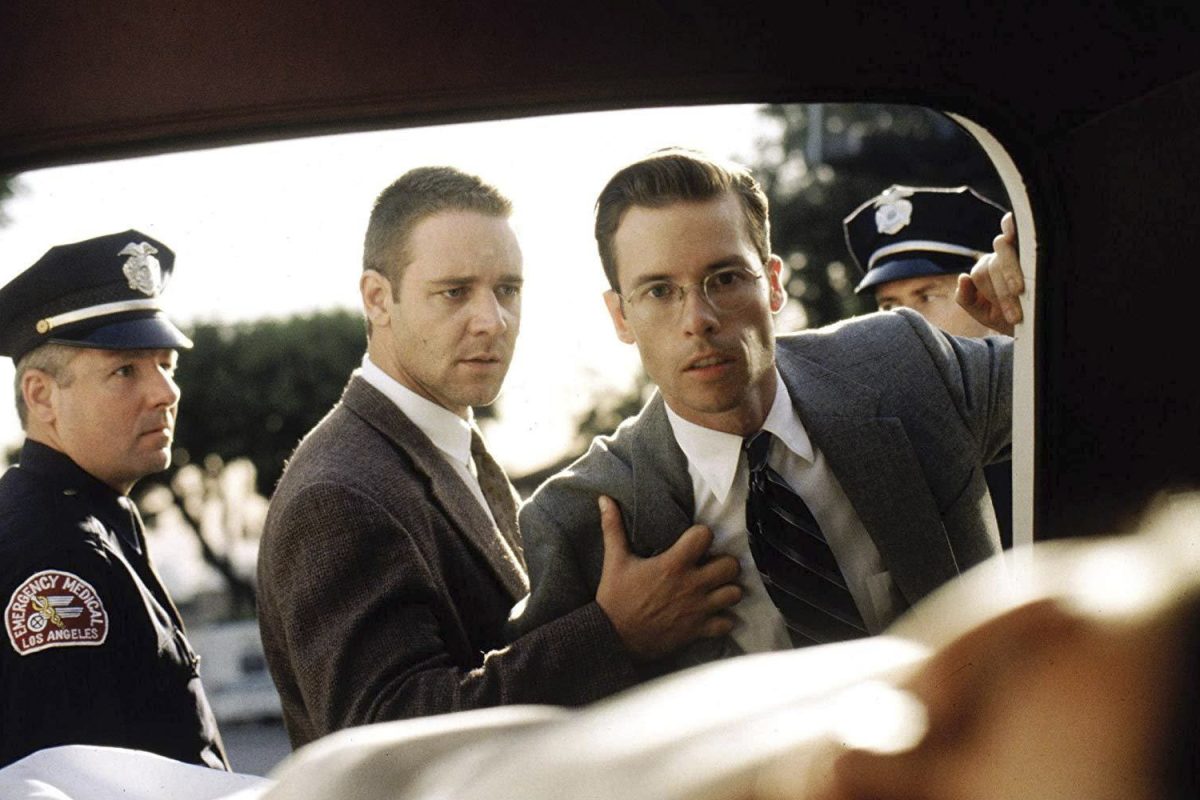
“L.A. Confidential: you could be the iceberg tonight” — Billy Crystal, musical opening monologue at the 1998 Academy Awards
Sadly, Curtis Hanson’s film wasn’t able to sink Titanic at that year’s Oscars, winning just two awards on March 23 out of its nine nominations — one over Titanic finalist Gloria Stuart (Best Supporting Actress went to Kim Basinger) and another in one of the few categories for which writer/director James “King of the World” Cameron didn’t qualify (Best Adapted Screenplay, which went to Hanson and co-writer Brian Helgeland). But in hindsight, discerning moviegoers increasingly wish it — or something else — might have played spoiler for some of the more prestigious prizes.
Not that anything had a legitimate shot at stealing Best Picture from Titanic. Certain films are cultural phenomenons and not awarding them feels disingenuous to that particular moment. Though no longer the all-time box office champion (that would be Cameron’s Pocahontas-with–Smurf-cats follow-up, Avatar), few films have made as significant a cultural impact as his little boat movie, and had it lost there may or may not have been riots (and/or lots of upset teenage girls and/or Paramount executives).
Historically, the foils to such popular works are slightly smaller films that do well critically and commercially, then endure, attracting passionate fans over time and earning a reputation as an all-time great. Such movies typically do better initially with critics groups than professional guilds, as was the case with L.A. Confidential, which won Best Picture honors from reviewers in L.A., New York City, Chicago, Boston, and Dallas-Fort Worth, plus the National Society of Film Critics, Critics Choice Awards, and the National Board of Review.
That trust and foresight from these professional organizations was rewarded as, nearly 30 years after its release, L.A. Confidential has aged significantly better than its fellow 1997 releases and 1998 Academy Awards contenders/winners, along with the similarly enduring (though to slightly lesser degrees) Boogie Nights and Good Will Hunting. This timelessness is perhaps appropriate for a film that, from the start, is one that exists out of time — as does its source material. Set in the early 1950s, James Ellroy’s novel of the same name was published in 1990, serving up a revisionist noir take on a bygone era.
Like Titanic, it fictionalizes a historical event and its aftermath through impressive period detail: in this case 1951’s “Bloody Christmas,” during which Los Angeles Police Department officers, drunk from the departmental holiday party, beat up multiple Mexican-American prisoners who were brought in for altercations with their cop colleagues. But the writing, acting, and directing in Hanson’s film pack a more sustained punch that’s kept L.A. Confidential far more eminently watchable with each passing year.
Clocking in at an hour shorter than Titanic, this police corruption thriller remains a masterclass in pacing and tonal control. Powered by the opening tabloid voiceover narration of Hush-Hush magazine reporter Sid Hudgens (Danny DeVito) telling the tale of the city’s “up for grabs” organized crime status — paired with the oddly fitting accompaniment of Johnny Mercer’s “Ac-Cent-Tchu-Ate the Positive” on the soundtrack — the film establishes its dense but intriguing style in its initial minutes.
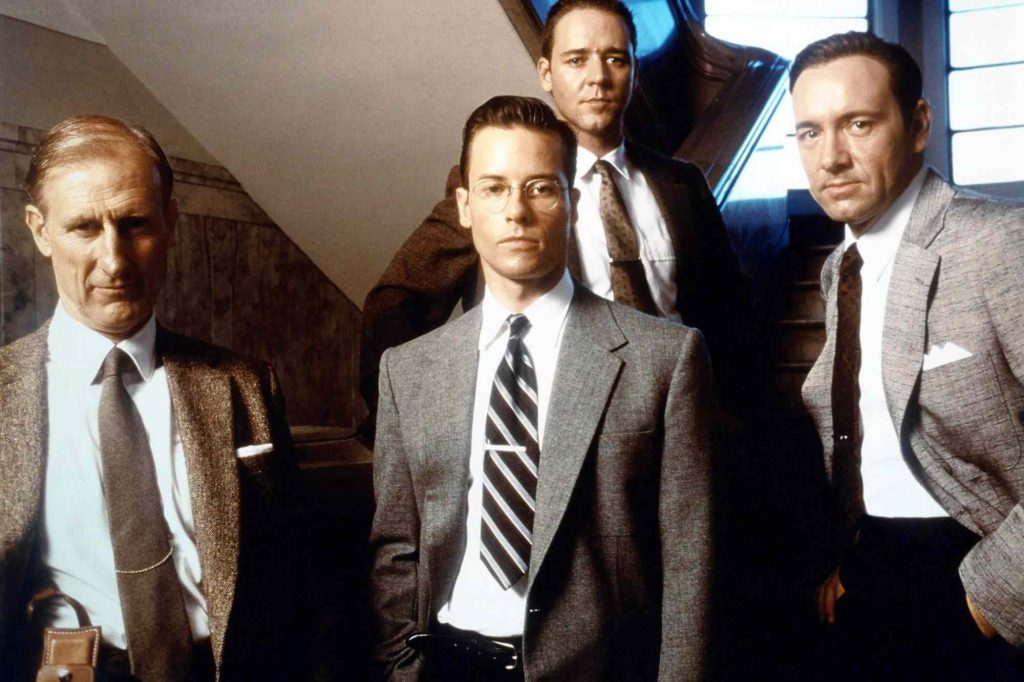
This dramatically rich storytelling remains consistent as the core trio of LAPD officers — ambitious, squeaky-clean rookie Edmund “Ed” Exley (Guy Pearce), tough guy Wendell “Bud” White (Russell Crowe), and cool veteran Jack Vincennes (Kevin Spacey) — are introduced via brief scenes that establish their respective cop stereotypes. Hooker-with-a-heart-of-gold Lynn Bracken (Basinger), hard-nosed Capt. Dudley Smith (James Cromwell), and DeVito’s Sid are likewise formulaic types, as are more minor characters. But all of the above rarely feel cliché, thanks to intelligent cuts by journeyman editor Peter Honess (Rob Roy, The Fast and the Furious) that keep the film cooking, as well as witty writing that organically introduces their respective vulnerabilities.
Hanson and Helgeland leave precious little time for these characters to grow stale, feeding and surrounding them with classic rat-a-tat noir dialogue, disarming humor, and cool actions that sustain viewer attention. Truly, the confident way White taps his badge on the car window belonging to pornographer Pierce Patchett (David Strathairn) and spins it clockwise to indicate he’d like the glass rolled down has more personality in it than most films from ’97. Tying it all together, Jerry Goldsmith’s piano, trumpet, and string score — maybe his best outside of spiritual ancestor Chinatown — wisely augments the action at hand, ramping up the suspense, doubt, and romance as needed.
However, L.A. Confidential was perhaps too dark to make much of a dent at the Academy Awards in 1998. A victim of the Oscars’ frustrating see-sawing between daring and safe offerings, it was only a few years removed from the encouraging crowning of Jonathan Demme’s horror masterpiece The Silence of the Lambs, yet released firmly in the midst of the Academy’s predictable reignited love affair with such prestige (but still excellent) “Oscar-bait” fare as Forrest Gump and The English Patient.
Had it been released in the upswing eras of The Departed, No Country for Old Men, or Parasite, during which the modern equivalents of Titanic fell out of favor, perhaps Hanson’s film might have stood more of a chance. But as real heads know, Oscars don’t matter when all you want is a great film.
“L.A. Confidential” is streaming on Amazon Prime Video.