Sean Burns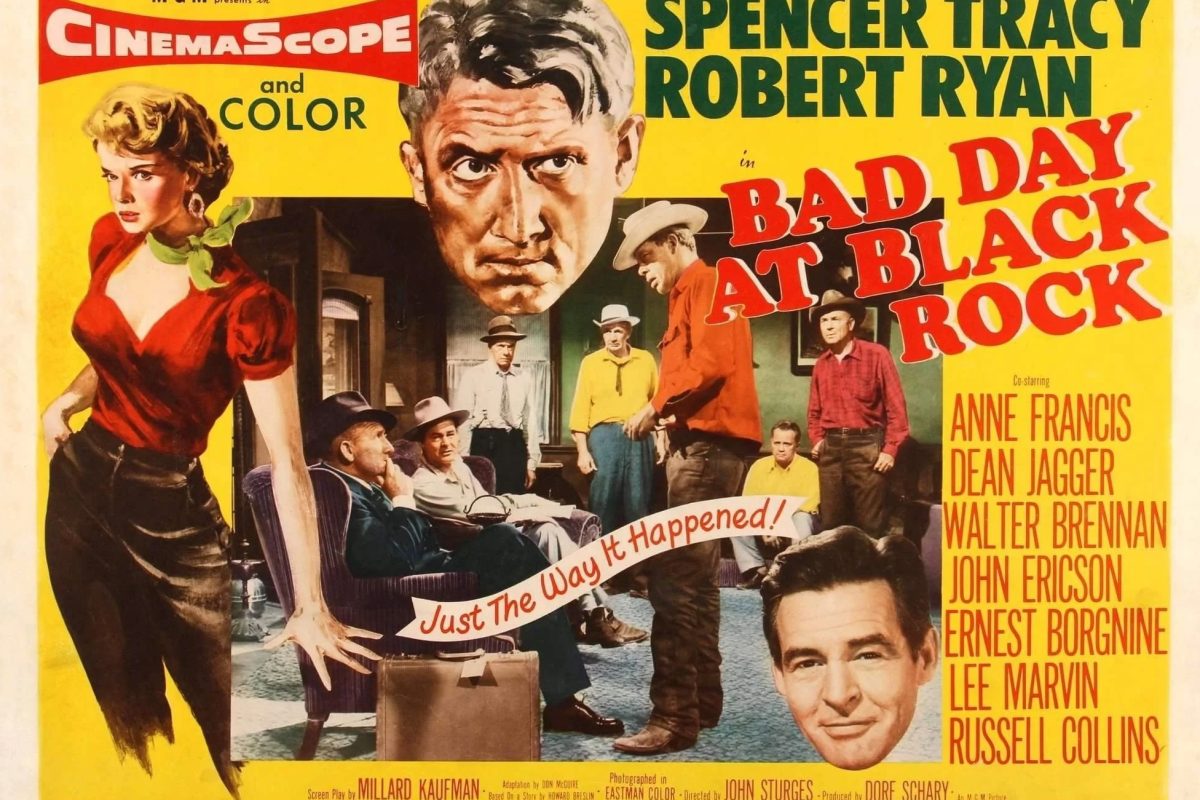
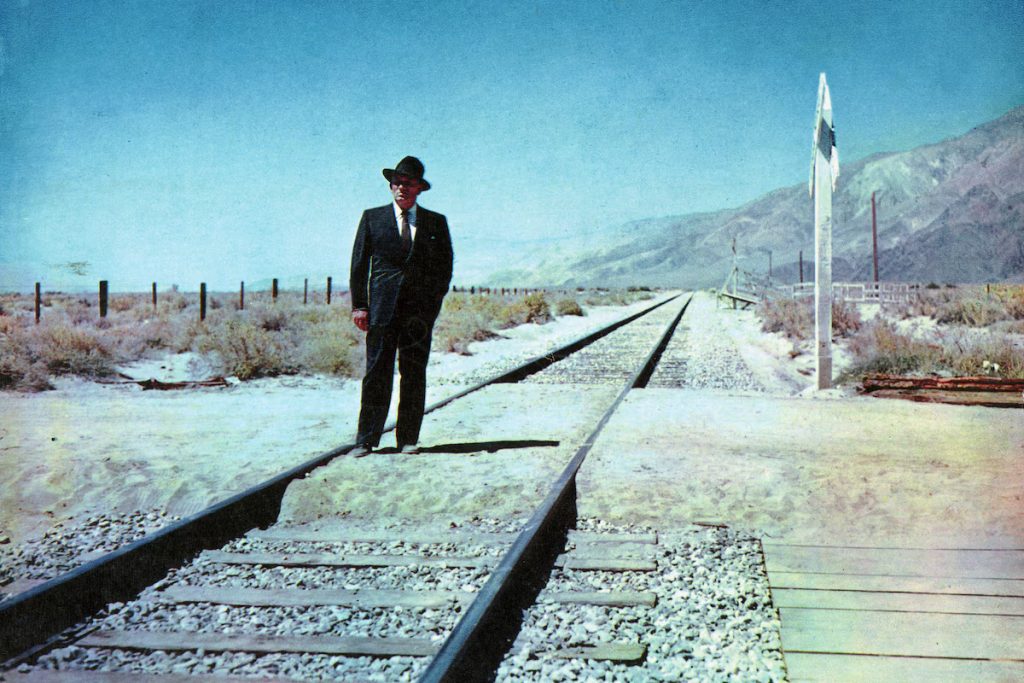
Director John Sturges’s Bad Day at Black Rock begins with the timeless emptiness of Death Valley filled with the roar of a modern passenger train, hurtling toward the camera throughout the opening titles. Civilization is coming to the Old West, loud and fast. Black Rock is a flag stop. We’re told that this is the first time the train has had to stop there in years. It doesn’t take long for us to see why. The place is a purgatorial ghost town, with a few ramshackle businesses and a whole lot of nothing stretching way past the edges of the CinemaScope frame. A one-armed man gets off the train alone. He wears a heavy black suit that must be brutal in that weather. His hat is tilted to hide his eyes. His name is Macreedy. He doesn’t belong here.
The people he meets in Black Rock want to make sure he understands right away that this is not a place that cottons to outsiders. Macreedy rents a room and gets out of the shower to find a smirking, insolent cowboy lounging on his bed, telling the old man that this is his room now. The cowboy is played by a young Lee Marvin, all lanky sinew and insinuation, seven years before he’d become Liberty Valance. Macreedy can’t sit down at a lunch counter without being taunted by another goon in a hat, this one played by Ernest Borgnine, the same year he’d play Marty and go home with an Oscar. He’s a thick, noisy slab of a fellow, but Macreedy isn’t intimidated. He’s just back from the war and his eyes let us know he’s seen a lot worse. He’s also played by Spencer Tracy, who with his wry, avuncular charm, isn’t intimidated by anybody.
“Nobody around here seems big enough to make you mad,” observes Robert Ryan, a very tall man filmed from low angles so he looms even larger. Even he’s not big enough to make Macreedy mad. At least not yet. Other actors liked to say that when you saw Tracy looking at the ground, you knew he was stealing the scene from you. (It was such a trademark mannerism Eddie Murphy joked that he was always looking for his mark.) The macho bluster of these overgrown boys doesn’t trouble Macreedy in the slightest, and that really gets their goat. He’s here on a mission, one that might be his last.
Macreedy served in Italy alongside a Japanese-American soldier who died saving his life. The army gave the dead soldier a medal for his trouble, Macreedy’s here to give it to the boy’s father – a Japanese farmer named Komoko. Except nobody’s seen the farmer in a good long while, and they all get pretty shifty whenever Macreedy mentions his name. Parked somewhere between a Western, a film noir, and an indictment of smalltown conformity, Bad Day at Black Rock is a superlative Hollywood entertainment that stares deep into the rotten heart of America’s racist history, confronting the recent Japanese internment without ever mentioning it explicitly.
Of course these thugs killed Komoko. They got “patriotic drunk” after Pearl Harbor and took it out on the only Japanese person they knew. Now they’re too stupid and lazy to even do a halfway decent job of covering it up. Maimed and haunted by the war, Macreedy was fixing to kill himself or at least drink his way into oblivion after dropping off the medal, but now that these yokels all want to murder him he’s starting to have second thoughts. Now he wants justice.
Running a trim 81 minutes without a wasted breath, Bad Day at Black Rock is a model of efficiency and camera blocking. CinemaScope was only a couple of years old at the time and Sturges had to pester MGM into letting him use it for this. The suits assumed the fledgling format was only good for Biblical epics with thousands of extras; they thought it was absurd to “waste” the giant frame on a small chamber piece like this one. (Similarly stupid complaints arose when Quentin Tarantino shot The Hateful Eight in 70mm UltraPanavision.) But Sturges saw the dramatic possibilities in filling the extra-wide screen with those vast, Lone Pine locations, isolating Tracy in an empty landscape.
He would go on to become one of the ultimate “Dad movie” directors, helming The Great Escape, The Magnificent Seven and double-dipping with Gunfight at the O.K. Corral and Hour of the Gun, two Wyatt Earp pictures telling the same story a decade apart. But Bad Day at Black Rock is his leanest, most elegant picture, a hit at both the Academy Awards and the Cannes Film Festival. (Tracy won Best Actor at the latter.) It’s sparse enough to invite all sorts of allegorical readings; at the time, some viewers assumed it was secretly a statement about the HUAC hearings, something Sturges has vehemently denied. Alas, the racist bullying and cowardice on display in Bad Day at Black Rock are depressingly applicable to all sorts of American eras, and I note with a shudder that Ryan’s sneering, bloodthirsty ringleader is first seen wearing a red baseball cap.
Black Rock is symbolically freighted but doesn’t make a big deal out of it. Like when Macreedy dispatches Borgnine’s goon with a Judo chop to the throat. This has been cited as the first use of Asian martial arts in a Hollywood film. Tracy was worried nobody would buy an old man like him taking down a brick shithouse like Borgnine, while a Judo expert found the scene unbelievable because he said the move would have crushed ol’ Ernie’s windpipe instantly. In any case, the point is that Macreedy’s using the tools of Komoko’s people against their oppressors, bringing a righteous justice that I worry we can only find in the movies.
“Bad Day at Black Rock” is streaming on the Criterion Channel and Hoopla.