Craig J. Clark
From the time Menahem Golan and Yoram Globus took over the Cannon Group in 1979, they had designs on becoming major players in Hollywood. Even as exploitation films of all stripes were their bread and butter, they sought legitimacy by backing projects by arthouse auteurs and producing their own would-be blockbusters. (With his three-picture deal, Tobe Hooper was among the most fortunate recipients of their largesse.) The trend toward overextending themselves reached its zenith in 1987, when the company released a slew of films, including expensive and/or misguided endeavors like the Sylvester Stallone arm-wrestling flick Over the Top, which Golan directed, and Superman IV: The Quest for Peace, which had its budget ruinously slashed partway through production. Then came Masters of the Universe.
Based on the popular toy line, comics, and animated series, Masters was a hot property – or so Golan and Globus thought – but its journey to the big screen was filled with stumbling blocks. Chief among them: the entire production was closely supervised by Mattel, which had a vested interest in protecting their family-friendly brand. (Preliminary concept art showing He-Man slaying demonic-looking foes, blood dripping from his sword, was quickly nixed.) Furthermore, in spite of having Richard Edlund in charge of the visual effects, budgetary limitations prevented the inclusion of characters like He-Man’s ferocious Battle Cat and floating wizard friend/irritant Orko. (Also MIA: She-Ra, who appeared in early drafts of the script, many of Skeletor’s minions and He-Man’s allies, and his secret identity as the wimpy Prince Adam.) The most crippling cost-conscious decision, however, was to set the majority of the action on Earth. While this helped Cannon deliver a film they could afford, it failed to spark the magic necessary to make it successful.
The story starts off well enough, with an extended sequence in Eternia that finds He-Man’s forces routed by the evil Skeletor, who takes Castle Grayskull and captures the Sorceress, whose power he drains in anticipation of a celestial event that will enthrone him once and for all. (He’s clearly goal-oriented.) Caught on the back foot, He-Man regroups with fellow warriors Man at Arms and Teela, and comes to the rescue of diminutive locksmith Gwildor, whose invention the Cosmic Key made Skeletor’s sneak attack possible. (Funny how inventors never consider the possibility of their doodads falling into the wrong hands.) When their attempt to free the Sorceress turns into an ambush, Gwildor uses his backup Cosmic Key to transport them out of harm’s way, but where they land 17 minutes in is Earth, and that’s when things seriously go south.
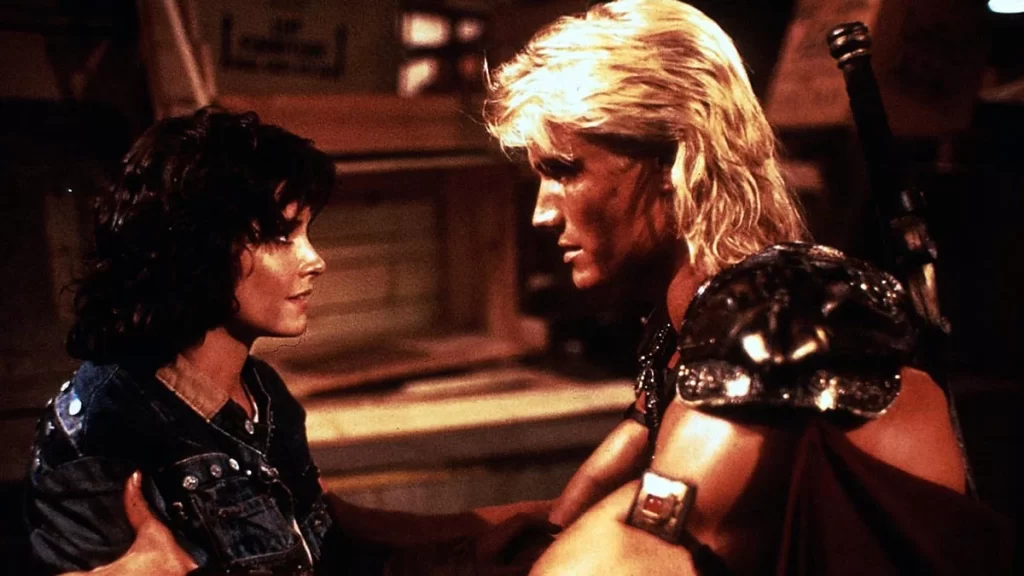
If He-Man fans had been polled in 1987, and asked what they wanted to see in their hero’s movie, it’s a sure bet few would have said, “a tedious subplot about a teenager named Julie breaking up with her boyfriend and moving to New Jersey in the wake of her parents’ deaths in a plane crash.” This is not to suggest movies aimed at children can’t traffic in heavy themes (The NeverEnding Story certainly does), but the disconnect between Julie’s grief and the overarching plot about He-Man and his friends getting back to Eternia in time to thwart Skeletor’s plans is too great to hand-wave away. The clash of tones is baked in, though, with the ostensibly battle-hardened He-Man, Man at Arms, and Teela frequently shown heartily chuckling at Gwildor’s tiresome antics, which seasoned performer Billy Barty sells as best he can.
Less seasoned is lead Dolph Lundgren, who looks the part, but required a drama coach, a speech coach, a trainer, a creative advisor, and a hair stylist. Just as new to movies was Courteney Cox, who did her best with the underwritten role of Julie and likely shared war stories with Leprechaun star Jennifer Aniston between setups on Friends. On surer footing are Frank Langella, whose campy Skeletor steals every scene he’s in (he also gets the best lines, including his dismissal of Earth as “this primitive and tasteless planet”), Meg Foster as his steely-eyed second-in-command Evil-Lyn, and the late James Tolkan as a no-nonsense cop who puts up with plenty of nonsense before it’s all over. They’re not doing Shakespeare and they know it, but the film gets a definite lift whenever they’re around.
As one of the bellwethers of Cannon’s decline, Masters of the Universe has much to live down to. It’s no surprise that its failure is a prime topic in Mark Hartley’s 2014 documentary Electric Boogaloo: The Untold Story of Cannon Films, though it’s conspicuously absent from Golan and Globus’s competing puff piece The Go-Go Boys. Its plentiful production woes also get aired out in 2017’s Power of Grayskull: The Definitive History of He-Man and the Masters of the Universe. Will a bigger-budgeted Masters be more fondly remembered than its 39-year-old forerunner? Depends how much time it spends spinning its wheels on Earth.
Cannon’s “Masters of the Universe” is streaming on a number of services, including Kanopy, Plex, Tubi, and History Vault (?). Sure, why not?