Chloe Walker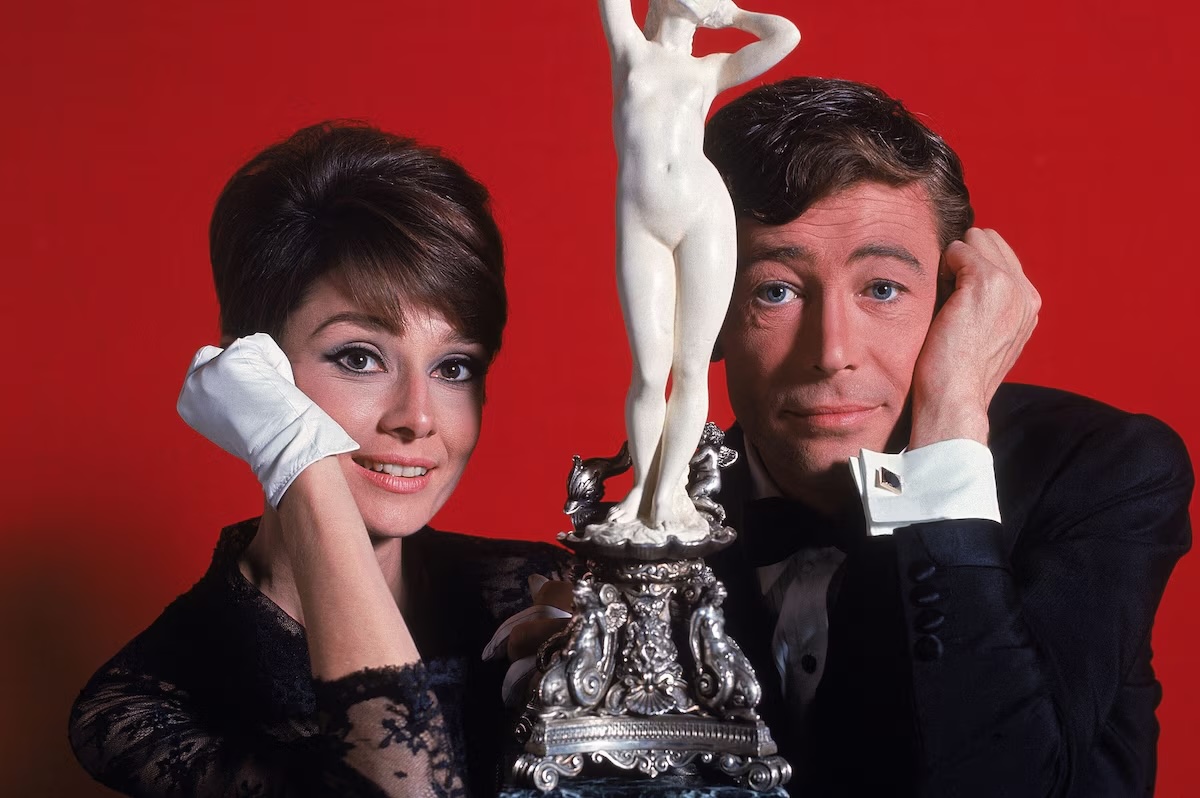
Peter O’Toole was an eight-time Oscar nominee and a stage legend. He did pretty well for himself, all things considered. Nevertheless, once you’ve seen him spend twenty minutes hiding in a closet with Audrey Hepburn, it still seems a shame that How To Steal A Million – released sixty years ago this week – was his only traditional romantic comedy.
O’Toole, who’d become globally famous four years earlier after starring in Lawrence of Arabia, had pursued the role in a bid to leaven the self-serious image such epics had garnered him. Per Robert Sellers’ O’Toole biography, the actor was after “a touch of the Cary Grants,” referencing Charade, the sublime 1963 confection in which Hepburn and Grant had co-starred.
Hepburn had a track record of making successful rom-coms with male leads known for more serious work, like 1953’s Roman Holiday with Gregory Peck, 1954’s Sabrina with Humphrey Bogart, and 1964’s My Fair Lady with Rex Harrison. Acting opposite her presented an opportunity for serious thespians to present a lighter side, while still retaining their dignity.
How To Steal A Million revolves around Nicole (Hepburn), the daughter of an art forger, recruiting Simon (O’Toole), a cat burglar (or so she thinks…) to steal one of her father’s pieces from a museum before it’s discovered to be a fake. The first hour is fun, if a little baggy in the way that ‘60s comedies often were. However the second, which almost entirely revolves around Nicole and Simon undertaking the heist, could match any of the era’s best productions for sheer, unbridled charm.
Much of that was down to O’Toole. His famed drinking stole his looks prematurely, but aged 34, his striking blue eyes (commented on dreamily by Nicole) and his tall, elegant frame meant he was still very much leading man handsome. One of the many pleasures of How To Steal a Million is the way O’Toole contorts his long limbs; slinking into the museum’s shadows, curling up in the closet with Hepburn hiding from the guards, leaping for the boomerang that befuddles the alarm system. Add in that mellifluous RADA voice, and his abundant chemistry with the typically wonderful Hepburn, and it’s all the stuff of a classic romantic comedy working as it should – the combination of silliness and sexiness creating magic from the flimsiest of narratives.
Looking for something in the rest of his filmography to replicate that frothy magic is a tricky proposition. There had been Woody Allen-penned What’s New Pussycat?, the year before, but that was more a farce than a rom-com; the same could be said for 1968’s Great Catherine, which found O’Toole’s British officer the plaything of Catherine the Great (Jeanne Moreau). On the opposite end of the scale was 1969’s Goodbye Mr. Chips, the musical remake of the 1939 classic. While deeply romantic, the laughs are fewer, and a tragic third act turns it all into more of a weepie.
To otherwise scratch the rom-com itch, you have to look askew at some of the less obvious prospects.
In 1960’s The Day They Robbed The Bank of England – a different kind of heist movie – master thief Norgate (Aldo Ray) needs information about the titular bank’s layout. So, in a scene staged like a meet cute, he finds bank guard Fitch (O’Toole), and courts him, the two going fishing and having dinners together as he tries to wheedle out the inside knowledge he needs. There’s heartbreak when Fitch discovers he’s been used, yet until that happens, their scenes play out as an opening act of a romantic comedy. Although it’s all but forgotten now, it was David Lean seeing this film that led to O’Toole’s star-making casting in Lawrence of Arabia.
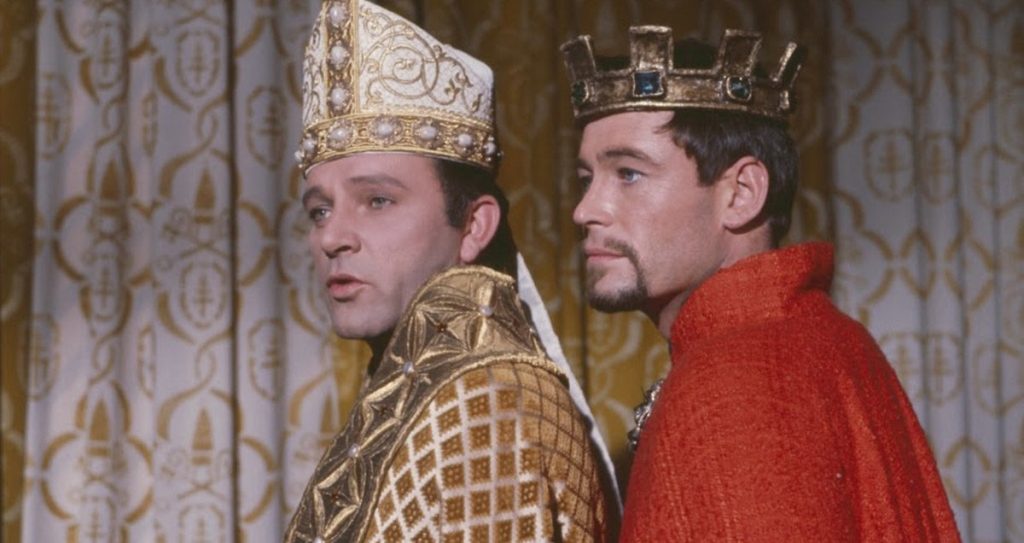
Then there were the two movies in which O’Toole portrayed Henry II. In 1964’s Becket, Richard Burton is the monarch’s titular consigliere, who Henry installs as the Archbishop of Canterbury in a power play. Becket develops an unexpected affinity for the role, ultimately favouring God over king. King doesn’t take it well. O’Toole plays his scheming royal as a petulant spurned lover, alternating between petty snark and yearning desperation as he tries to win Becket back. He and Burton were great friends and drinking buddies, and their offscreen closeness helps their onscreen relationship seem like that of an old married couple.
Four years later, The Lion in Winter revolved around an actual old married couple. Estranged royals Henry II (O’Toole ) and Eleanor of Aquitaine (Katharine Hepburn) share a brutal Christmas fighting over which of their sons will succeed him to the throne. They spend the film spewing the most hilariously volcanic vitriol at each other, even plotting murder, yet all the while it seems to be coming from a place of twisted affection. The two great actors – twenty-five years apart, but convincing peers via cinematic sorcery – paint a complicated, convincing history together. Essentially, it’s a tale of lovers, to enemies, to loving enemies.
1985’s Creator is the story of Nobel-Prize winning professor Henry (O’Toole) trying to regrow his dead wife in a lab. It’s also a knockabout campus comedy, a meditation on the need to let go, and a romantic sci-fi fairytale. Amidst all the chaos, Meli (Mariel Hemingway), one of Henry’s young research assistants, starts pursuing him romantically. The movie navigates the 29-year age gap with almost supernatural grace; that, as in Charade with Hepburn and Grant, Hemingway’s younger woman is the pursuer aids in undercutting any potential queasiness. She and O’Toole make for a surprisingly sweet pairing – it looks bad on paper, but works in the weird, wild world of Creator.
There was an even larger age gap in 2006’s Venus, the last significant role of O’Toole’s career. His aging actor, Maurice, falls into a strange relationship with his friend’s grandniece, Jessie (Jodie Whittaker), half a century his junior (the actors were 74 and 24 at the time of release). It’s a creepy set-up handled with a deft touch, odd-couple banter and genuine tenderness helping prevent the premise’s inherent discomfort from overpowering the film’s great warmth. O’Toole’s complexly vulnerable, charming performance won him his final Oscar nomination.
Over many decades, Peter O’Toole left behind an offbeat collection of movies tied together with his electric onscreen chemistry with various co-stars and his prowess at delivering devastatingly witty lines, often complemented by his nimble physicality. An alternate rom-com canon, if you will. Still, if you’re looking for the romantic comedy at its most sublimely frothy, it’s hard to improve upon How To Steal A Million.
“How to Steal a Million” is available for digital rental or purchase.