Zach Vasquez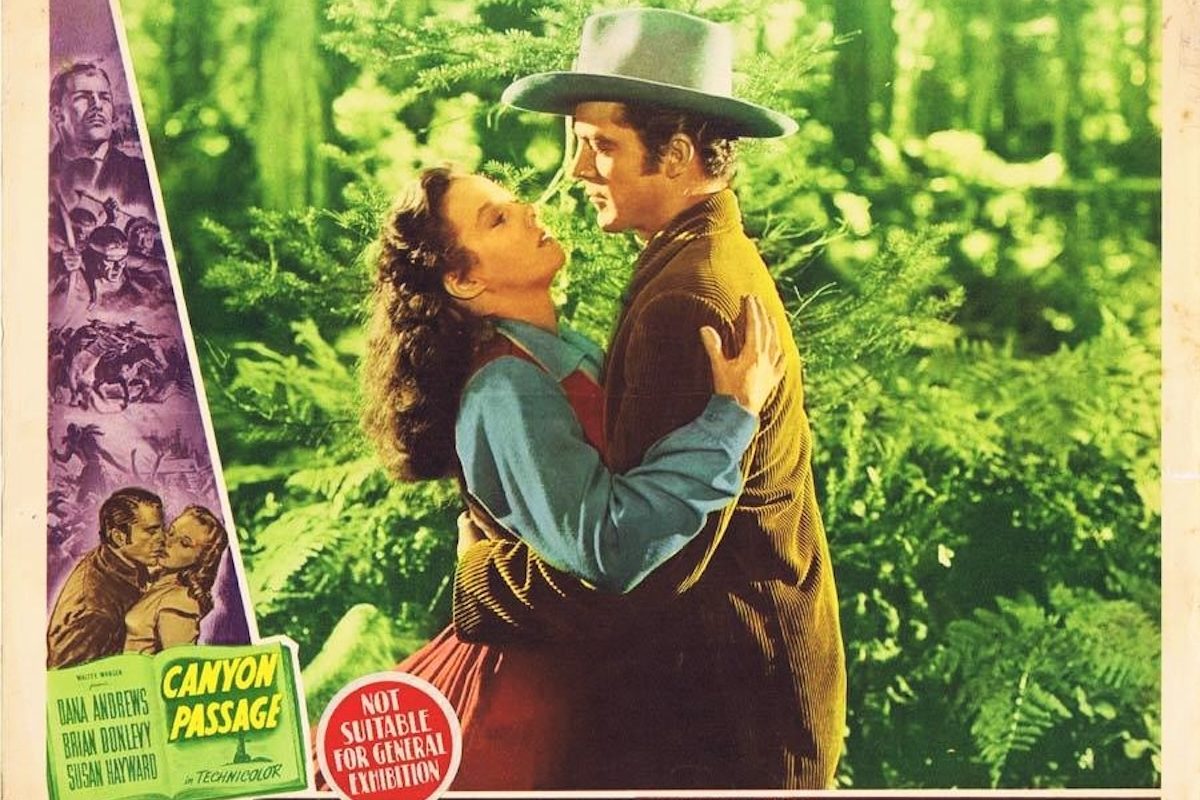
Eighty years after its debut, it feels as though Canyon Passage, the 1946 western drama from French-American director Jacques Tourneur, is finally set to get its proper recognition as one of the great American westerns. While long overdue, it is fitting that a movie about the neurotic restlessness that drove westward expansion should take so many years to finally get settled.
As far as pedigrees go, few can match Canyon Passage: adapted from a story from Stagecoach author Erest Haycox, it features some of the most iconic western actors of its day, including Dana Andrews (three years removed from his incredible turn in The Ox-Bow Incident), burly tough guy Ward Bond, loveable sidekick Andy Devine, wily cad Lloyd Bridges, and Tin Pan-alley star Hoagy Carmicheal (whose musical contributions to the film earned him an Oscar nomination for Best Original Song). Tournier, though mostly known for his noirs and noirish horror efforts (Out of the Past, Nightfall, Cat People, I Walked with a Zombie, The Leopard Man, and Night of the Demon, which also starred Andrews), helmed half a dozen films in the genre.
Set mostly in the bustling mining settlement of Jacksonville, Oregon in the year 1856, Canyon Passage stars Andrews as Logan Stuart, an ambitious freighter and storeowner who finds himself in the center of various maelstroms, including a love triangle between pretty, kindly orphan Caroline (Patricia Roc) and Lucy (Susan Hayward), the well-heeled but independent fiancé of his best bud George (Brian Donlevy), the latter of whom falls into serious gambling debt and makes a number of deadly mistakes attempting to settle them; attracting the violent ire of town thug Honey Bragg (Bond), whom Logan knows (but cannot prove) is responsible for a recent robbery-murder; and the ever-present danger of attacks from the surrounding indigenous tribes in the face of a shaky truce.
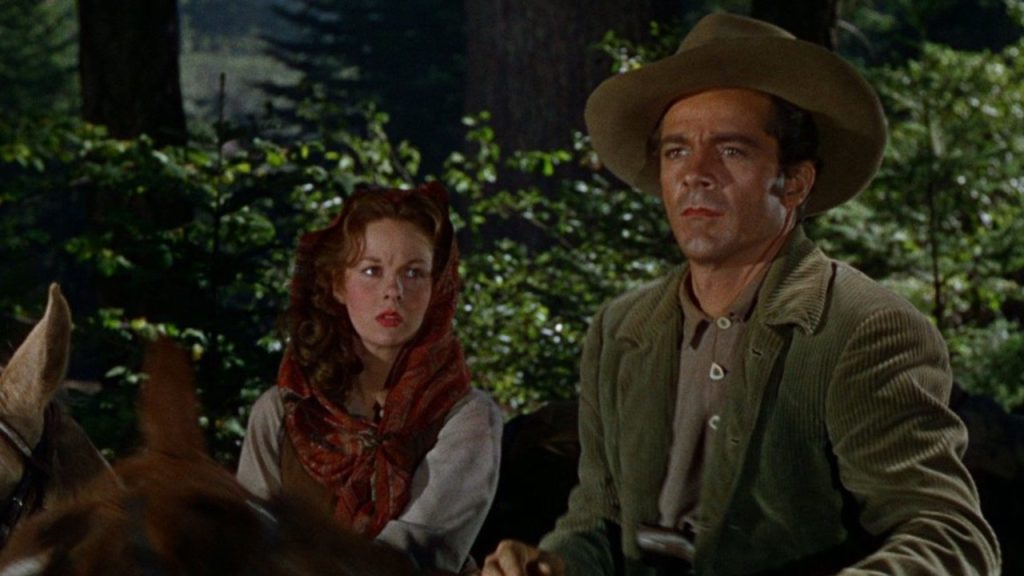
Logan is the Platonic ideal of rugged individualism, but his stoic outlook on life – “This is Jacksonville, U.S.A. We sail with the tide”— is no match for the capricious vicissitudes of frontier life. Or, for that matter, life in general. As his pessimistic and parsimonious English business partner Clenchfield (Halliwell Hobbes) reminds him, “All Americans think that. They think the tide flows forever for them. But mark me… gold veins run out, crops fail, men starve, wars come.”
Although Andrews is undoubtedly the lead, Canyon Passage really is more of an ensemble picture, with much of its runtime given over to the other characters (the doomed arc of Donlevy’s hedonistic gambler could sustain its own very good film). In the New York Times’ contemporaneous review, critic Tom M. Pryor, while singing the praises of its breathtaking Technicolor splendor (particularly the use of Oregon’s natural landscape) and Tournier’s staging during two memorable set pieces (a bloody bar fight and a celebratory barn raising ceremony), also chastised it for an overstuffed plot full of “sagebrush melodrama.”
This is a baffling take when viewing the film today, as its panoramic structure is one of the qualities that sets it apart. Using a frontier boomtown as a microcosm for America in order to blow up the national myth of rugged individualism by showing how individual actions affect and alter the greater community feels even more modern than what most of the psychological Westerns of the time were doing. Tournier imbues the drama with a noirish sense of fatalism and grittiness, and while tame by today’s standards, the violence within the film is pretty harsh for its era (particularly a couple of disturbing snippets involving young victims). You can see the film’s DNA in two of the best and most radical Westerns of the following decades: Robert Altman’s elegiac masterwork McCabe & Mrs. Miller and HBO’s profanely profound series Deadwood.
A decade after Canyon Passage, John Ford would explore similar thematic terrain with his magnum opus The Searchers. But whereas that film contemplates the infernal cost of settling the western wilderness so that future generations to settle in peace and prosperity, Canyon Passage acknowledges that the tide never flows one way forever, and that nothing — especially not peace and prosperity — is ever really settled.
“Canyon Passage” is streaming on Tubi and Fawesome.