Craig J. Clark
“I told them the factory will burn down in the night. But, like sleep-walkers, people walk towards their doom.”
Over the course of his long career, now in its seventh decade, Werner Herzog has gone to great lengths and endured hardships aplenty to realize many of his films. He has traveled to every continent. He has dragged a steamboat over a mountain and ventured deep into forbidding jungles. He has worked with Klaus Kinski. Among his most unusual productions, however, was one where he stayed close to home.
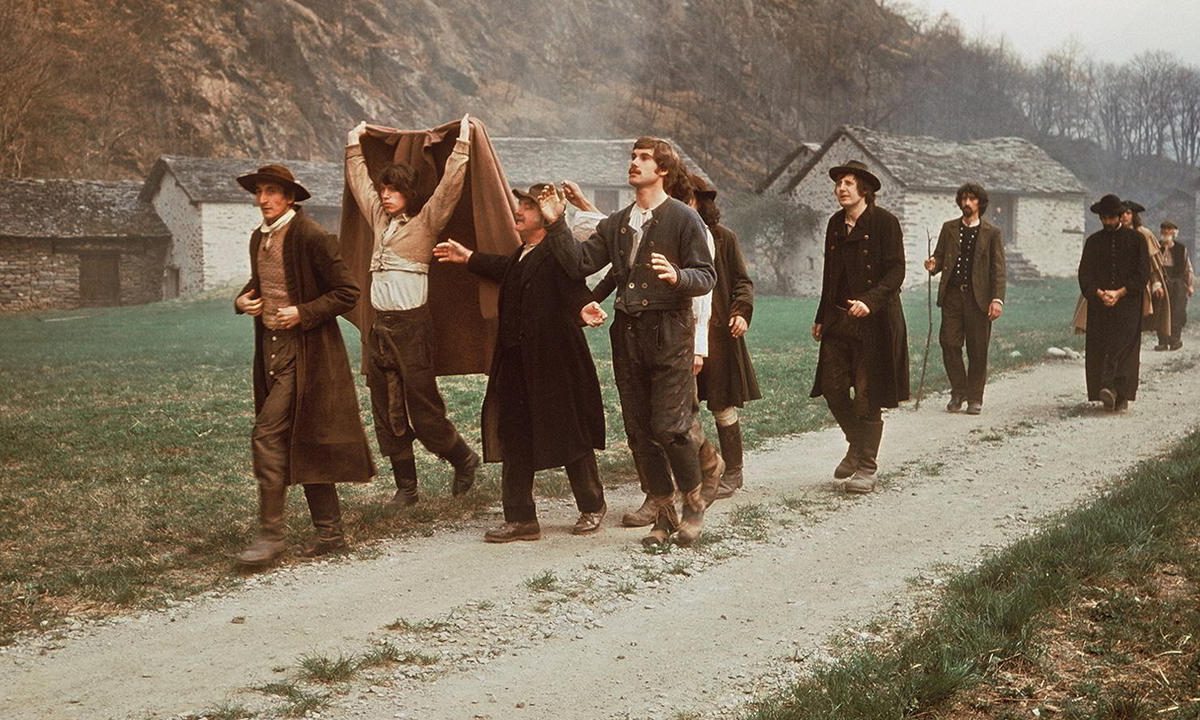
Save for a handful of abstract landscape shots, Herzog filmed most of 1976’s Heart of Glass in Bavaria, where he grew up, and neighboring Switzerland. His intimate familiarity with the setting was essential since he was telling a Bavarian legend, as set down by author and filmmaker Herbert Achternbusch. In the process of adapting it, Herzog put his own stamp on the material, and hit upon the idea of hypnotizing the actors, most of whom were recruited via newspaper ads and tested to see how receptive they were to hypnosis. In this way, their performances would fit the story, which told of a whole village descending into madness and torpor when their livelihood is suddenly taken away. The sole exception is the central character Hias (played by Joseph Bierbichler, the only actor never hypnotized), a herdsman who has visions of things to come, most of which come true.
Where everyone else walks with a shambling gait (that is, when they’re not rooted to the spot), Hias strides with purpose. While they’re glassy-eyed, their stares fixed on a point in front of them, Hias looks directly at whoever he’s addressing. He only gets a faraway look in his eyes when he’s having his visions, which he shares with whoever’s in earshot. Yet in spite of his ability to foresee the calamity that is unfolding, he’s no more able to act on his premonitions than anyone else. “Should I leave this place?” he muses to himself. “Madness is rampant in this village.” Who’s to say things are better anywhere else, though?
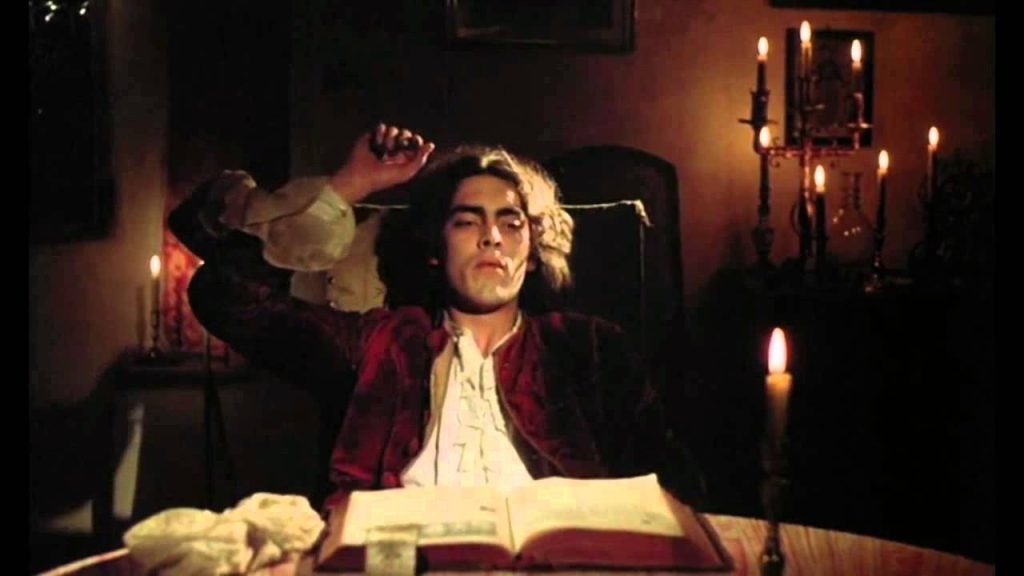
This particular crisis is touched off by the death of Mühlbeck, the foreman of the village’s glassworks who took to the grave the secret of how to make its famous ruby glass. Herzog never reveals how Mühlbeck died, but nobody apart from his mother seems all that broken up about it. Rather, all are preoccupied with recovering the secret of the ruby glass, none more fervently than the aristocratic factory owner, who exhausts every means he can think of to learn it. This includes tearing the stuffing out of a davenport Mühlbeck gave his mother, where the owner thinks he may have hidden the secret. It is a desperate act of a desperate man, though, and presages more extreme measures to come.
From its evocative opening, which plays Swiss yodeling over a shot of Hias’s back as he watches his herd grazing in the fog, Heart of Glass is designed to lull the viewer into a trancelike state. A time-lapse shot of mist rolling over a forest similarly draws the audience into a contemplative frame of mind. Other scenes are accompanied by Popol Vuh’s lyrical score, continuing a collaboration that reached back to Herzog’s first feature, Signs of Life (in which Florian Fricke appeared as a pianist), and included Aguirre, the Wrath of God and The Great Ecstasy of Woodcarver Steiner.
In Woodcarver Steiner, Herzog marries Popol Vuh’s soaring music to stunning, slow-motion footage of ski jumpers in flight. In Heart of Glass, he achieves a similar effect with the helicopter shots in the epilogue, which starts a whole new story (filmed on and around a rocky island off the coast of Ireland) that has no connection to the main plot and is left unresolved. It wasn’t even included in Herzog’s original scenario, but neither was the character of the factory owner’s father, who hasn’t gotten out of his chair for twelve years and thus has to be carried everywhere. That Herzog would invent a role for an actor on the spot is part and parcel of his methodology, which is open to the unexpected since that’s the best way to capture something that’s never been on film before.
On the commentary for Heart of Glass, recorded 25 years after it was made, Herzog expressed concern over how it would be received by younger viewers weaned on MTV and fast cutting. “It’s a strange film,” he says. “It is a totally unusual film, and I hope that it will stay alive a little bit more time, and will have its chance.” That Roger Ebert – one of Herzog’s longtime champions – included Heart of Glass in his Great Movies column in 2011 is but one example of how it continues to live on for those who have seen and been struck by its beauty.
Fear not. The secret of “Heart of Glass” hasn’t been lost. It can be found on a number of streaming services.