Craig J. Clark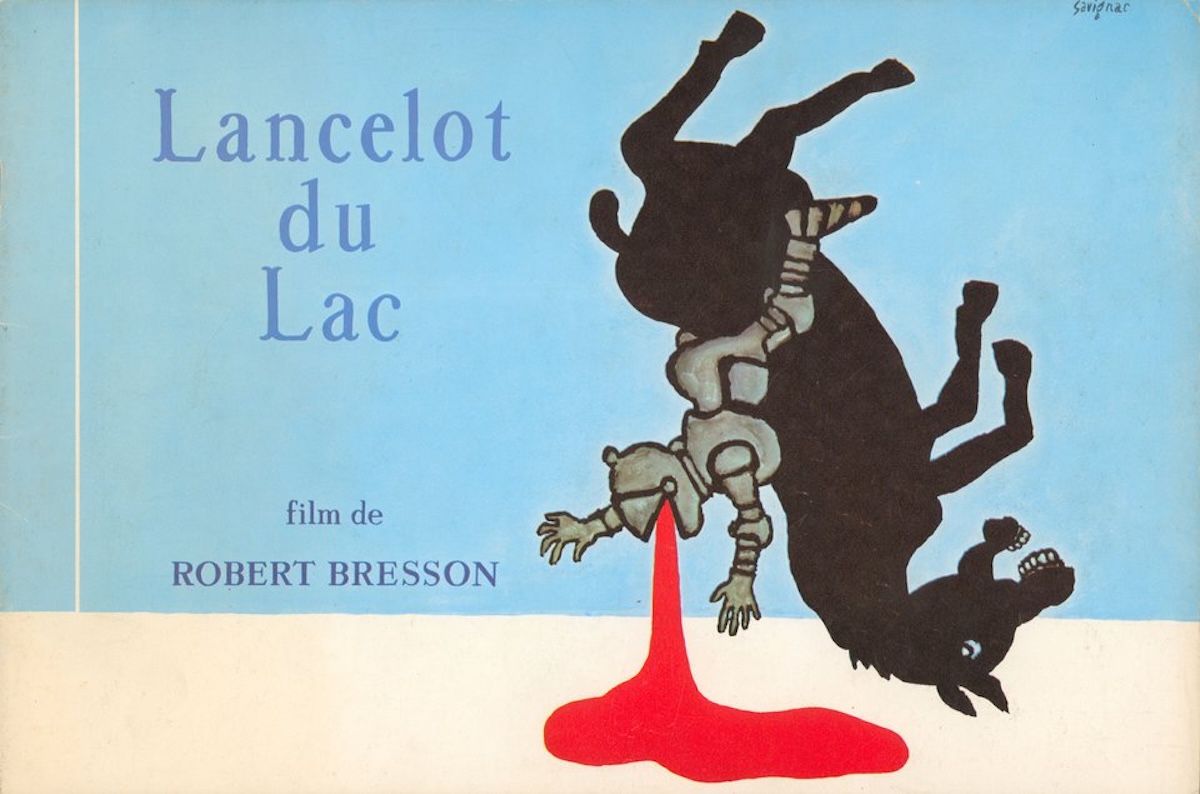
It’s tantalizing to imagine how Robert Bresson’s Grail film would have turned out had he directed it when he originally wrote it, after 1951’s Diary of a Country Priest. It assuredly would have been in black and white (as all his films were until 1969’s Une femme douce) and made on a lower budget, but the project stalled out, and not for the last time. Lancelot was again touted as his next film in 1962, when it was being planned as his follow-up to The Trial of Joan of Arc, and he was asked about it four years later by Jean-Luc Godard and Michel Delahaye, who interviewed him for Cahiers du cinema in English after the premiere of Au Hasard Balthazar.
At the time, Bresson was prepared to make it in French and English so he could “have a little more money at the start, which is important, since I cannot make the film with France solely … Unless I take stars.” That was a non-starter for Bresson, and the project lay fallow several more years before emerging as Lancelot du Lac in 1974, made as an Italian co-production and entirely in French, with no stars in sight. He did have the services of Italian cinematographer Pasqualino De Santis, whose resume included films for Franco Zeffirelli (Romeo and Juliet) and Luchino Visconti (The Damned and Death in Venice). Happily, their sensibilities were attuned enough that De Santis shot Bresson’s next two features – 1977’s The Devil, Probably and 1983’s L’Argent – which turned out to be his last.
The delay in bringing Lancelot to the screen meant Bresson could include things that wouldn’t have passed muster two decades earlier. That accounts for the matter-of-fact nudity as much as the bloody dismemberments that lend the battle scenes a startling intensity. Within the first three minutes, and before any of the characters are introduced, two anonymous knights are shown fighting at close quarters, the awkwardness of their struggle accentuated by tight shots of their armored torsos and swinging arms. When one is literally disarmed and then beheaded, the blood that spurts from the wounds is worthy of Monty Python, whose own Grail film was still to come. Other grisly moments in the prologue include a knight being stabbed in the groin and another having his helmet bloodily bashed in.
This, we soon learn, is what the quest for the Holy Grail has been reduced to. “The Grail eludes us,” Lancelot reports. “There was only blood and death.” As this is not news to the King’s ears, Arthur orders the Round Table hall closed up. “Too many dead, and too many memories,” he sighs, but he entreats his knights to “remain at arms.” This allows Bresson to fill the soundtrack with clanking armor, a constant reminder of their failure, which Lancelot takes personally. (Many conversations are also punctuated by their whinnying horses.)
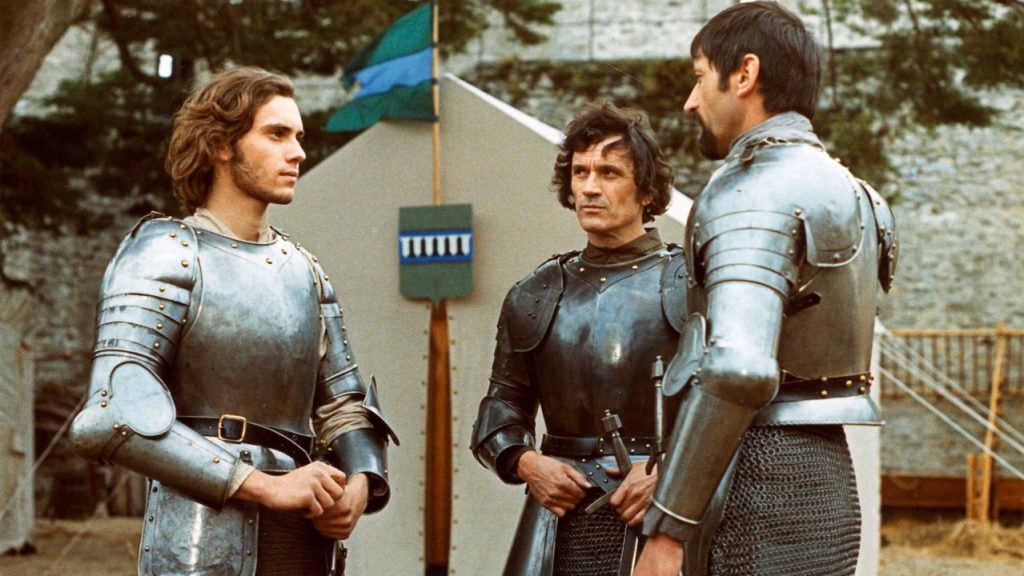
Just as Bresson skips everything leading up to the Grail quest (excluding the character of Merlin and all references to magic entirely), he has the viewer join the forbidden romance between Lancelot and Queen Guinevere in progress, but before they have acted on it. That hardly matters to the scheming Mordred, who gets evidence of their tryst, but does a poor job of sneaking up on them when they finally throw caution to the wind. (Suits of armor are not designed for stealth.)
By shifting the focus from the Grail to Lancelot, Bresson hinges the drama on the knight’s dilemma, caught between loyalty to his King and love for his Queen. Bresson’s insistence on non-emotive acting means this has to be conveyed without the demonstrative performance style that marks John Boorman’s Excalibur, which was made seven years later, but had been gestating nearly as long. Two very different takes on the same material, but there’s enough overlap between them (e.g. the corpse-strewn battlefield that closes both films) to show how durable such legends are. It’s notable, however, that the first people who speak in Lancelot aren’t nobility, but rather a peasant family who give directions to a knight who has lost his way. Later, when a humbled Lancelot is convalescing with them and leaves prematurely to rescue Guinevere, the old woman tells him, “Go, then. Go and be killed.” And so he is.
And so is everyone else, as predicted by the mortally wounded Gawain a few scenes later. Bresson doesn’t show Gawain’s clash with Lancelot, just as he elides the final battle, choosing instead to intercut shots of riderless horses and tableaus of dead and wounded knights. In the end, the only combatants left are archers in trees pitilessly picking off any stragglers. A grim note to end on, but after waiting so long to make Lancelot his way, Bresson had no desire to soft-pedal it.
“Lancelot du Lac” is streaming (alongside most of Robert Bresson’s other films) on the Criterion Channel.