Sean Burns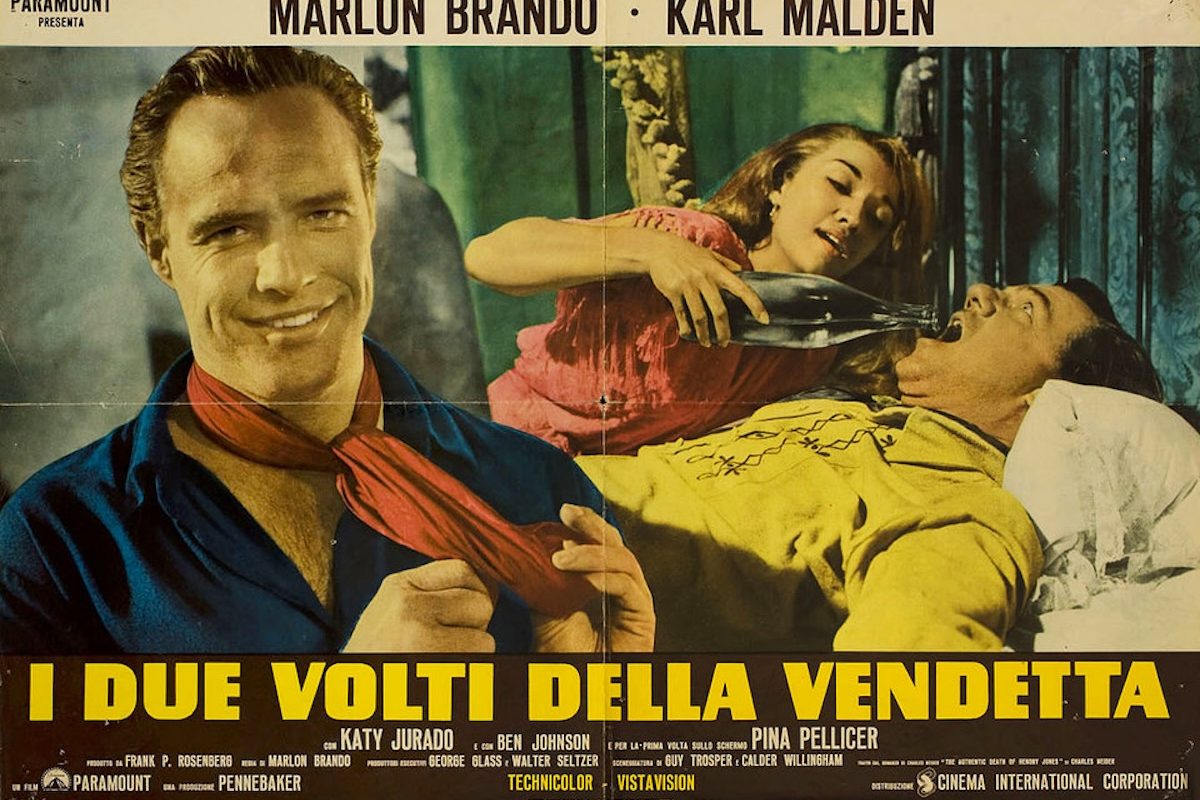
Marlon Brando shot more than a million feet of film while making his lone directorial effort, One-Eyed Jacks. A notoriously troubled production, the film took twice as long as scheduled and tripled its original budget. After lengthy battles in the editing room, the actor dumped a five-and-a-half hour cut of the picture in Paramount’s lap and let the studio saw it down to a marketable length. Released in 1961, the 141-minute final product turned out to be pretty popular at the box office, though not popular enough to recoup the considerable cost overruns. Still, knowing Brando’s restless, exploratory methods in front of the camera, it’s hard to believe anyone ever expected any less from him behind it.
An odd, mercurial Western from an odd, mercurial genius, One-Eyed Jacks has one foot in a classic Hollywood production style, with handsome VistaVision photography and a traditional Western score. Yet there’s something troubling and downright nasty about the picture, which anticipates the morally ambiguous, revisionist Westerns that would come along a few years later. Brando stars as remorseless bank robber Rio, a smiling outlaw who lies as easily as he breathes and spends five years in a hot, hellhole Mexican prison dreaming of cold-blooded revenge on the partner and father figure who left him for dead.
One of Brando’s original ideas was to set The Count of Monte Cristo in the Old West, and it’s easy to see some elements of the Alexandre Dumas classic in what made it to the screen. But like all things having to do with One-Eyed Jacks, the story takes a circuitous route. The movie is credited as an adaptation of Charles Neider’s 1956 novel The Authentic Death of Hendry Jones, itself a reworking of the legend of Pat Garrett and Billy the Kid. Rod Serling wrote a treatment for the picture, then a young TV writer named Sam Peckinpah came in and penned a screenplay many in town described as “perfect.” Brando didn’t agree, first bringing in Calder Willingham to take another pass before Guy Trosper wound up rewriting the picture as it was shot.
In the meantime, Brando butted heads with original director Stanley Kubrick until two weeks before production, when the filmmaker was either fired or quit, depending on who you ask. According to One-Eyed Jacks superfan Martin Scorsese, “Kubrick left and went to England and never came back.” I recently saw an original 35mm release print as part of the Harvard Film Archive’s The Complete Stanley Kubrick retrospective, but even the most dedicated forensic auteurists would have difficulty finding much you could call Kubrickian in the film’s final form. (Though it is fun watching The Killing co-stars Elisha Cook Jr. and Timothy Carey show up to meet memorable demises.)
However, one can see a lot of Peckinpah in the picture, adding a weird echo effect since Bloody Sam repurposed a good deal of that “perfect” script for his 1973 masterpiece Pat Garrett and Billy The Kid, which featured indelible appearances by One-Eyed Jacks co-stars Slim Pickens and Katy Jurado. The Garrett figure in Brando’s film is Karl Malden’s Dad Longworth (what a name!) who abandons his partner to the federales for two sacks of gold and starts over with a prosperous new life as the sheriff of Monterey, California. He’s perfectly happy with his wife (Jurado) and stepdaughter (Pina Pellicer) until Rio shows up on his doorstep to reminisce about old times.
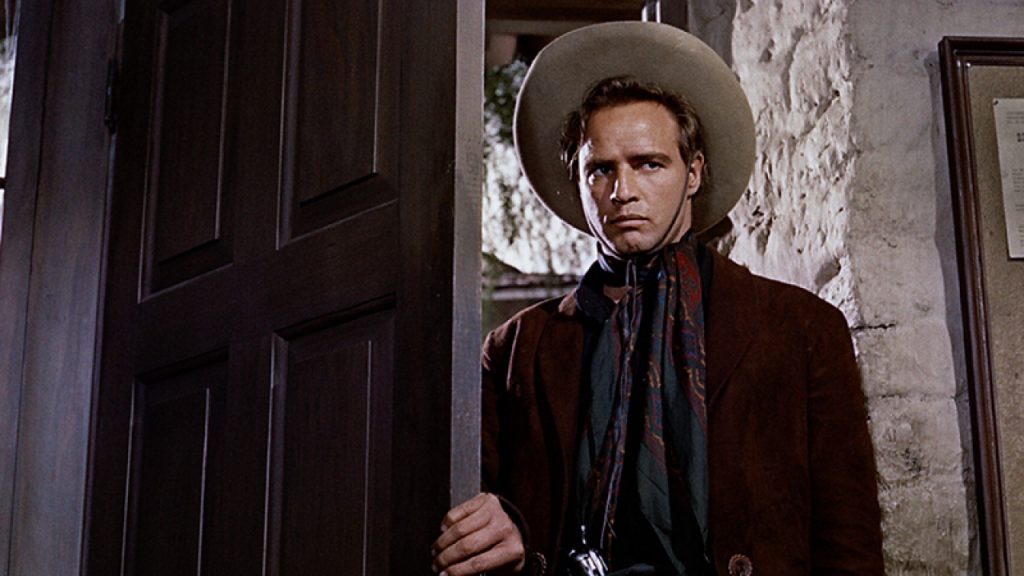
Brando’s grinning, coquettish sociopath doesn’t mention that he’s recently busted out of a Mexican prison. But Dad Longworth – I really love that name – can intuit his old partner is up to no good, even before he meets the crew of miscreants Rio’s running with, led by a wonderfully insinuating Ben Johnson. (“I’ve seen your picture at the post office,” Malden says to him with a loaded smile.) The brooding Brando is waiting to take his revenge until after they’ve knocked over a local bank that doesn’t open until Monday, so in the meantime he decides to seduce Dad’s stepdaughter.
The scene between Brando and the girl are by far the film’s weakest, hinting at a possible redemption for the character that’s neither interesting nor particularly believable. Far more compelling is the hothouse Oedipal conflict – I mean, he’s named “Dad” – which quivers with a sadomasochistic, psychosexual energy even before the sheriff whips the outlaw’s bare back in front of a whole town of gawling observers. Of course, Brando and Malden had worked together before in On the Waterfront and A Streetcar Named Desire, so elements of their shared screen history can’t help rippling through these scenes. (Kubrick’s choice for the role was Spencer Tracy, to cite one of their myriad disagreements.)
Brando still had his early, swarthy magnetism – though during the shoot his costumes had to be adjusted to accommodate his fluctuating weight – and as a director he regards himself onscreen with a fascinating mix of narcissism and self-loathing. For the saloon scenes, which are legion, he had his actors actually get drunk, conjuring a loutish sluggishness in the characters’ heavy eyes. A brutal rape scene was written but never filmed. The studio also put the kibosh on Brando’s original ending, in which Longworth accidentally killed his pregnant stepdaughter. The re-shot, more hopeful conclusion is both hasty and feels out of another movie altogether.
There’s something fascinatingly counterintuitive about setting a Western in Monterey. Though not historically inaccurate, it’s nonetheless jarring to see iconic cowpokes like Slim Pickens and Ben Johnson in front of waves crashing up on the beach. Like the Method electricity that crackles through One-Eyed Jacks’ most effective scenes, it’s the sign of a messy, seditious Western trying to take the genre somewhere it hadn’t been before.
“One-Eyed Jacks” is streaming on pretty much every ad-based streamer possible.