Josh Bell
It’s a jarring sight, all the more so for how casually the characters approach it: A grown man, clad in a bib and a diaper, lying in an adult-sized crib sleeping peacefully like, well, a baby. Just a few minutes into the delightful cult oddity The Baby, which was released 50 years ago this week, director Ted Post makes it clear how committed he is to the movie’s bonkers premise. The title character (David Manzy) lives with his mother and two adult sisters in a permanent state of infancy, taking naps, crawling around, drinking from a bottle, and expressing himself via inarticulate gurgling and crying. He has no name other than Baby.
This isn’t some hidden secret, though. As Baby’s mother Mrs. Wadsworth (Ruth Roman) tells social worker Ann Gentry (Anjanette Comer) when she pays the family a visit, social workers have been coming to the Wadsworth house regularly since Baby was a child, and they’ve apparently found nothing amiss. The government even sends the Wadsworths money for Baby’s care, which is the family’s sole source of income. Mrs. Wadsworth is unconcerned and dismissive with this new case worker, even expressing surprise that Ann wants to bother seeing Baby in person.
Ann, however, has taken an inordinate interest in Baby, and from early in the movie there are hints that her concern isn’t entirely altruistic. Her eyes light up when she tells Mrs. Wadsworth that she requested to be assigned to the case, and soon she’s asking to feed and play with Baby herself. Previous case workers would check in twice a year, but Ann shows up three times in her first week. Baby has never received any kind of medical diagnosis, and the Wadsworth family dynamic is obviously not healthy. Maybe it’s a good thing that someone from the government is finally showing concern for Baby’s well-being.
As blatantly twisted as the Wadsworths are, Ann herself is perhaps more insidious, keeping her own proclivities under wraps for most of the movie. She gets a troubled look when Baby’s sister Germaine (Marianna Hill) asks if she’s married, first speaking about her husband in the past tense before clumsily correcting herself. “I lead a pretty conventional life,” she tells Germaine, which of course is something that no normal person would actually say.
Still, Ann seems like a perfectly sane alternative to the Wadsworths, who are reluctant to let Baby be examined or leave him alone with anyone. There are only brief glimpses of their demented private treatment of Baby, but they’re enough to make it clear that he’s being abused and exploited, whatever his genuine condition might be. “He loves being a baby,” says his sexpot sister Alba (Suzanne Zenor), whose own stunted personal style could be described as “naughty schoolgirl,” but what Baby actually cares about is of no concern to anyone in his family.
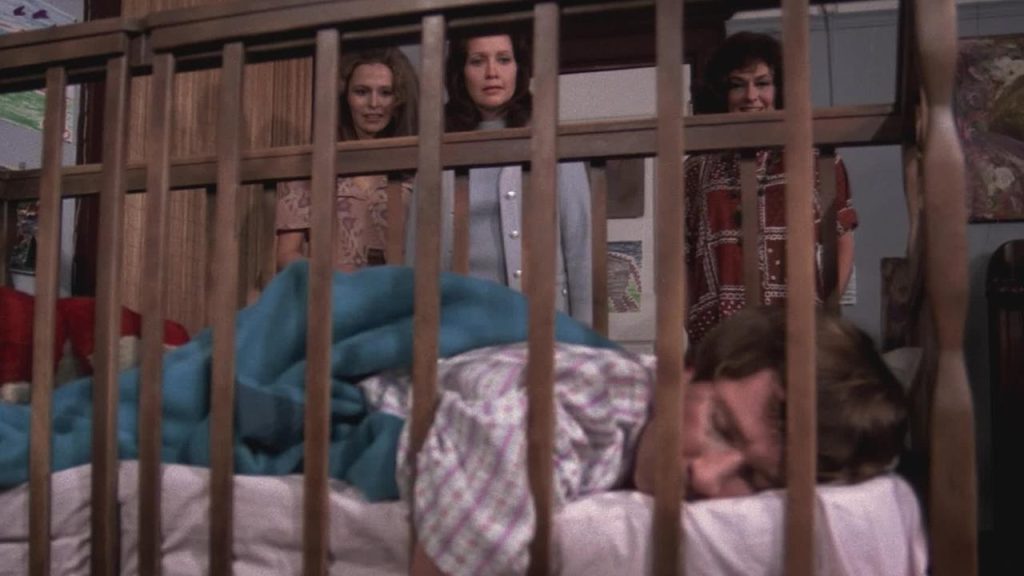
The Baby gets more deranged as it goes along, and it could easily be played for laughs or for cheap exploitation. Instead, Post approaches the material almost entirely straight, letting the plot and the characters carry the absurdity. A journeyman director whose credits include numerous TV episodes and later installments in the Dirty Harry and Planet of the Apes franchises, Post brings a matter-of-fact perspective to The Baby that ultimately makes it more disturbing.
A director with a more distinctive, stylized vision could tip the movie into camp, but Post underplays even the most outlandish developments. By the time the movie arrives at Baby’s birthday party, a swinging ’70s shindig full of adults smoking pot and dancing suggestively, the audience is fully on board for whatever the filmmaker can throw at them. As shocking as the final twists may be, right up to the gleefully horrific closing freeze frame, they feel almost inevitable, a foregone conclusion in a world as plainly unhinged as this one.
The performances support Post’s gritty, immersive approach, from Roman’s world-weary, smoky-voiced matriarch to Comer’s wide-eyed, chipper idealist. Manzy, who has only a handful of acting credits, is remarkable as Baby, making this ridiculous character believable and even tragic. Without any actual lines, he conveys Baby’s confusion, longing, and desperation. The scene of Baby frantically attempting to latch onto a teenage babysitter’s breast to feed is both horrifying and weirdly tender. There’s an undercurrent of sexual fetishism to the way that the other characters, who are almost all women, interact with Baby, but the movie never feels prurient or sleazy — at least not in a negative way.
The Baby’s central family dynamic has echoes in more explicitly violent horror movies, from the following year’s The Texas Chain Saw Massacre to Rob Zombie’s Firefly family trilogy (House of 1000 Corpses, The Devil’s Rejects, 3 From Hell), which also prominently features a character named Baby. Despite its current streaming home on Shudder, though, The Baby isn’t really a horror movie. It’s a psychosexual drama about women taking control over men via one particularly helpless avatar, an expression of anxiety during a period of social turmoil. It’s also about a grown man rolling around in a playpen, and it has to be seen to be believed.
“The Baby” is streaming on Shudder and on free services including Tubi, Plex, and the Roku Channel.