Jonah Koslofsky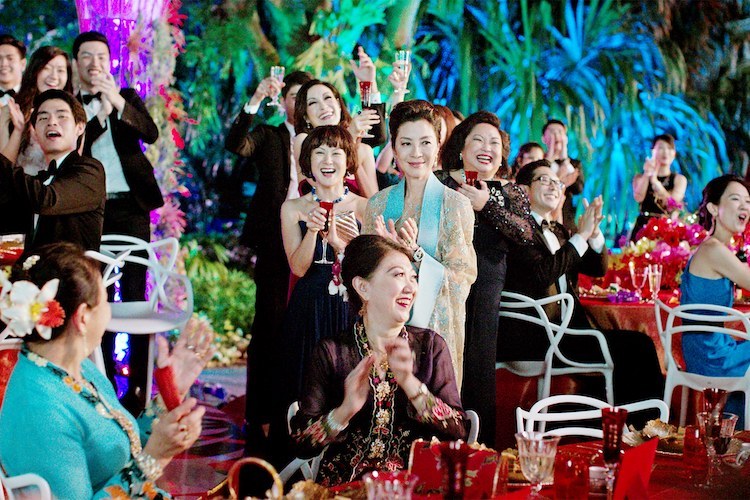
In the year since it was unleashed on the public, two schools of thought have formed around Crazy Rich Asians. Hailed for its inclusion of Asian and Asian-American actors in an industry where said actors are often sidelined, the Golden Globe-nominated romantic-comedy has been recognized as a progressive move forward. Representation matters.
And it does — I’m not suggesting that this reading of Crazy Rich Asians is false. But in this case, said representation comes at a high price — both literally and figuratively. This is a text that completely affirms both the wealthy and wealth itself. As you probably remember, we follow Rachel Chu (Constance Wu), an economics professor at NYU, accompanying her boyfriend Nick (Harry Golding) home to Singapore for his best friend’s wedding. The twist? Nick’s rich. So very rich.
So our hero’s quest is to assimilate into the upper class, to gain the approval of the ultra-wealthy. Nick’s family, “the Youngs,” are the biggest names in Asian real estate development, and apparently built Singapore as we know it out of “swamp” (as Awkwafina’s character Peik Lin puts it). Casual colonial re-writing of history aside, the Young family fortune and their class position is treated as this abstract, happy coincidence. Never once does Crazy Rich Asians suggest that Nick’s family has more money than anyone ever should, nor does it imply or acknowledge that said excess is inherently connected to those who have less.
It’s here that the movie descends into dishonesty: In a day and age where the gap between the rich and poor is larger than it’s ever been, where capitalism has successfully connected the world such that labor can be easily exported anywhere, it is simply irresponsible to glorify the lives of the top 1 percent when they are responsible for the suffering of billions (of course, the system they profit from bears some of the blame too). According to the movie, the lavish lifestyles of the Young family are to be celebrated. Instead of satire or parody, Crazy Rich Asians settles on insidious luxury porn.
Look no further than the final shot, which features the main characters at yet another extravagant party, literally dancing on top of the rest of the world. Don’t you wish you were invited? But Crazy Rich Asians endorses a framework designed to keep this guest-list as small as possible. That you are not invited is a feature, not a bug.
Furthermore, the film posits that class transcends race, drawing a clear link between these two readings. In the opening scene, a flashback to a rainy London night, the Young family is rejected from their posh hotel on explicitly racist grounds. That is, until matriarch Eleanor Sung-Young (Michelle Yeoh) gets through to one of the hotel’s wealthiest guests and proprietors. The scene ends with the concierges humiliated — had they known how rich the Asian family was, of course they would have treated them nicely! But this is far from a sustainable or reasonable solution to the prejudice faced by the targets of white supremacy. It’s great that the Young family can get out of the rain, but “the rich sticking together” is hardly a rational roadmap for all. The movie doesn’t seem to care.

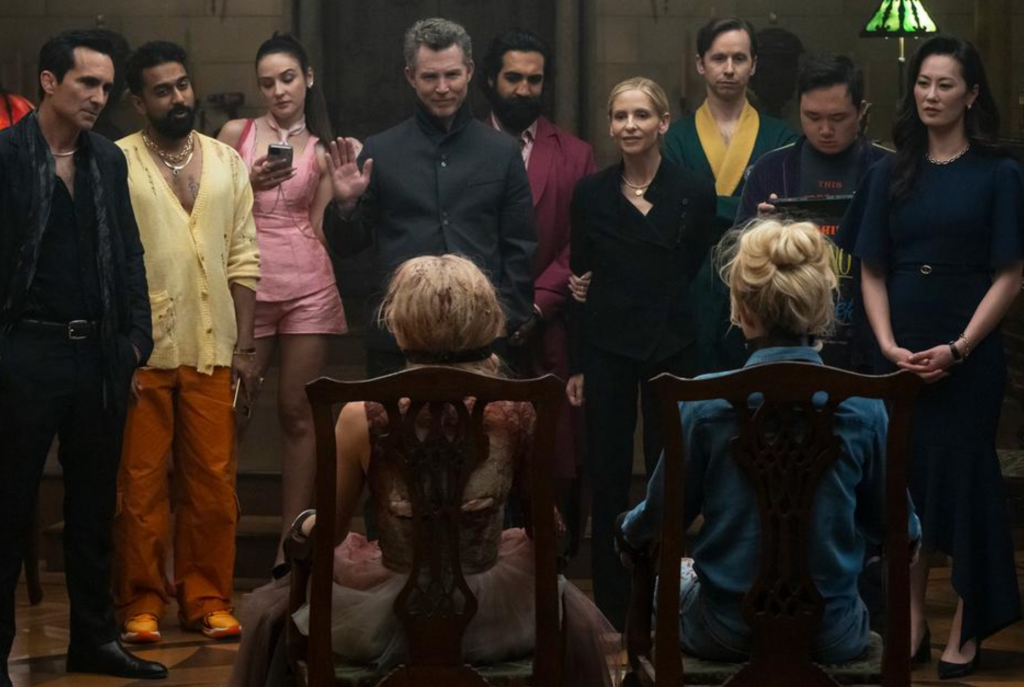
But one August later, the Hollywood machine has spit out an antidote to its own poison: the horror-comedy Ready or Not. Like Crazy Rich Asians, this is a movie about assimilating into wealth — she is Grace (Samara Weaving), and she’s delighted to be marrying Alex Le Domas (Mark O’Brien), heir to the Le Domas family fortune. While we don’t learn much about Grace over the course of Ready or Not’s brisk 90-minute runtime, her desire to marry Alex seems to stem from her upbringing as a foster child — she doesn’t want the Le Domases’ money, she just wants to be a part of their strong, close family.
Until she doesn’t. What Grace doesn’t know is that the Le Domases’ fortune and tight familial bonds are the product of a pact they’ve made with the Devil, or “Mr. Le Bail” as he’s known to the aristocrats. The deal is simple: For an outsider to be allowed into the Le Domas clan, they must play a game chosen by a special box provided by Le Bail. Usually, the box chooses something harmless like chess, but in Grace’s case it spits out “hide and seek,” an exception that means the Le Domas’ must hunt Grace down and kill her before dawn, or face dire consequences.
Like in Crazy Rich Asians, Grace realizes the key to her success (and survival) is to play the games of the rich. Just as Rachel realizes that she won’t be able to charm her way into the heart of Nick’s mother Eleanor and decides her only way forward is to engage in multiple games of chicken with the Singapore elite, Grace is forced to accept that there’s no talking the Le Domases out of their bloodthirsty ritual.
But the stakes in Crazy Rich Asians are ridiculously low, even for a rom-com. The thing we care about — Nick and Rachel’s relationship — is never in any jeopardy, regardless of how the Young family feels about Rachel. On the other hand, whether or not Grace can play the Le Domases’ game is a genuine matter of life and death.
The film is willing to look one step further too, acknowledging that Grace and the Le Domases aren’t the only people playing. The household staff is roped in as well, and all meet a grisly end as a result of the family’s ultra-violent rite. Ready or Not may not be a subtle movie, but there’s some insightful subtext here: The buffoonish behavior of the super-rich has gruesome consequences — especially for those they employ. Crazy Rich Asians is willing to paint some members of the Young family as playfully idiotic, but it’s never inclined to show any real ramifications for their actions (give or take a quickly forgotten dead fish).
Finally, Ready or Not concludes on a genuinely tragic note, no matter how you interpret the ending. As the Le Domas mansion burns, an exhausted Grace finally rests, firefighters and law enforcement on their way. But the credits roll before we get clarification in terms of what exactly will happen next. Will the police find the dead bodies of the servants and arrest Grace? Or worse, will Grace walk free, inheriting the entire Le Domas fortune? For like Rachel, Grace has proven herself exceptionally good at playing upper-class games, and it seems only “fair” that having pulled herself up by her bootstraps, she should be allowed to reap the endless rewards. Through this lens, Ready or Not functions as the opposite side of the Crazy Rich Asians coin, framing assimilation into wealth not as one wild weekend but a traumatic, cannibalistic struggle.
And while many have excused Crazy Rich Asians’ regressive class politics on account of its genre and polish, there’s really no ignoring its blatant disregard for anything outside the top of the hierarchical scheme it endorses. I am the last person to push back against the inherent pleasures of the rom-com or escapist pop art in general, but I would argue that it’s worth keeping our eyes open when it comes to the media we consume. Ready or Not belongs to a genre considered lowbrow, but it tells the same story as the rom-com only in terms we deserve: When we play the games of the super-rich, nobody wins.