Jeremy Herbert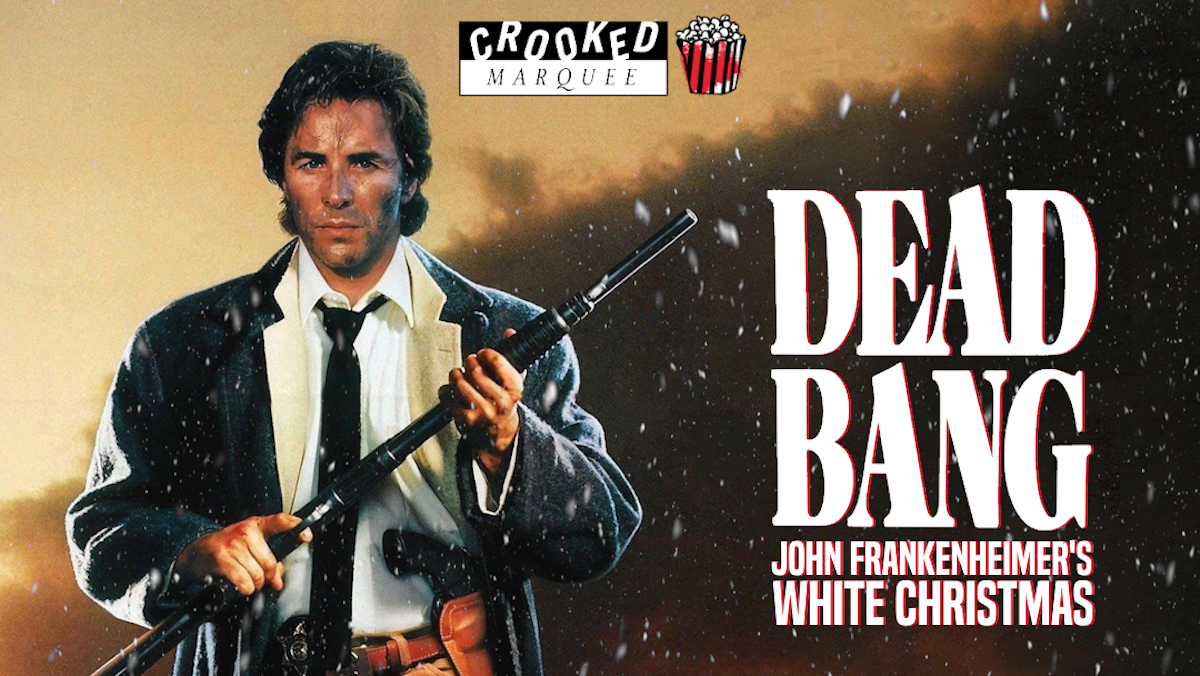
Two months before the sun set on Miami Vice, Don Johnson staked his claim to big-screen stardom with a familiar image – a 747 glittering between palm trees. But instead of a coke-white Ferrari Testarossa, he pulls up in a primer-black Pontiac Executive. This cop wears a white suit from JC Penney, not Armani, and lives in a flophouse, not a houseboat. His first order of business as a twenty-foot-tall leading man is squinting out a restraining order against his children through reading glasses missing a wing.
Sonny Crockett, this is not. If anything, he bears a closer resemblance to John McClane, another prickly deadbeat detective who keeps time on his depressive spiral by Christmas decoration. The similarity might be more than a little personal – Johnson scored Bruce Willis a breakout role on Miami Vice and later turned down Die Hard over obligations to the series, accidentally handing his old friend a ticket to movie stardom. Dead Bang was filmed a couple months before Die Hard opened. It cost half as much and made half of that. On the rare occasion that Johnson talks about the film, as in a recent JoBlo interview, he does with the rose-tint of a cause lost: “That movie had a real chance.”
In all surviving media, director John Frankenheimer never brought it up by name. For a 1989 Los Angeles Times profile published eight months after the release, he only offered lines to read between. “Once a movie starts and you find yourself in a situation where you have a very difficult star, it’s like you’re a hostage…that’s tough to do if you’ve created the project and worked with the writer on it from the beginning.” After taking what he could get for most of the 1980s, the veteran journeyman bought the life rights of LASD detective Jerome “Bulldog” Beck to develop a project on his own terms. The pyrotechnically enhanced plot may belong to Beck, but his fictional equivalent’s alcoholism belongs to Frankenheimer, whose moment of clarity arrived when he left a party through a glass coffee table. Dead Bang was his third film after seeking help in the early 1980s and the only one until his death to say the magic word.
Despite the best efforts of Don Johnson’s perm, Jerry Beck is not pretty. The enduring image of Dead Bang, if such a thing exists in pan-and-scan purgatory, is our hungover hero puking all over a pinned suspect because their foot chase went on a little too long. But that’s just a twist of a knife that cuts earlier, almost silently, when parole officer Bob Balaban reluctantly leaves the kids on Christmas morning to run him some files and offers unsolicited advice: “If I were you, I’d give AA a thought. Alcoholism is a disease, you know.” He hasn’t seen Jerry Beck drink. Even at a “Lonely Guys Christmas Eve Ball” where Stroh’s cans shine like tinsel, Jerry sips carefully in a corner. Everyone senses it coming off of him like impolite radiation and only a coworker who hates his guts ever cares enough to tell him. Even Penelope Ann Miller, a complete stranger, can clock the damage of his goods from across the room: “First Christmas away from home?”
“I’m sorry,” he says after spoiling a joke about the most wonderful time of the year, “I didn’t mean to sound glib.” But everything sounds glib at Christmas when you’re sick and lonely. All Jerry has is his next case and a gaggle of Neo-Nazis to gun down.
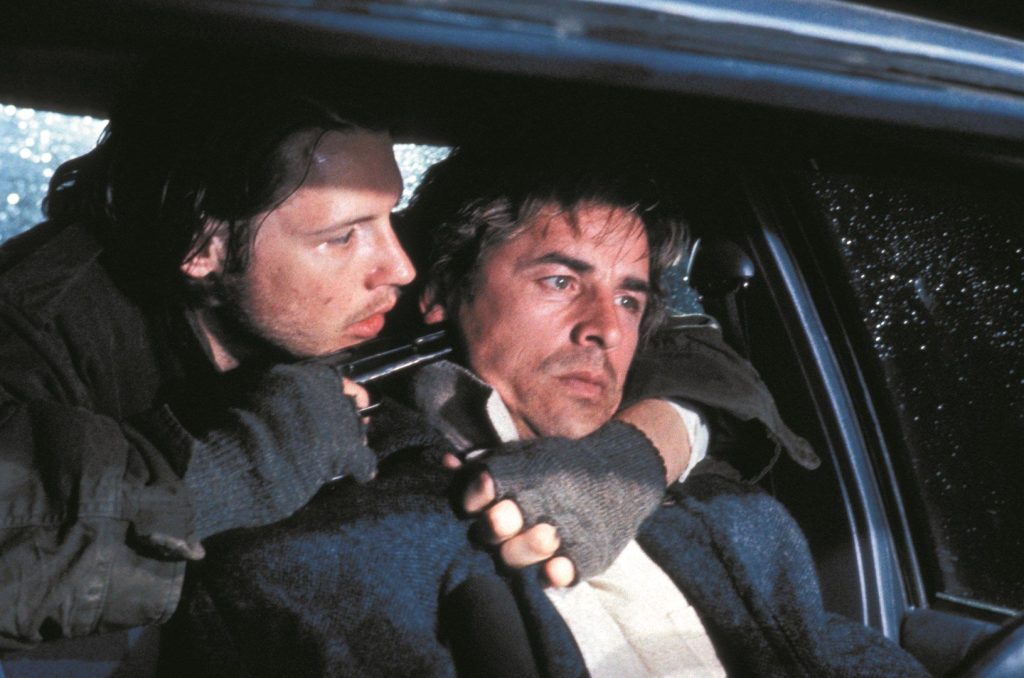
For all its popcorn packaging, Dead Bang is shockingly unsparing on white supremacy and the agencies paid to stomp it out. The biggest, brightest trees belong to The Aryan Nation Church of Christ. It has all the rustic charm of your average flyover congregation. The pastor calmly rebukes “low blood” like any other sin while his wife force-feeds Beck baked goods. The only unnerving giveaway is a shooting range out back where bullseyed racial caricatures are hung with care. There’s no untangling the holiday from the religion, the religion from the extremists – skinhead leader Bobby Burns compares their movement to Christianity surviving the Colosseum. But when Beck tries to rally the metaphorical Romans, even in a sundown town that still keeps a hard-R warning in the Sheriff’s Office, the FBI only takes issue with his decorum: “I find your language personally offensive.”
The climactic showdown that sees Beck lighting up the gang’s underground hovel with volcanic Mac-10 fire is primally satisfying if disappointingly conventional, a compromise Johnson pitched after the 1988 Writers Guild of America strike halted rewrites: “The ending, I’m sorry to say, was an invention of mine.” But beneath all the soot and gunpowder, there’s still a pitch-black punchline. White supremacists only kill cops if they don’t know the rules yet and cops only take them down by accident; they stumble across the hideout solely because of literal departmental in-fighting. If there wasn’t some poor bastard with nothing better to do for the holidays than prove he’s still got his fastball, nobody would’ve taken the case at all.
For the rest of his career, John Frankenheimer was written off as a promising young man who got old – thumbs up and down for Ronin still graded him on the Manchurian Candidate curve. But now that 52 Pick-Up has been rightly reappraised, the sleazy yin to Dead Bang’s furious yang, the more personal Frankenheimer B-side deserves its day in the sun, or at least a boutique Blu-ray. You’d be hard-pressed to find another Christmas movie with an elaborate tracking shot that starts on a Neo-Nazi’s wrist tattoo, sweeps across the windows of a sleepy household all a-trim for Santa Claus, and ends tight on the security mirror of a convenience store across the street as he sticks the place up with a Browning Hi-Power handgun.
“Dead Bang” is available for digital rental or purchase.