Roxana Hadadi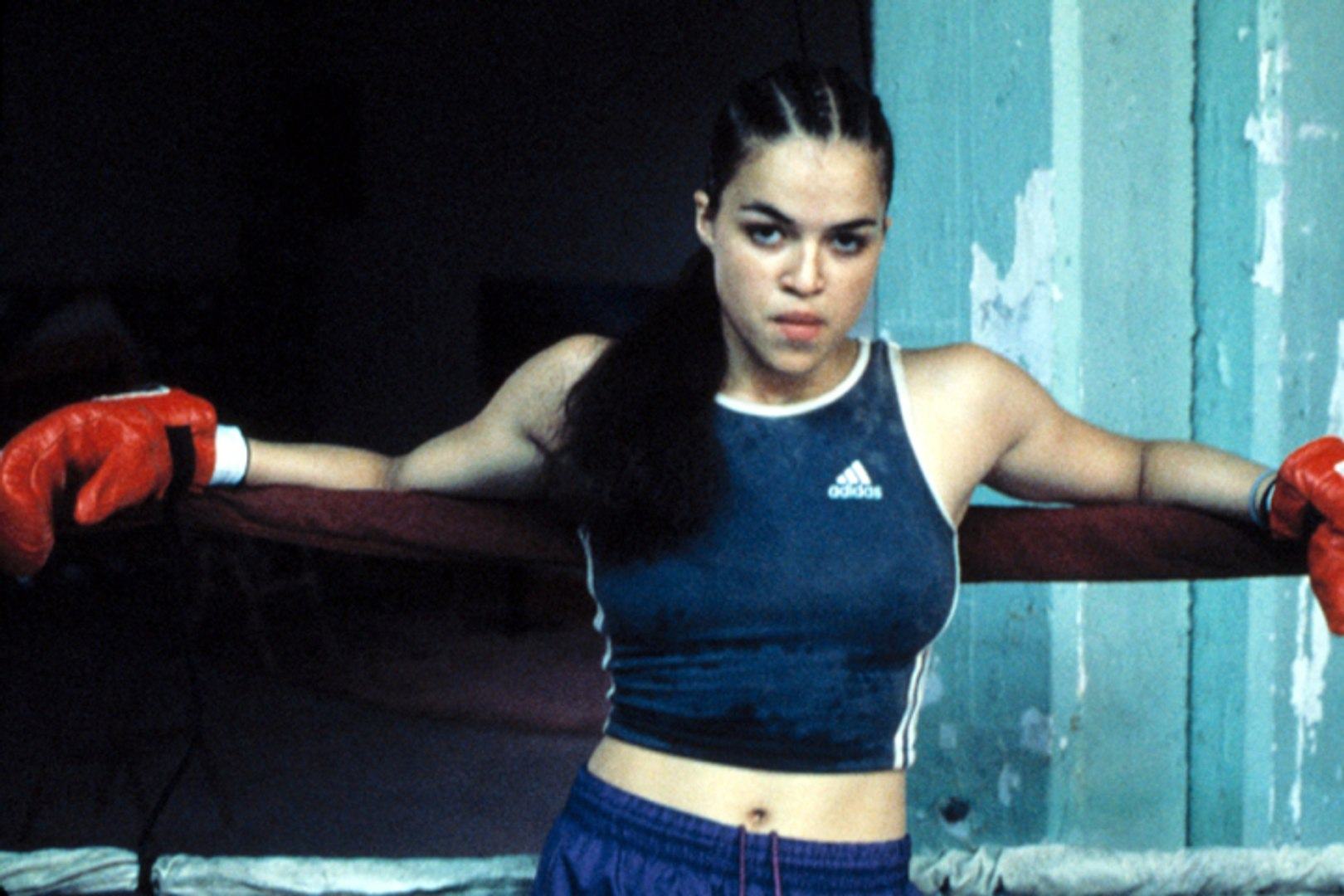
In Karyn Kusama’s Girlfight, Michelle Rodriguez introduced herself to us angry. Resentful of traditional femininity. Embittered by her belittling father. Scornful toward her dismissive teachers. Her eyes narrow quickly into a suspicious glare; her lips curl upward easily into a judgmental sneer. Rodriguez’s Diana Guzman is a live wire of disgust and disdain in response to a world that underestimates her at every turn, and Kusama never questions the intensity of that feeling. Diana’s hostility is justified, and Rodriguez is its perfect conduit.
Winner of the Grand Jury Prize at the 2000 Sundance Film Festival and the debut film for both Kusama and Rodriguez, Girlfight (released 20 years ago on Sept. 29) follows Brooklyn teenager Diana as she shoulders her way through a world shaped nearly exclusively by men: their presence, their absence, their opinions, their desires. The other girls at school, including Diana’s only friend, Marisol (Elisa Bocanegra), are always fighting amongst themselves about boys. At home in their projects apartment, her father Sandro (Paul Calderón) is a cruel bully, needling her constantly with comments like, “Why you always gotta fuck up like this, huh? You embarrass me. Sometimes I don’t even think you’re mine.” Sandro’s friends comment on how much Diana looks like her mother, who isn’t around; their compliments rub salt into a still-open wound. Diana’s younger brother Tiny (Ray Santiago) gets irritated when she comes to his defense, although he often needs it. Pushed away by her family, written off by her educators and classmates, and objectified in the casually ubiquitous way young women often are, Diana barely speaks. But she holds her head high, maintains eye contact a little too long, revels in making people feel as uncomfortable and unwanted as she does. Her defensiveness is an attack: a declaration of her selfhood, and a refusal to hide.
Diana’s rawness manifests in a purposefully broken dinner plate, a fight instigated in a school hallway, and a punch to the face of a man who mocks Tiny. And it begins to transform into something else—something more finessed, and more purposeful—when Diana decides to take boxing lessons at the Brooklyn Athletic Club, where Sandro is already paying for Tiny to receive training. When Sandro refuses to cover Diana’s costs, too, he’s another man telling her what to do, and just another voice to stifle. She steals the money. She convinces former boxer Hector (Jaime Tirelli) to coach her, acquiescing to his “You don’t sweat for me, you’re out of my life” warning. And every day after school, she gets to work in the rundown club, with inspirational messages scrawled in marker on haphazardly hung squares of cardboard, a sagging mattress doubling as a training ring, and a locker room fashioned out of a musty closet of cleaning supplies. Push-ups. Pull-ups. Speed bag. Footwork. Running. Sparring. “All force and no technique,” Hector says of Diana when they begin working together, and she is not particularly graceful. But she is committed, and perhaps already prepared for the self-sufficiency the ring offers. “It can be a lonely place,” Hector warns her, but Diana’s whole life up to this point has been spent in various forms of isolation. What could possibly be new about the feeling of being alone?

Sports movies are, at their core, about respect. They can be about the friction of teamwork, like the millennial favorites Remember the Titans or The Mighty Ducks, or about the struggle of realizing your best days are behind you, like The Wrestler or Any Given Sunday, or about the single-minded focus that is needed for success, like Eddie the Eagle or Free Solo. But those are secondary attributes. What is most primary and most formative for the genre’s athlete protagonists is the pursuit of that final victory, and the esteem that comes with it. There can be only one winner, and the best sports movies explore whether the pressures involved in that singularity are worth the accompanying reverence.
Girlfight accomplishes this twice, focusing first on how Diana’s new passion gives her a sense of direction that her school and home lives had both lacked, and then on her budding relationship with fellow boxer Adrian (Santiago Douglas). An up-and-coming contender who also trains at the Brooklyn Athletic Club, Adrian unexpectedly kisses Diana one night after giving her a ride home. “I always thought of myself as salty,” Diana admits when Adrian notes that she “taste[s] sweet,” and it’s unsurprising how quickly she falls in love with him. But when their individual meteoric rises eventually pit them against each other, Diana is forced to contemplate what she’s really fighting for, a consideration that results in some of the strongest work of Rodriguez’s career.

Since Girlfight, Rodriguez has become a certifiable badass, a mainstay in action franchises like Fast & Furious, Machete, and Resident Evil, as well as blockbuster fare like Avatar and Battle Los Angeles. But some of her best performances (the surfing film Blue Crush, Steve McQueen’s underappreciated Widows) ask the same questions of her that Girlfight did: What is it like to dream, and to have that dream ripped away from you? Kusama and cinematographer Patrick Cady keep Rodriguez centered in shallow focus throughout Girlfight, whether she’s opposite her school principal, standing underneath elevated train tracks, lingering on the outskirts of a party, or settled in the middle of the ring. The set of her jaw, like she is always chomping down on a mouthpiece, and the pent-up energy in her body, like she’s about to strike forward, draw our immediate attention. But there is softness to Rodriguez’s portrayal, too, that reminds us Diana is just a teenage girl. The whine to her voice when she complains to a leaving Marisol, “But you said you’d do my braids!”, or the sadness in her face when Hector, thinking about his own career failures, shares that what it takes to be a great boxer is a “real strong will,” or her frozen shock when Adrian shows up to Hector’s birthday party with the girlfriend he said he was no longer dating. There are layers to Diana Guzman that Rodriguez nailed in her first film performance, and they continue to color her work decades later.
Equally thoughtful is how Kusama peppers in details that help round out Diana and the community of which she is now a part, like the birthday cake leftovers from Hector’s party showing up at the boxing gym the next day, or a fight attendee dismissing Diana’s name in an event program as a typo. Those particulars, coupled with Rodriguez’s performance, helped Kusama craft Girlfight into a sports movie that wasn’t afraid to look inward. “You know yourself? Then that’s all you need,” Hector tells Diana, and that push toward self-respect is Girlfight’s enduring gift to all difficult women.