Kimber Myers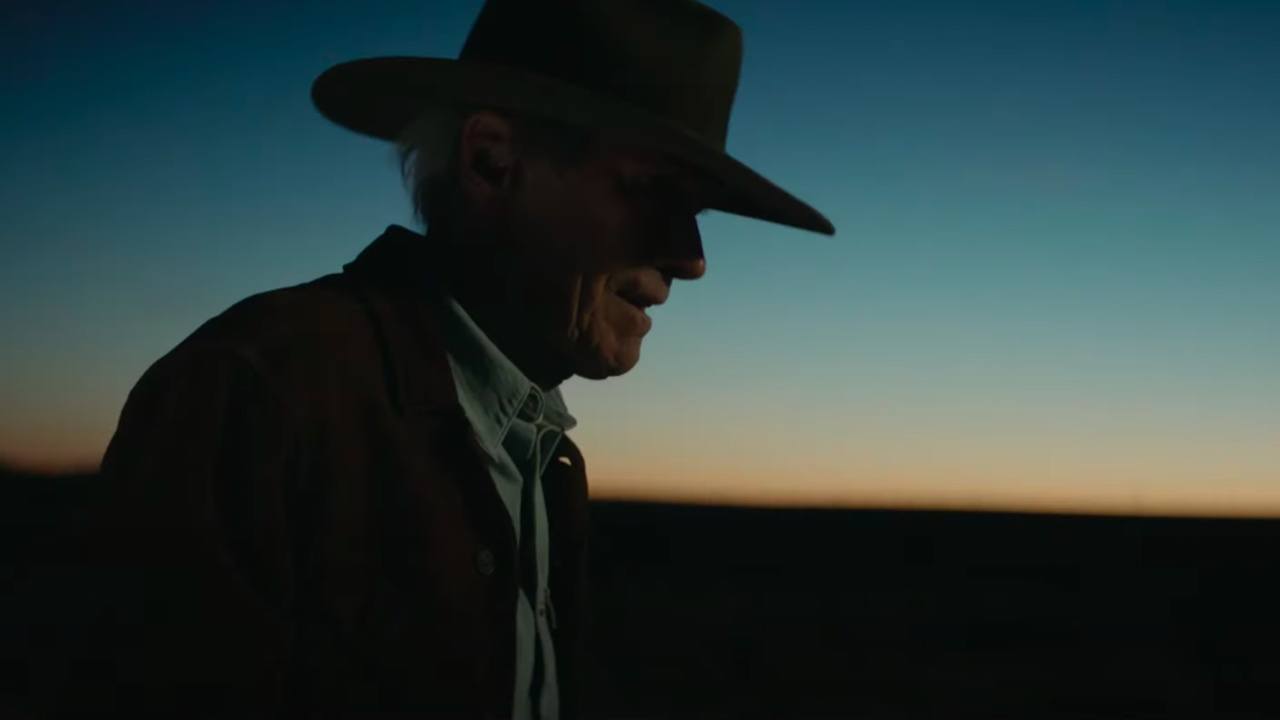
There’s a welcome familiarity in the quiet opening of ‘70s-set Cry Macho. A classic Chevy truck — vintage even then — winds down rural Texas roads with music to match in Will Banister’s amiable country song “Finding a New Home.” When Clint Eastwood appears on screen for the first time, he’s climbing out of the truck, patting it gently on the hood like it’s the haunch of a horse, thanking it for the ride. But once the dialogue begins, this Western temporarily loses its charm, as Dwight Yoakam is saddled with a load of expository dialogue that would test even a plowhorse’s strength. But Cry Macho finds its way again, turning into a fine drama that caters to Eastwood’s strengths as an actor, director, and icon.
As Yoakam’s Howard Polk explicates too explicitly, Mike Milo (Eastwood) just ain’t what he used to be — a rodeo star and ace horse breeder — after he fell on hard times and into a bottle. He’s grown tired of Mike’s irascible attitude and fires him. Fast forward a year later to 1979, and Howard again has a lot of explaining to do when he asks the taciturn Mike for a favor he feels he’s owed for all he’s done for his former employee. Howard wants Mike to travel to Mexico City to rescue (slash kidnap) his 13-year-old son, Rafo (Eduardo Minett), from his hard-partying mother (Fernanda Urrejola) and bring him back to Howard.
However, it isn’t just Rafo’s mother and the Mexican police who will complicate Mike’s mission to bring the boy back to Texas; Rafo himself is a handful. Mike picks the young troublemaker up at a cockfight, where he meets Rafo’s beloved fighter, a rooster named “Macho” (aka “Strong,” as Rafo translates). The unlikely trio travels north, as the crusty cowboy begins to soften toward his companions as they wend their way to the border.

A more literal translation of the rooster’s name is (unsurprisingly) “male,” and Cry Macho follows in the grand tradition of Eastwood films that comment on American masculinity – most notably in 1992’s Unforgiven, but also in basically any film where he dons a cowboy hat. Cry Macho initially seems like more of the same from the filmmaker, with the title almost an AI creation of an Eastwood film. But there’s a real tenderness here to balance the trademark toughness of the actor and director, and it’s not just in his friendship with Rafo. Animals beyond Macho and the inevitable horses parade through the film, with Mike treating them each with real care. Additionally, Eastwood has never looked more vulnerable on screen, and other than a scene that obviously uses a stunt double, the veteran star appears okay with showing his 91 years through his hunched posture and the way he struggles up a hill.
Beyond Eastwood’s performance, his visuals showcase the expansive vistas with as much attention as you’d expect in any well-crafted Western, with stunning sunsets and wide shots of the desert. Cinematographer Ben Davis doesn’t just shoot exteriors well, though; he does some lovely work with sunlight and shadow, especially in how he approaches the worn face of the actor-director. It’s initially tempting to mute the movie, with visuals far outperforming the dialogue in early scenes, but the script from Nick Schenk and N. Richard Nash soon improves. Adapted from Nash’s 1975 novel, Cry Macho is paced at a gentle trot, rather than a gallop, with its 104 minutes seeming far longer. When Yoakam’s Howard tells Mike to hurry it up, it’s hard to disagree, even though some of the film’s best moments arrive once Mike and Rafo are making little progress in their journey.
Cry Macho ultimately rewards those who stick through its rough beginning, which feels more like a parody of an Eastwood movie than the director’s work itself. Once the film settles in, it offers viewers an unexpectedly moving drama that feels like both a tribute to and vehicle for the legendary man behind it. 
B+
“Cry Macho” is out Friday in theaters and on HBO Max.