Jason Bailey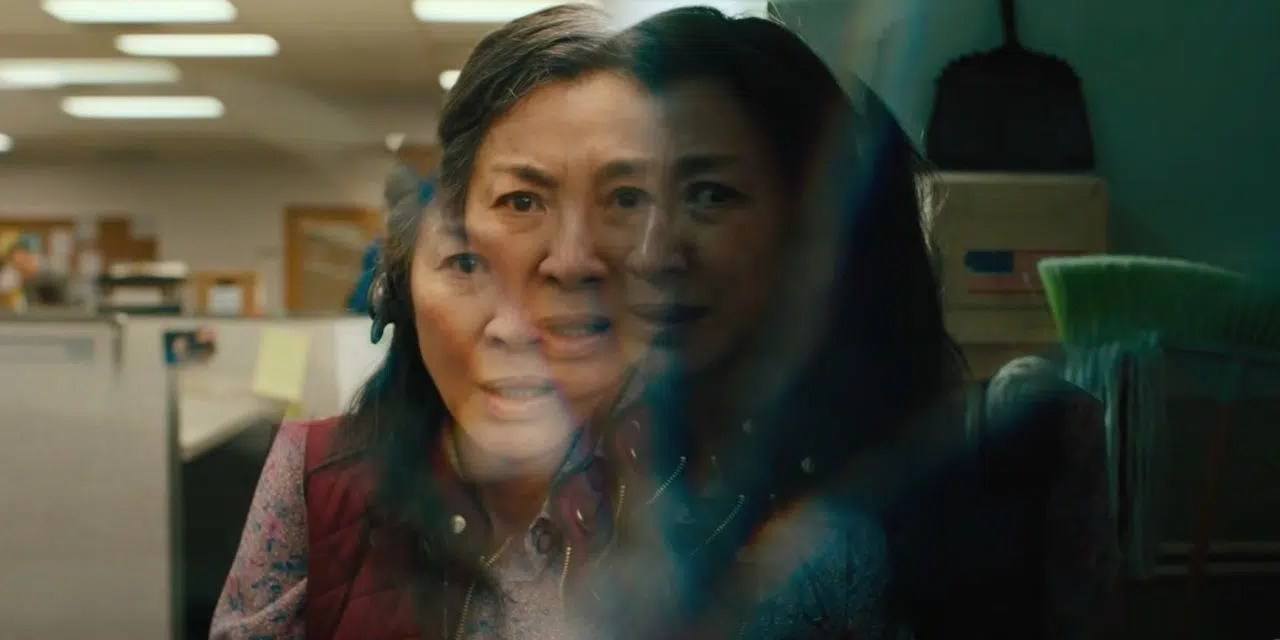
Let us consider the Valentine to the Beloved Star, in which a young filmmaker writes an earnest script that gives the aging actor the kind of showcase role they deserve, but may not otherwise get, in the youth-oriented marketplace. It’s one of the most noticeable trends of the last decade or so in indie cinema, starting with I’ll See You in My Dreams (Blythe Danner) and Hello, My Name is Doris (Sally Field) in 2015, followed by such titles as The Hero (Sam Elliot), Lucky (Harry Dean Stanton), and last year’s Swan Song (Udo Kier).
Those folks being who they are, their Valentines were modest comedy-dramas, which gave them the opportunity to shamble, emote, and sparkle. Michelle Yeoh being who she is means her Valentine is a hyperactive mixture of martial arts, broad comedy, and sci-fi world-building. It’s called Everything Everywhere All At Once, it’s directed by Daniels (Daniel Kwan and Daniel Scheinert) of Swiss Army Man fame, and if it’s a bit too hyperactive, well, that’s probably forgivable, considering what it’s setting out to do.
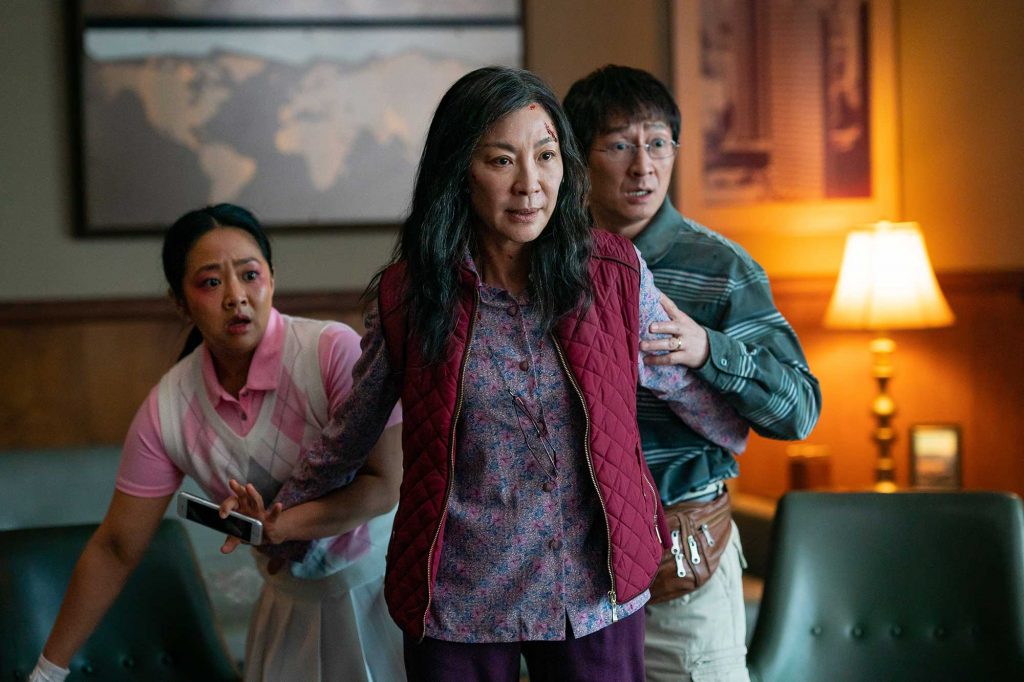
It begins as a familial comedy, albeit an uncommonly tense one. Evelyn Wang (Yeoh) is a laundromat owner who is stretched to the breaking point – her judgmental father (James Hong) is visiting for his birthday, her daughter Joy (Stephanie Hsu) is all but estranged, her husband Waymond (Ke Huy Quan) is about to divorce her, and an irritating IRS agent (Jamie Lee Curtis) is auditing the laundromat Evelyn and Waymond co-own. You could politely call her a flawed heroine.
But suddenly, unexpectedly, everything changes. During a visit to the IRS office (inconveniently enough), Waymond’s body is suddenly taken over by another version of himself – a Waymond Alpha, who explains that all of the choices and life-paths Evelyn should have taken and didn’t have created, around her, a multiverse of parallel realities. “Every rejection, every disappointment, led you here, to this woman,” he says – a good line – as he lays out the rules and jargon of “verse-jumping” and all of the alternate iterations of herself she can tap into. “It doesn’t make any sense!” she protests. “Exactly!”
So what we have here is a Matrix-style search for The One, though Evelyn is a reluctant world-saver, to put it mildly. When (under considerable duress) she makes these leaps, and takes on these combinations, the screen splits jaggedly, like a shattered mirror. He see her other selves in quick-cut montages: an opera singer, a chef, a house keeper at an S&M club, and best of all, a version where she is basically Michelle Yeoh, a kung-fu master movie star, cleverly deploying her own iconography (and, in what must’ve helped the budget, her own red carpet footage). Her work here has a fierce physicality, which is expected, but what’s striking is how the Daniels patiently deploy the tools she’s acquired over a career – how much she can convey with a look, a glance, a stare.
“Everything Everywhere All At Once” is, unsurprisingly, visually striking. The Daniels’ music video background is present in their gonzo compositions and hyper-saturated look, and there’s a welcome sense of weirdness and joy in their surprise juxtapositions, especially further on (because the deeper they get, the more versions of her they’re juggling). And though it’s Yeoh’s show, they give her supporting cast plenty of opportunities to step up; Hong get laughs just by being old and mad, Hsu handles the later, more poignant sections with aplomb, and Curtis is clearly having a blast. But the real find – if that word is even appropriate – is Quan, so delightful as a child actor in “The Goonies” and “Indiana Jones and the Temple of Doom,” returning to the screen after a long absence. His big fight scene, using only his hands and an artfully deployed fanny pack, is one of the film’s high points.
But the filmmakers are occasionally too pleased by their own cleverness, and some of the jokes are awfully infantile (even by the standards of the guys who made the “farting corpse movie”). It’s inventive, but bombastically so, which becomes clear during a sequence with two rocks – I’ll say no more – which is funny and poignant but also refreshing, because the movie slows down for a damn minute. A film’s pace and tempo aren’t just about its speed; it’s also a question of variety, and the non-stop go-go-go nature “Everything Everywhere All At Once” is initially exciting but eventually exhausting. Its fast and furious, anything-goes wildness is initially its strength, and eventually its flaw. 
B-
“Everything Everywhere All at Once” is in theaters Friday.