Steve Erickson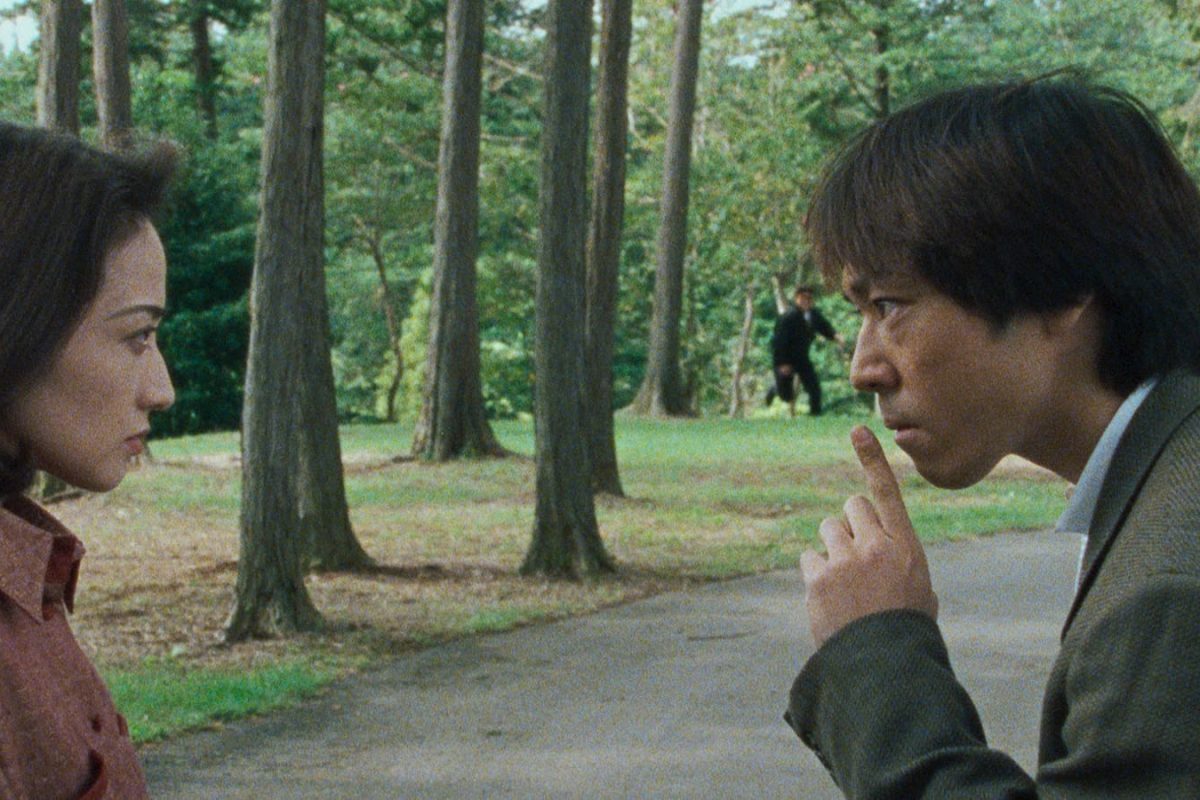
Kiyoshi Kurosawa spent a long apprenticeship working up to his 1997 breakthrough, Cure. Like Takashi Miike, he cranked out low-budget straight-to-video films for years. While he had attended film school, this was a real training ground. After Cure, he returned to the path of quickly shot B-movies; Principal photography for his next film, Serpent’s Path, only took a week. It was made back-to-back with Eyes of the Spider, intended to be a companion piece. Both star Sho Aikawa, and were made under similarly hasty conditions with the same crew. Each follows a man on a plot to avenge the murder of his daughter. Two years ago, he remade Serpent’s Path in France, and while one hopes that too makes it into American theaters, the 1998 version is now being released here for the first time, with one of his most experimental works, the 2024 short Chime.
Serpent’s Path finds two men on their way to execute a mysterious task. Nijima (Sho Aikawa), a math teacher, is the calmer of the two. The achingly desperate Miyashita (Teruyuki Kagawa), who used to be a yakuza, is the one who set this scheme in motion. His 8-year-old daughter was raped and tortured to death for child sexual exploitation material; he thinks he’s found the gangsters responsible. They drive to another man’s house, pretend to deliver a package, attack him with a taser, drop his body in their car’s trunk, and chain him up in a warehouse. Miyashita and Nijima humiliate their victim by starving him and forcing him to soil himself. He insists that he’s innocent, and his claims that another gangster committed the murder lead Miyashita and Nijima to commit another kidnapping, invading a posh golf course.
With this storyline, most directors would have turned Serpent’s Path into a proto-Taken/John Wick action movie. Kurosawa films violence carefully, without making it titillating. Instead of using murders as set pieces, they become links in a chain of misery. He shoots many scenes from a distance, and the sound of gunshots and the sight of muzzle flash get disconnected from their targets; people are dehumanized to the point of becoming disposable. (Three corpses, starting to rot, are lined up in a row.) As dreadful as the plot is, there’s barely any gore. The one exception is a woman who slowly bleeds out before collapsing after being stabbed in the neck.
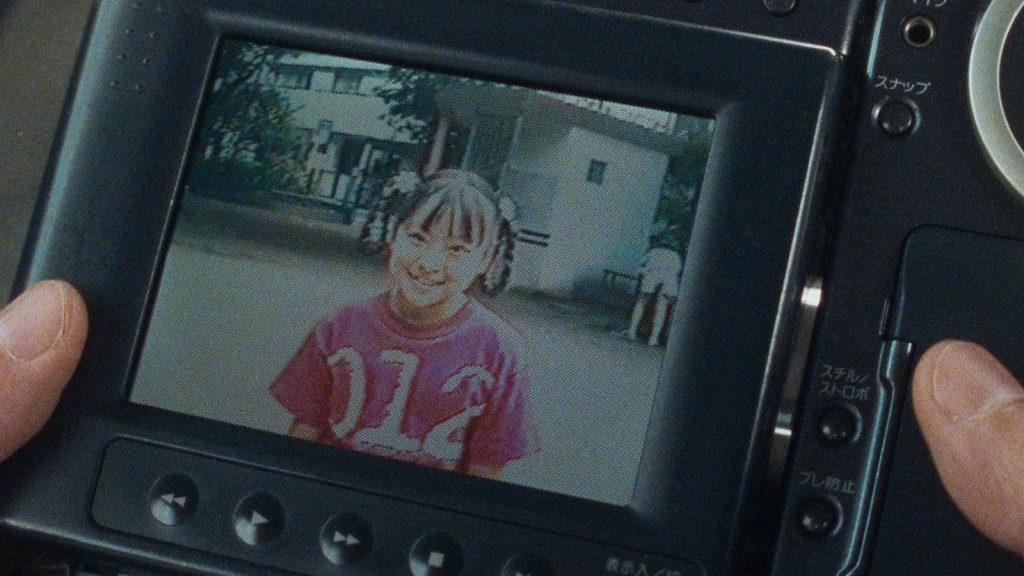
Serpent’s Path shows a man trapped in an endless loop of torment enabled by video. Its treatment of the technology evokes Videodrome and Atom Egoyan’s Speaking Parts and Exotica. Miyashita watches a tape of his daughter in happier times, and shows it to all the men he’s kidnapped, but he seems far more disturbed by it. Cradling a TV monitor, he acts as though he were able to touch his daughter through the screen. Of course, making a video is the reason she was murdered. In the end, that snuff film is shown to a prisoner as a form of torture.
Even with such a rushed shoot, Kurosawa took great care with the direction. The warehouse is an archetypal space in his films, its back wall propped up by dingy concrete. The set design sports artfully splattered colors. As the prisoners’ clothes become dirtier, they start to match their surroundings.
A few times, Kurosawa uses camera angles that raise questions about whose consciousness they represent. The very first scene is one: before we’ve seen Nijima and Miyashita, we see a steep hill rising, ahead of the car they’ve driving. While this image is easily explained, the camera’s position in the warehouse implies a hidden overseer. Extreme long shots hide people away, even as their voices are still audible. The camera seems like a dispassionate observer, staying aloof. If people themselves are distant from the carnage they create, it stands by and watches them destroy themselves.
Nijima remains enigmatic. His class apparently plays some role in the story, but Serpent’s Path never informs us exactly what that is. After writing a complicated equation on the blackboard, he asks his students, “If this leads to that, what follows?” A young girl taking his class serves as a doppelganger of Miyashita’s daughter. As the blog Japan On Film observed, he becomes obsessed with solving these complex formulae, sketching them on the street in chalk. It’s as if he can figure out the mysteries of human behavior if he can puzzle out mathematical solutions. The ending confirms that there’s more to Nijima’s actions than meets the eye, even as it maintains his unknowability.
Serpent’s Path returns to many of the visual and thematic preoccupations of Kurosawa’s work. The dirt and decay of the warehouse have entered its characters’ souls. Rather than propping up anyone as an avenging hero, its path circles around towards universal guilt and complicity in violence.
“Serpent’s Path” (with the short film “Chime”) opens Friday at New York’s IFC Center, followed by a national rollout through April, including Los Angeles on April 10.