Zach Vasquez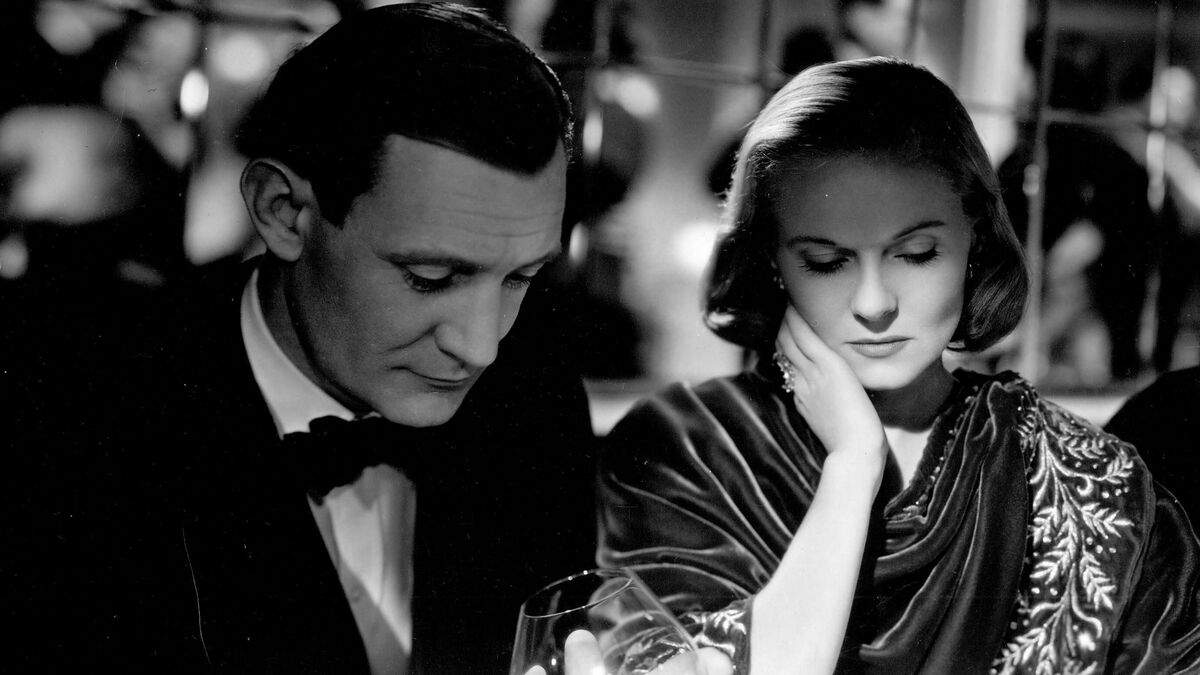
In the wake of the release of director David Lean’s Brief Encounter (1945)—the quiet but quietly devastating story of a passionate, yet unconsummated extramarital affair between two middle class Englanders—which won the 1946 Palm D’Or, scored four Oscar nominations (including two, for directing and adapted screenplay, for Lean), and became its nation’s biggest box office draw of the year, it seemed as though the company that made it, Cineguild Productions, was primed to reshape the British film scene for decades to come.
Alas, by the end of the ‘40s, Cineguild—which had been founded by Lean, producer Anthony Havelock-Allan, and cinematographer Ronald Neame—was shuttered. The events that led to the company’s folding mostly occurred during the making of The Passionate Friends (1949), something of a sister film to Brief Encounter. Ironically, that picture, which begins with one of cinema’s most rollicking and brilliantly-filmed New Year’s Eve parties, charts the disintegration of two partnerships, before concluding with a denouement about the power of forgiveness and second (or third, or fourth) chances.
The plot of The Passionate Friends is similar to that of Brief Encounter, in that it concerns a very intense, yet very polite, affair. The participants are independently-minded (by mid-century British standards) Mary (Ann Todd), and charming biologist Steven (Trevor Howard, who also starred, in practically the same role, in Encounter), former college lovers who reunite by chance after nine years apart during the aforementioned NYE party. The extra element this time out is the inclusion of a third party in the form of Mary’s husband Howard (Claude Rains), a highly successful and wealthy banker. The first half of the narrative unfolds via flashback to Mary and Steven’s doomed affair, while the second half picks up after another nine years, when fate brings the two together yet again during separate holidays in the Swiss Alps.
To give away more of the plot would be wrong, as one of Friends‘ great pleasures is the unexpected turns it takes, never reverting to the stock tropes you expect from love triangle narratives. One thing that must be noted is that if The Passionate Friends lacks some of the depth and haunting force of Brief Encounter—an unfair comparison, perhaps, given that it is amongst the greatest dramas ever made—Raines’s performance gives Encounters’s Celia Johnson’s a run for its money as the best between both films.
Partly, that comes from the filmgoer’s preconceived notion of Raines, best known then and today for playing magnetic villains and scoundrels in the likes of The Invisible Man, Casablanca, and Notorious. That latter film, from Alfred Hitchcock, is particularly relevant, since it also features Reigns as a scheming cuckold. For those who have seen both Notorious and The Passionate Friends—and let’s be honest here, it’s highly unlikely anyone watching classic movies today has seen the latter but not the former—it’s impossible not to bring certain expectations to bear in regards to Howard, expectations that the film constantly upends, thereby earning its greatest moments of catharsis.
The Passionate Friends also distinguishes itself by refusing to condemn its female protagonist for her desires, the sexual and romantic desires that lead her to step outside her marriage, as well as those that convince her to return to it: not merely financial security and social advancement, but the understanding she shares with her husband that, despite initial appearances, allows her to maintain a type of personal freedom most women in her (or any) position at the time could not. The Passionate Friends is a surprising, and surprisingly mature, examination of love that eschews the notion that the romantic kind is the only legitimate kind.
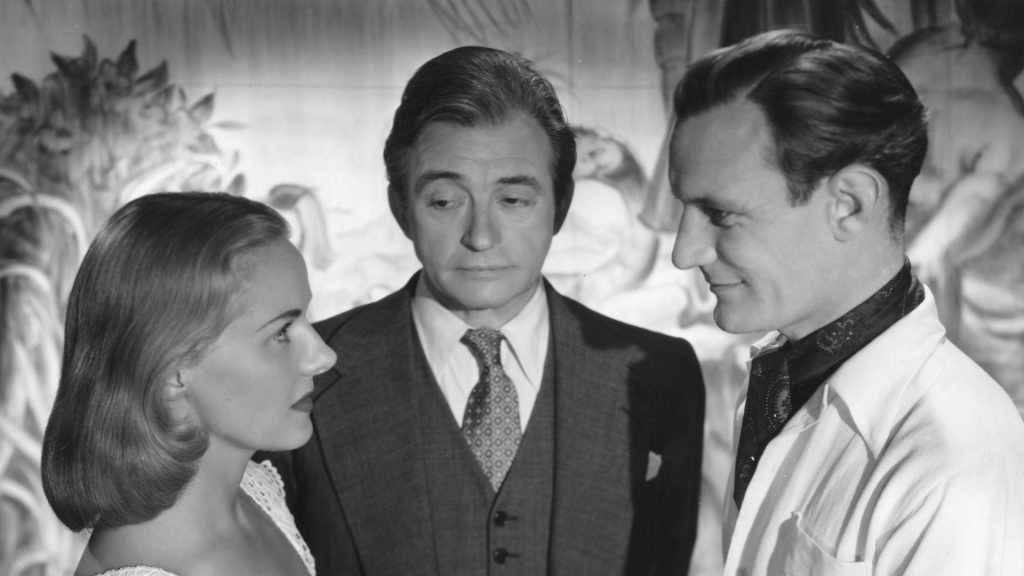
The drama that Lean and co. put on screen was mirrored, and indeed ultimately eclipsed, by that which unfurled behind the camera. The Passionate Friends was initially meant to serve as a directorial feature for Neame, with Lean merely producing. However, Lean started inserting himself during the writing process after finding the script—an adaptation (the second, as a matter of fact) of the 1913 novel of the same name by none other than H.G. Wells, which will probably come as a surprise to those (which is to say: most people) who only know him for his science fiction stories—lacking.
Neame attempted to start production with only 40 pages of the script written, before he was wholly replaced by Lean. Filming was shut down while the script was completed, with Howard coming aboard to replace original co-lead Marius Goring. In an act of life imitating art, Lean and Todd, both married to other people at the time, fell in love while making the movie; they ended up leaving the spouses for one another. The fallout from Lean replacing Neame, meanwhile, led to the disintegration of their production company the following year.
(In another ironic twist, Neame would, some 23 years later, finds himself in a similar position as Lean, replacing the original director of 1972’s The Poseidon Adventure, by far his most financially successful and, in his own words, personal favorite film because “it give me F.U. money.”)
Lean, of course, would continue his brilliant career, directing a number of the greatest and most popular films of his day (and since), a list that includes The Bridge on the River Kwai, Lawrence of Arabia, Doctor Zhivago, Summertime, Ryan’s Daughter, and A Passage to India. He and Todd divorced in 1957.
Over the intervening decades, The Passionate Friends fell into obscurity, although it has been rediscovered and reappraised in recent years, following the proselytizing of Paul Thomas Anderson, who continually cited it as a major influence on his own moody English romantic drama Phantom Thread (2017). Said influence is particularly noticeable when comparing the two films’ New Years Eve set pieces, but it goes deeper than that. Both are stories about the lines, often blurred, between commitment and control, between devotion and possession, and between romance and real love.
Above all though, the story of The Passionate Friends, both onscreen and off, is about loyalty, how it falters, and how it mends.
“The Passionate Friends’ is streaming on the Criterion Channel, Tubi, Shout TV, and Plex.