Craig J. Clark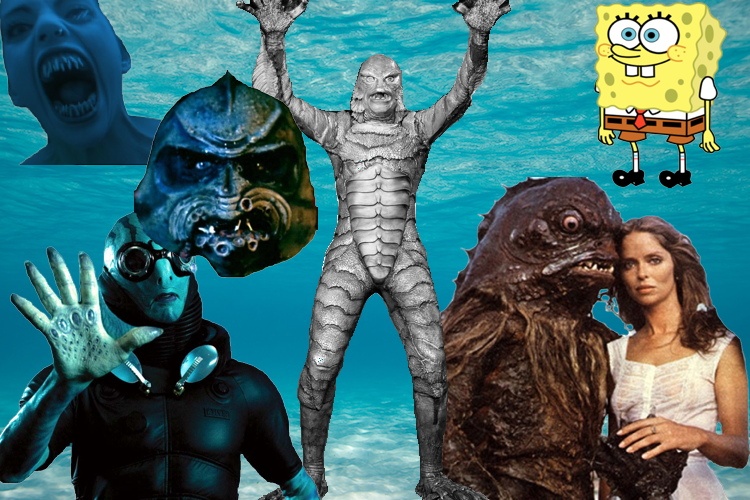
From the moment the project was announced, the easy conclusion to jump to was that The Shape of Water was Guillermo del Toro’s sneaky way of making a spin-off about Abe Sapien, the amphibious man played by Doug Jones in both of del Toro’s Hellboy movies. That turned out not to be the case, but the Amphibious Man in Shape — again played by Jones — has numerous predecessors.
The most direct forerunner of the Amphibious Man’s look is the Gill-man from Creature from the Black Lagoon, the great-granddaddy of all rubber-suited monsters. They even share the same place of origin: the Amazon River, where one is worshiped as a god and the other is considered a legend. The intervening decades have seen a number of pretenders to the throne, though, with a number showing an interest in the human female that ranges from romantic attachment to rapacious desire. (By the way, this list doesn’t pretend to be comprehensive. There are always more fish-men in the sea.)
 1. The Gill-man (Creature from the Black Lagoon, 1954; Revenge of the Creature, 1955; The Creature Walks Among Us, 1956)
While Universal was winding down its classic monster cycle by having each of them in turn meet up with Abbott and Costello, the studio produced a self-contained trilogy centered on an amphibian “missing link” from the Devonian Age. Clocking in at a lean 79 minutes, the first film efficiently establishes the Gill-man’s territorial nature and interest in women — in this case, a marine biologist who goes along on an expedition to find the fossilized remains of its relatives. It also set precedent that the Gill-man may seem dead at the end of each picture, but its healing powers are such that it can keep being brought back for more the following year.
The opening of Revenge, which finds the Gill-man captured by a return expedition to its lagoon, effectively covers the backstory that Michael Shannon’s Agent Strickland alludes to in The Shape of Water, but that del Toro doesn’t show. (Revenge is also the source of the electric prod the sadistic Strickland uses to torture the Amphibious Man.) Instead of a secret government lab in Baltimore, though, the Gill-man is taken to a Florida aquarium, where it’s studied and put on display before escaping and trying to make off with another female scientist. In the third film, however, it’s too preoccupied with recovering from third-degree burns it receives all over its body and undergoing an operation that turns it into an air-breather to even think about looking at a woman, let alone picking one up.
 2. The Monster (The Monster of Piedras Blancas, 1959)
Decidedly more brutal than its South American counterpart, the Monster in this low-budget Creature knock-off is a legend of Californian origin being held at bay by the local lighthouse keeper who doesn’t know how to control it when its food source is cut off. While the Gill-man’s kills are largely bloodless affairs, this Monster goes all-in on the beheadings and dismemberments, which the characters describe in gruesome detail. And even if it doesn’t show as much interest in the ladies as its Devonian cousin, the Monster does have the requisite moment where it picks up the lighthouse keeper’s daughter and starts to carry her off. It doesn’t get very far, though (in either sense), before it’s stopped in its tracks and killed.
 3. The Horror (The Horror of Party Beach, 1964)
Party Beach was once a thriving beachfront hangout where innocent teenagers liked to party, listen to music, and surf. That was before some irresponsible company started dumping its toxic waste offshore, creating a variety (well, two varieties) of lumbering sea creatures that periodically surface to stalk and kill said teenagers. As in Piedras Blancas, they don’t appear to have any romantic designs on their female victims, but one of their main offensives is a pajama party where a whole array of them are slaughtered because, being girls in a ’60s monster movie, they’re incapable of fighting back or having the presence of mind to run for their lives. If not for sodium, the Horror might still be plaguing Party Beach to this day.
 4. Dr. Leopold (Zaat, a.k.a. Blood Waters of Dr. Z, 1971)
Unlike the other monsters on this list, Dr. Kurt Leopold is a self-made fish-man. In fact, the first 20 minutes of this Florida-lensed cheapie are devoted entirely to the disgraced scientist and the laborious process by which he turns himself into a walking catfish. Once his transformation is complete, Dr. Leopold sets about using his formula on the local fish population and putting the other parts of his master plan into effect. These include murdering the scoffers who denied him funding and finding a suitable mate. Both go swimmingly up to a point, but when Dr. L. tries to recreate his experiment on the woman he captures, it doesn’t take and she drowns. Luckily, he has a backup, although it’s unclear how she became converted to his way of thinking or why she chooses a life in the ocean with him since she doesn’t undergo any kind of physical transformation. To be honest, it’s all very muddled and confusing, but that’s Zaat for you.
 5. The Slithis (Spawn of the Slithis, 1978)
This is an updated version of The Horror of Party Beach pitched to the environmental concerns of the ’70s, coupled with the desire to rip off Jaws. The titular substance in Slithis is a kind of organic mud that is activated by the runoff from a leaky nuclear power plant and evolves into a humanoid fish creature that trolls the canals of Venice, California, in search of small pets and unwary humans to devour. For the most part, it just mutilates its victims because its only interest is food, but later on there’s an attack on a couple on a boat where the Slithis, having dispatched the man in a flash, takes its time with the woman, pawing at her body, seemingly attempting to mount her, and exposing one of her breasts before finally chowing down on her.
Echoing the scene in Revenge of the Creature where the Gill-man overturns a car, sending it rolling down a hill (and almost straight into the camera), there’s one in Slithis where the super-strong creature demolishes a station wagon that is driven into the bay because the filmmakers had the budget for that. The Slithis then winds up on a boat where it wipes out half the crew and injures the other half before finally being killed by the bland protagonist. However, when he tries to dump its body into the water (as opposed to bringing it ashore so its existence can be verified), the Slithis revives and claws him, proving one should never take pity on an apparently dead sea monster.
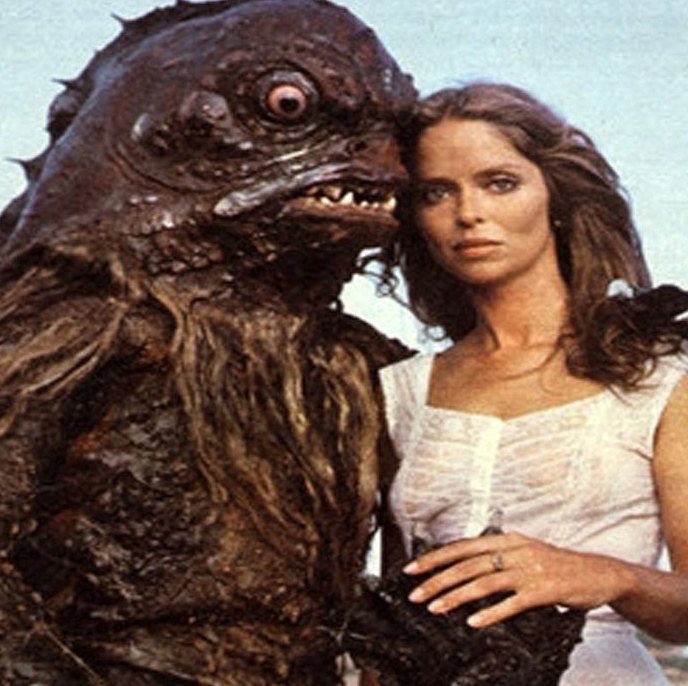 6. The Fishmen (Island of the Fishmen, 1979; Screamers, 1981; The Fishmen and Their Queen, 1995)
Following in the scaly footsteps of Zaat, Island of the Fishmen is an Italian monster movie about a mad scientist (a visibly embarrassed Joseph Cotten) working on an uncharted island who figures out how to turn men into human/fish hybrids and keeps them docile with the help of his daughter, of whom they’re very protective. This is because she’s played by Barbara Bach, who has what could charitably be called a close relationship with them, but co-writer/director Sergio Martino could have been more protective of his film since it’s effectively been butchered twice, first in 1981 when Roger Corman’s New World Pictures acquired it for US distribution. Instead of simply redubbing it, Corman’s people added about 15 minutes of new material with American actors and sent it out with a new title and horribly misleading ad campaign.
That would be bad enough, but 14 years later, Martino raided his own film for insert shots of the Fishmen for his post-apocalyptic action film The Fishmen and Their Queen, a loose sequel which also borrowed footage from his 1983 film 2019: After the Fall of New York. Not exclusive to Martino, this is a trick Corman himself pulled the same year with his direct-to video remake of Piranha, which happened to be New World’s first stab at a Jaws knock-off. The second was…
 7. The Humanoids (Humanoids from the Deep, 1980, 1996)
The stars of one of New World’s most notorious films, the Humanoids are a species of mutated, bipedal fish that besiege a coastal community, savagely killing the men and brutally raping the women. Apparently seeking to head off criticism from feminist groups, Roger Corman hired Barbara Peeters to direct, but that didn’t prevent the uproar it met upon its release, especially since Corman had another (male) director shoot the graphic sex scenes Peeters declined to. It’s hard to imagine how she thought she could get around them, though. After all, the film’s climax takes place during the town’s annual Salmon Festival, which is overrun by dozens of Rob Bottin’s slimy, sex-crazed creatures. Unsurprisingly, this is the sequence Corman borrowed the most footage from when Humanoids received the direct-to-video remake treatment in 1996.

8. The Imbocans (Dagon, 2001)
After Creature from the Black Lagoon, The Shape of Water most resembles Stuart Gordon’s Lovecraft-derived Dagon, albeit with a gender reversal. Its protagonist is Paul, a dot-com millionaire vacationing off the coast of Spain (his “mother country,” although he’s never been before and was forbidden to even learn the language) with his girlfriend Barbara and another couple. When a sudden storm blows in and wrecks their boat, Paul and Barbara head to shore to find help but get split up and Paul spends a long night on the run from the locals, who are revealed to be more and more monstrous at every turn.
With their pale skin, bulging eyes, webbed fingers, curious gaits, and gill-like neck slits, Imboca’s population seems like the product of inbreeding, but Paul eventually learns the truth — namely, that they’re a couple of generations into being worshipers of the sea god Dagon, whose twin thirsts are for blood sacrifices and women to mate with. (As in The Shape of Water, these couplings are kept off-screen — as is Dagon, for the most part — but their aftermaths are very different. Dagon is, to put it bluntly, not a gentle lover.)
The parallels with The Shape of Water are there from the start, since Dagon opens with Paul dreaming about being underwater. In his dream, he finds an eye-shaped portal at the bottom of the ocean and encounters a mermaid who seems alluring until she gives the audience its first of many jolts. Paul dreams about her one more time before meeting her in the flesh and, in the midst of being seduced by the bedridden maiden, discovers she has octopus-like appendages instead of legs. She also calls him Pablo even though he never introduced himself, something he might have wondered about if he wasn’t immediately off and running again.
The first place he runs to is a house knee-deep in water to accommodate one of its residents, neatly prefiguring the bathroom scene in Shape. The most direct link between both films, though, has to do with how they end, and the commonality between the scars on the mute Elisa’s throat and the bruises on Paul’s abdomen. To say any more could potentially spoil not one but two dark fairy tales about what it means to be an outsider. Granted, del Toro and his co-writer, Vanessa Taylor, hit this theme harder than Gordon and his screenwriter, fellow Re-Animator and From Beyond alumnus Dennis Paoli, but it’s there to be found in Dagon if you dive deep enough.
 9. Abe Sapien (Hellboy, 2004; Hellboy II: The Golden Army, 2008)
Finally, let’s not forget that del Toro has been down this road before with Mike Mignola’s amphibious creation. In his second cinematic outing, the soulful Abe is even given a love interest in the form of an albino princess whose twin brother threatens to break the truce that gave humanity dominion over the surface world. But with love comes heartbreak, and with heartbreak comes one of the funniest scenes in del Toro’s entire filmography when Ron Perlman’s Hellboy and Doug Jones’s Abe get drunk and croon along with Barry Manilow’s “Can’t Smile Without You.” As he’s proven once again with The Shape of Water, del Toro has always been just as interested in showing the human side of monsters as he has the monstrous side of humans.
Craig J. Clark lives underwater in Bloomington, Ind.