Craig J. Clark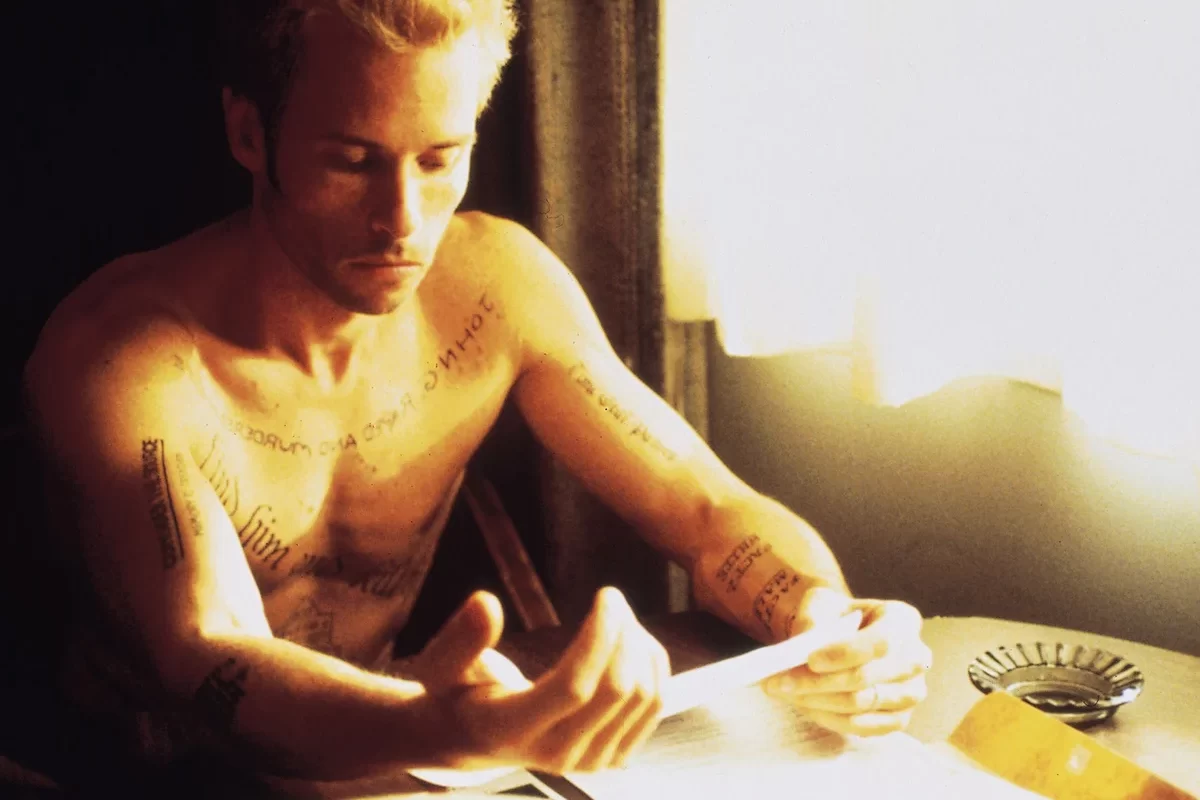
Leonard Shelby has a condition. It’s a condition he tells everybody about every time he meets them because, due to his short-term memory loss, he never knows if it’s the first time or not. It’s a condition that leaves him vulnerable to bad actors who might take advantage of him, potentially leaving him at the mercy of everyone he sees. The one he’s most in danger of being manipulated by, however, is the elaborately tattooed fellow he sees every time he looks in the mirror.
When writing about Christopher Nolan’s Memento, it’s tempting to start with the conclusion and work back, paragraph by paragraph, to the beginning, but this approach fails to take into account that the film’s structure is more complex. Rather than simply reversing the story’s chronology, Memento threads a parallel series of interludes between the more sustained, action-oriented scenes as Leonard pieces together the clues that tell him what to do and where to go next. What he wants to do most is kill the man who raped and murdered his wife, but as Nolan’s nonstandard narrative unspools, it becomes apparent his thirst for revenge isn’t easily slaked.
Nolan’s sophomore feature (following 1998’s Following, a similarly chronologically complex tale), Memento went into limited release in the U.S. 25 years ago, after spending six months kicking around Europe and various film festivals. At Sundance, Nolan scooped up the Waldo Salt Screenwriting Award, one of many plaudits his screenplay rightfully received. Taking inspiration from a short story by his brother (and future screenwriting collaborator) Jonathan, Nolan delivered an unconventional neo-noir that transcends its attention-getting gimmick. True, part of its appeal lies in figuring out alongside Leonard what’s happening from moment to moment, but multiple viewings reveal there’s more to appreciate than its clever construction. There’s also the bone-deep sadness of Leonard’s plight, echoed by that of Sammy Jankis, and a surprising amount of humor sprinkled throughout.
In light of Nolan’s subsequent reputation for self-seriousness, the borderline slapstick moment when Leonard arrives at his motel and tries to push a door that needs to be pulled open can be jarring. He immediately shrugs it off, though, because that’s the sort of thing that happens to him constantly. Even funnier is the scene that starts with Leonard running without knowing why. “Okay, what am I doing? Am I chasing this guy?” he asks when he spots someone running parallel with him. The penny drops when the man pulls a gun, prompting Leonard to do an about-face. “No,” he corrects himself. “He’s chasing me.”
Since Memento doesn’t build tension or momentum in the usual way, Nolan relies on his actors to ground their characters, which is especially important since the viewer’s read on them changes from scene to scene based on how they treat Leonard. This is certainly true of Joe Pantoliano’s Teddy, who seems helpful and jovial enough, but since he’s the man Leonard executes at the top of the film, it stands to reason he did something to rub Leonard the wrong way, even if he turns out not to be the “right” John G.
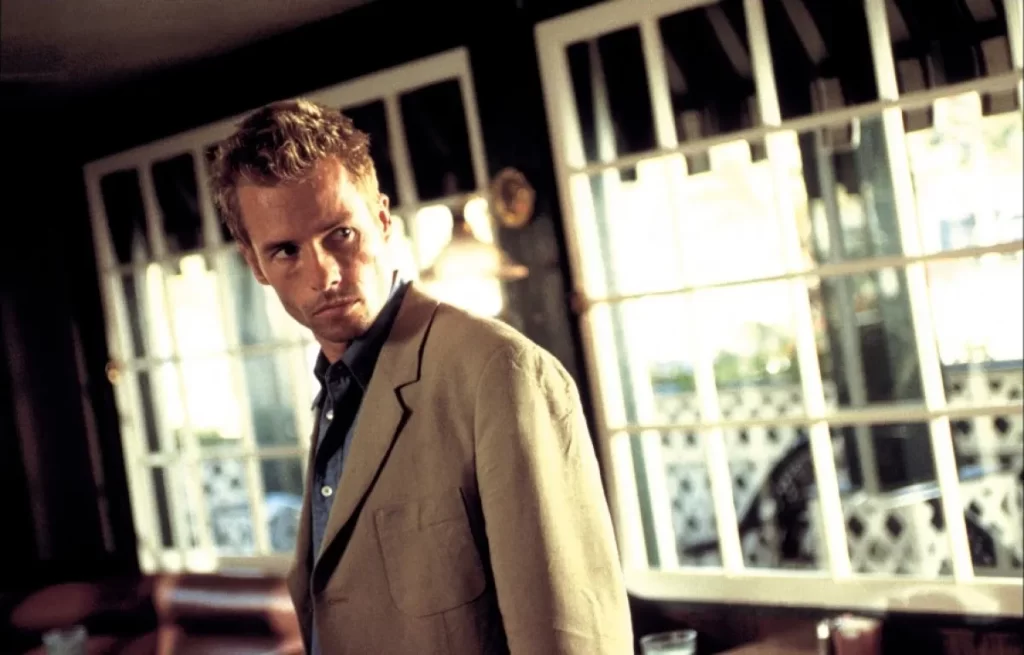
More complicated is Leonard’s relationship with Carrie Anne-Moss’s Natalie, who swings back and forth between feigning empathy for his plight and cruelly taking advantage of it. (Think of the beat when she serves him a stein of beer “on the house.”) She’s also the one who gets him mixed up with Callum Keith Rennie’s gun-toting Dodd, who’s ushered in and out of the narrative rather quickly. A master manipulator, Natalie fills the role of the film’s femme fatale to a T.
On another front, there’s Mark Boone Junior as motel desk clerk Burt, who cheerfully admits to renting Leonard multiple rooms, knowing full well he won’t remember it long enough to stay mad. And while they only appear in the flashbacks where Leonard tells his mystery caller about Sammy Jankis and his wife, Stephen Tobolowsky and Harriet Sansom Harris sell their story’s inherent tragedy.
That just leaves Leonard himself, who’s played by Guy Pearce with a mixture of guilelessness and resourcefulness. Proud of the system he’s developed for himself, Leonard is gifted with moments of genuine pathos and clarity, and Pearce leans into the aspects of the character that make plain how much he’s lost, to the point where he’s willing to blow up his entire support system. Based on what we know about him – which is only what he’s told us, and he’s one of the most unreliable narrators imaginable – it’s hard to say what will become of Leonard Shelby after he takes his last Polaroid.
As for how Nolan’s career developed, having proven himself with his American debut, his next project was 2002’s Insomnia, an adaptation of the Norwegian thriller of the same name. It represented a major change, with big stars, a screenplay he didn’t write himself, and a straightforward structure. As his entrée to studio filmmaking, Insomnia proved Nolan had more than one trick up his sleeve, and it laid the groundwork for what was to come. Soon, a dark knight would beckon, and the concept of a modestly budgeted Christopher Nolan film would become a memory.
Write this down: There is no shortage of places to stream “Memento.”